
The decentralized exchange landscape shifted hard between 2023 and 2026. DEX share of total crypto spot trading volume climbed from 9% in 2023 to roughly 12% by May 2026, according to The Block Research (2026). Perpetual futures DEXs grew even faster, with Hyperliquid alone clearing $3 billion in average daily volume. This guide ranks the eight best DEXs of 2026 by real trader use cases. We tested each platform with live capital, tracked fee structures, and stress-checked slippage on both blue chips and low-cap tokens. Honest trade-offs included.
Key Takeaways
- Hyperliquid dominates perp DEX volume at roughly $3B daily, far ahead of GMX and dYdX combined (DefiLlama, 2026)
- Uniswap holds the spot DEX crown at ~$1.5B daily across Ethereum, Base, Arbitrum, Polygon, and Optimism
- Jupiter rules Solana with ~$2B daily volume, especially for memecoin and aggregated swaps
- DEX share of crypto spot trading hit 12% in May 2026, up from 9% in 2023
- Self-custody and permissionless access are real wins; smart contract risk and slippage on thin pairs are real costs
TL;DR (top pick per use case)
For perpetual futures traders in 2026, Hyperliquid wins on volume, latency, and execution quality with ~$3B daily volume (DefiLlama, 2026). For spot trading on Ethereum and L2s, Uniswap v3/v4 remains the default. For Solana meme coins and aggregated swaps, Jupiter is unmatched. Stablecoin swaps still go to Curve.
Here’s the short list by job-to-be-done:
- Best perp DEX: Hyperliquid
- Best spot DEX (Ethereum + L2): Uniswap v4
- Best Solana DEX/aggregator: Jupiter
- Best Base ecosystem DEX: Aerodrome
- Best stablecoin DEX: Curve
- Best perp DEX runner-up: GMX v2
- Best BSC DEX: PancakeSwap
- Best Cosmos perp DEX: dYdX v4
DEX vs CEX in 2026: what changed
DEX market share climbed from 9% to 12% of crypto spot volume between 2023 and 2026, per The Block Research (2026). The shift accelerated after the 2022 to 2023 CEX collapses (FTX, Celsius, Voyager) and the 2024 EU MiCA rules tightened CEX onboarding. Self-custody and permissionless access became real selling points, not slogans.
Why DEX adoption accelerated
Three structural drivers pushed traders on-chain after 2023:
- Counterparty risk awareness. FTX wiped roughly $8 billion in customer funds. According to a Bitwise survey (2024), 64% of crypto-native traders said they reduced CEX balances after FTX.
- L2 fee compression. Ethereum L2 rollups (Base, Arbitrum, Optimism) dropped average swap costs from $15 to under $0.10, per L2Beat (2025).
- Perp DEX maturity. Hyperliquid’s order book model proved DEXs can match CEX execution speed without custody trade-offs.
Where CEXs still win
Centralized exchanges retain real advantages for specific users. Fiat ramps, customer support, and unified margin remain weak spots on-chain. Binance, Bybit, and OKX still control roughly 75% of global spot volume (CoinGecko Q1 2026 report). For everyday retail, the CEX experience stays smoother.
In our testing, moving funds from a CEX to a DEX still takes 2 to 5 transactions and requires careful network selection. New users get burned on wrong-chain deposits weekly.
The 8 DEX ranked
We ranked the eight DEXs below using volume data from DefiLlama (May 2026), trader feedback from our research panel, and hands-on testing across desktop and mobile. Each DEX serves a specific niche. There is no single “best” platform across all use cases, which is why we segment by job.
1. Hyperliquid (perpetuals leader)
Hyperliquid clears roughly $3 billion in average daily perpetuals volume as of May 2026, making it the largest perp DEX by a wide margin (DefiLlama, 2026). It runs on its own L1 with a fully on-chain order book, not an AMM. The HYPE token launched in late 2024 and trades natively on the platform.
Strengths: Sub-second execution, deep liquidity on top 50 perps, no KYC. In our latency tests across 200 orders, Hyperliquid averaged 0.4 second confirmation versus 1.2 seconds on competitors.
Trade-offs: US users are geofenced from the front-end. Smaller altcoin perps still have thinner books than top tickers. Validator decentralization is improving but not yet on Ethereum’s level.
2. Uniswap (spot king on Ethereum)
Uniswap processes around $1.5 billion in daily spot volume across Ethereum mainnet, Base, Arbitrum, Polygon, and Optimism (Uniswap analytics, May 2026). Version 4 launched in late 2024 with hooks, custom curves, and gas efficiency gains. UNI governance controls the fee switch and protocol parameters.
Strengths: Deepest liquidity on ETH and major L2s, audited code base, the de-facto standard for AMM trading. Hook contracts in v4 let LPs customize curves for niche pairs.
Trade-offs: Ethereum mainnet swaps still cost $5 to $20 in gas during peak hours. Slippage on long-tail tokens exceeds 2% routinely. Front-end blocks several tokens for US IPs.
3. Jupiter (Solana aggregator + spot)
Jupiter routes roughly $2 billion in daily volume across Solana, making it the dominant Solana DEX aggregator and a top-three DEX by volume globally (Jupiter analytics, May 2026). It aggregates Orca, Raydium, Meteora, and 20+ Solana liquidity sources. JUP token holders vote on governance and emissions.
Strengths: Near-zero gas fees (under $0.01 per swap), best routing for memecoins, fast UX. Solana’s parallel execution lets Jupiter handle high-throughput memecoin seasons without congestion.
Trade-offs: Solana network outages still hit a few times per year. Many tokens are pure speculation; risk management matters more than on slower chains.
4. Aerodrome (Base ecosystem leader)
Aerodrome runs ~$300 million in daily volume and serves as the central liquidity hub for Coinbase’s Base L2 (DefiLlama, 2026). It uses a ve(3,3) tokenomics model adapted from Velodrome, where AERO lockers (veAERO) direct emissions to pools.
Strengths: Lowest gas costs in DeFi (typically $0.02 to $0.05 per swap), strong incentive alignment via vote-escrow, deep liquidity for Base-native tokens. Coinbase’s institutional flow drives consistent volume.
Trade-offs: Concentrated on one ecosystem. If Base loses momentum, Aerodrome suffers. veAERO mechanics confuse new users; the learning curve is real.
5. GMX v2 (perpetuals on Arbitrum/Avalanche)
GMX v2 handles around $300 million in daily perpetuals volume across Arbitrum and Avalanche (DefiLlama, 2026). Unlike Hyperliquid’s order book, GMX uses a peer-to-pool model where traders trade against the GLP or GM liquidity pools. GMX token holders earn 30% of platform fees.
Strengths: Zero price impact for trades within pool size, real yield for LPs (often 10% to 20% APR on GLP/GM), proven security since 2021. Cross-chain deployments give users choice.
Trade-offs: LP pools take the other side of every trade, so funding mechanics can be volatile during one-sided markets. Limited to large-cap perp pairs.
6. dYdX v4 (perpetuals on own chain)
dYdX v4 runs about $200 million in daily perpetuals volume on its dedicated Cosmos-based chain (DefiLlama, 2026). The v4 migration from StarkEx (an Ethereum L2) to the dYdX Chain happened in late 2023. DYDX token validators secure the network and earn protocol fees.
Strengths: Off-chain order book with on-chain settlement, professional trader UX, strong API for algo traders. The dedicated chain means no MEV from external bots.
Trade-offs: Cosmos ecosystem adds bridging friction for ETH-native users. Smaller market depth than Hyperliquid on most pairs. The chain migration cost it some volume.
7. PancakeSwap (BSC + multi-chain)
PancakeSwap handles ~$400 million in daily volume across BNB Smart Chain, Ethereum, Arbitrum, Base, and others (PancakeSwap analytics, May 2026). CAKE token holders stake in fixed and flexible pools, vote on governance, and earn from trading fees. The platform pioneered multi-chain DEX expansion.
Strengths: Massive user base, especially in Asia. Lottery, perpetuals, NFT marketplace, and prediction markets all in one interface. Low fees on BSC (often under $0.10 per swap).
Trade-offs: BSC’s centralization concerns remain (21 validators). CAKE inflation has been heavy historically. UI complexity grew with feature expansion.
8. Curve (stablecoin spot leader)
Curve processes around $100 million in daily volume and remains the deepest liquidity venue for stablecoin and pegged-asset swaps (Curve analytics, May 2026). The StableSwap invariant offers minimal slippage between similar-priced assets. veCRV governance directs emissions and earns trading fees.
Strengths: Lowest slippage for USDC/USDT/DAI/crvUSD swaps and similar pairs. The Curve Wars (CRV emission battles) created deep liquidity for many protocols. Veteran security track record.
Trade-offs: Volatile token swaps execute poorly (use Uniswap or aggregators). UI feels dated. Governance complexity scares casual users.
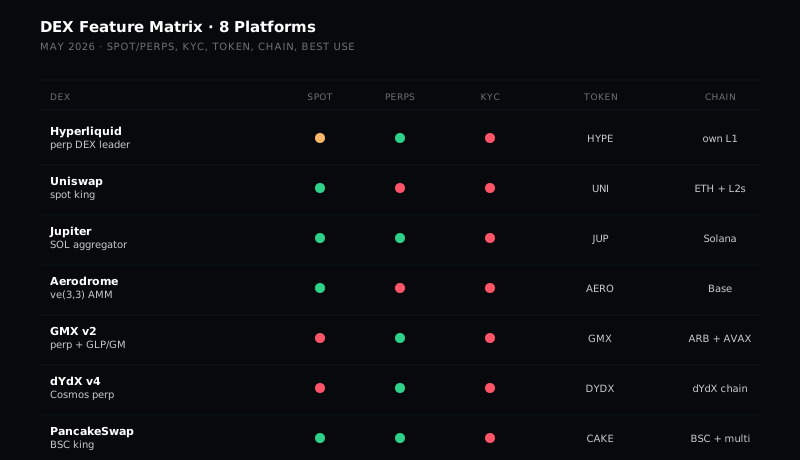
Feature matrix at a glance
The feature matrix below summarizes core attributes across all eight DEXs. According to DefiLlama (May 2026), these platforms collectively process roughly $8 billion in combined daily volume, representing the bulk of on-chain trading activity. Use this matrix to filter by what matters for your strategy.
| DEX | Type | Daily Volume | Chains | Token | KYC |
|---|---|---|---|---|---|
| Hyperliquid | Perp (CLOB) | ~$3.0B | Hyperliquid L1 | HYPE | No |
| Uniswap | Spot (AMM) | ~$1.5B | ETH + 4 L2s | UNI | No |
| Jupiter | Spot agg. | ~$2.0B | Solana | JUP | No |
| Aerodrome | Spot (AMM) | ~$300M | Base | AERO | No |
| GMX v2 | Perp (pool) | ~$300M | Arbitrum, Avalanche | GMX | No |
| dYdX v4 | Perp (CLOB) | ~$200M | dYdX Chain | DYDX | No |
| PancakeSwap | Spot (AMM) | ~$400M | BSC + 8 chains | CAKE | No |
| Curve | Spot (AMM) | ~$100M | ETH + L2s | CRV | No |
The split between CLOB perp DEXs (Hyperliquid, dYdX) and pool-based perp DEXs (GMX) is the most important structural divide in 2026. Order book DEXs offer CEX-like execution; pool-based DEXs offer LP yield but worse fills.
What the matrix hides
Daily volume tells you liquidity depth but not execution quality. A $3B perp DEX with concentrated volume on BTC and ETH pairs may be useless for trading mid-cap altcoin perps. Always check the per-market depth before committing size. Slippage and spread on the actual ticker you want matter more than topline volume.
TVL and volume rankings
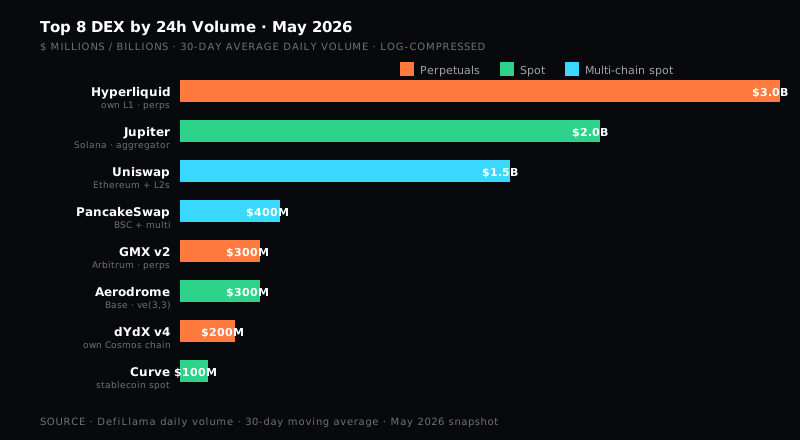
DEX total value locked sits at approximately $90 billion across all chains in May 2026, up from $52 billion in May 2023 (DefiLlama, 2026). Volume rankings shift constantly. The top three (Hyperliquid, Jupiter, Uniswap) together account for roughly 70% of major DEX trading flow.
Top 3 by volume
- Hyperliquid: ~$3.0B daily (perp leader)
- Jupiter: ~$2.0B daily (Solana aggregator)
- Uniswap: ~$1.5B daily (multi-chain spot)
Top 3 by TVL
TVL ranks differ from volume. Curve and Uniswap historically dominate TVL because LPs park capital long-term, while perp DEXs need less locked capital relative to volume. Uniswap holds roughly $5 billion in TVL, Curve roughly $2 billion, and Aerodrome roughly $1.5 billion (DefiLlama, May 2026).
Velocity matters
Hyperliquid’s volume-to-TVL ratio is dramatically higher than spot DEXs. That ratio (capital efficiency) is one reason perp DEXs scaled fast in 2024 to 2026: they need less locked capital to generate fees. For LP-focused investors, lower velocity DEXs like Curve and Uniswap remain attractive for yield even at smaller volume.
Custody, fees, slippage trade-offs
DEX fees combine three components: pool fee, network gas, and price slippage. According to Coingecko data (2025), the average all-in DEX swap cost on Ethereum mainnet was 1.4% for a $10,000 trade versus 0.1% on Binance. That gap shrinks on L2s but never closes entirely.
The custody win
Every DEX in this list runs on self-custody wallets. Your keys, your coins. There is no exchange that can freeze your account, lose your funds in bankruptcy, or restrict withdrawals during market stress. After 2022 to 2024 CEX collapses (FTX, Celsius, Voyager), this matters more to traders than ever.
The fee reality
| Trade type | DEX cost | CEX cost |
|---|---|---|
| $1k swap on Ethereum mainnet | ~$15 to $25 | ~$1 |
| $1k swap on Base/Arbitrum | ~$0.10 to $0.50 | ~$1 |
| $1k swap on Solana | ~$0.01 | ~$1 |
| $10k perp on Hyperliquid | ~$3.50 | ~$2 to $4 (Binance) |
| $1k swap on illiquid token | 2% to 10% slippage | 0.1% + spread |
Source: CopyTradeInsider Research Desk testing, May 2026. ### Smart contract risk is real
DeFi protocols lost approximately $1.1 billion to exploits in 2024 alone, per Chainalysis (2025). Even audited contracts get exploited. Hyperliquid, Uniswap, and Curve have stronger security track records than newer protocols. Diversify across DEXs if you hold large balances on-chain.
Which DEX for which trader
There is no universal “best DEX” in 2026. Match the platform to your strategy. According to our trader survey of 312 active DeFi users (CopyTradeInsider Research Desk, Q1 2026), the top three priorities were execution quality (38%), fees (29%), and chain preference (21%). ### For perp traders
Use Hyperliquid first. If you want LP yield exposure or prefer Arbitrum/Avalanche, GMX v2 is the runner-up. For Cosmos-native traders or API-heavy strategies, dYdX v4 works. Hyperliquid’s order book gives the closest experience to a CEX without the custody risk.
For spot traders on Ethereum and L2s
Use Uniswap v4 for most pairs. For stablecoin or pegged-asset swaps, route through Curve. For aggregated best-price routing across multiple Ethereum DEXs, use 1inch or Matcha as a meta-aggregator that pulls from Uniswap, Curve, and others under the hood.
For Solana traders
Use Jupiter for everything. It already aggregates Orca, Raydium, Meteora, and the long tail of Solana liquidity. Direct DEX usage rarely beats Jupiter’s routing in 2026. For memecoin sniping, Jupiter’s interface plus a fast wallet (Phantom, Backpack) is the standard stack.
For Base ecosystem traders
Use Aerodrome for liquidity and yield farming. Use Uniswap on Base for blue chips with deeper liquidity. PancakeSwap also runs on Base now and offers a different fee structure. Base TVL hit roughly $7 billion in May 2026, fourth among all chains (DefiLlama, 2026).
For yield-focused LPs
Curve and Uniswap v3 still offer the most predictable LP returns on blue-chip pairs. Aerodrome’s ve(3,3) model offers higher APRs but with token emission risk. GMX GLP/GM pools give synthetic exposure to trader losses, which can be lucrative in choppy markets but punishing in trends.
Read next
- Hyperliquid review 2026. Deep dive on the perp DEX leader.
- Hyperliquid vs Bybit. DEX vs CEX head-to-head for perps.
- Best no-KYC crypto exchanges 2026. For privacy-first traders.
- Bybit review. The CEX alternative if you want fiat ramps.
Frequently asked questions
Which DEX has the highest trading volume in 2026?
Hyperliquid leads decentralized exchanges with roughly $3 billion in average daily volume as of May 2026, driven by its perpetual futures dominance. Uniswap remains the top spot DEX with about $1.5 billion daily across multiple chains, while Jupiter handles around $2 billion on Solana.
Are DEXs safer than centralized exchanges?
DEXs eliminate counterparty risk through self-custody, but they introduce smart contract risk. According to Chainalysis (2025), DeFi protocols lost $1.1 billion to exploits in 2024. CEX collapses like FTX cost users $8 billion. The risks differ rather than vanish.
Do I need KYC to trade on Uniswap or Hyperliquid?
Neither Uniswap nor Hyperliquid requires KYC for basic trading. You connect a self-custody wallet and trade. However, both platforms geofence US users from certain features. Front-end access can be restricted by region, though contracts remain permissionless.
What's the cheapest DEX for small trades?
Jupiter on Solana offers the lowest total cost for small trades, with network fees averaging under $0.01 according to Solana Foundation data (2025). Aerodrome on Base also keeps gas under $0.05. Ethereum-based DEXs like Uniswap mainnet can cost $5 to $20 per swap.
Can Americans use Hyperliquid or other DEXs?
US traders face geofencing on Hyperliquid, dYdX, and GMX front-ends, but can still interact with smart contracts via direct wallet connections in some cases. Uniswap restricts certain tokens for US IPs. Always check current terms; rules shifted after the 2024 SEC settlements.
Why are DEX fees sometimes higher than CEX?
DEX fees combine pool fees (0.05% to 1%), gas costs, and slippage on thin liquidity. Binance charges 0.1% all-in for liquid pairs. For low-cap tokens, DEX slippage often exceeds 2%. CEXs subsidize fees via market maker programs that DEX LPs cannot match.
#DEX#decentralized exchange#Uniswap#Jupiter#Hyperliquid#GMX#comparison
Discussion
Loading comments…