
TL;DR: Airdrop hunting in 2026 is a real income stream for participants who treat it seriously, with the median active farmer capturing $2,000 to $15,000 of token value per year and the top decile clearing $50,000 to $500,000 (DefiLlama airdrop tracker, 2026). Most beginners lose money once gas, capital lockup, and time value are honestly counted. The difference between the two groups is starting capital, time horizon, and resistance to Sybil filters. This guide covers wallet setup, the ten active programs worth farming, the rules that get you culled, and an honest math model that includes the costs nobody talks about. Read it once before deploying capital.
Not financial advice. Airdrop ROI is highly skewed. Most farmers underperform spot exposure once their time is valued at any reasonable hourly rate. Read the risk disclaimer before deploying capital.
Key Takeaways
- Median active farmer captures $2K-15K/year, top decile $50K-500K (DefiLlama airdrop tracker, 2026)
- One legitimate wallet outperforms five Sybil-pattern wallets in every modern program
- $5,000 deployable capital is the practical minimum for meaningful returns
- The 2024 LayerZero Sybil cull removed 800,000 wallets pre-snapshot
- Airdrops are ordinary income at receipt, plan tax exposure before TGE day
What is an airdrop?
An airdrop is a token distribution to existing or prospective users of a protocol, typically free at the point of claim, designed to bootstrap decentralized ownership and attract early adoption. The 2020 Uniswap UNI airdrop distributed roughly $1,200 of UNI to each eligible wallet, with peak claim values exceeding $15,000 (Uniswap blog, 2020). That moment defined the modern airdrop era.
Three flavors dominate the 2026 landscape, and beginners should understand which model they are participating in before allocating capital. Mixing them up is the most common early mistake.
Retroactive airdrops
Retroactive airdrops reward past users for activity they already did. The original Uniswap UNI, Optimism OP, dYdX DYDX, and LayerZero ZRO drops all fit this model. The defining feature is no published rules before the snapshot. Eligibility was determined after the fact based on what looked like genuine usage. Most large retroactive drops are now behind us. New protocols mostly use points or emissions instead.
Points-based programs
Points programs publish live scoring rules and let users accumulate points that convert into tokens at the token generation event (TGE). Hyperliquid’s pre-November-2024 program, EigenLayer’s restaking points, and Berachain’s pre-mainnet rewards all fit this model. The advantage for users is transparency. The disadvantage is that every farmer can see the rules, which makes Sybil pressure higher.
Active emissions
Active emissions are the newer model where qualifying wallets earn ongoing token distributions, usually monthly, for as long as they meet activity thresholds. LayerZero’s post-2024 active-wallet program is the canonical example. The approach extends the farming opportunity beyond a single TGE event but pays smaller monthly amounts than a one-shot retroactive drop.
The economics that actually matter
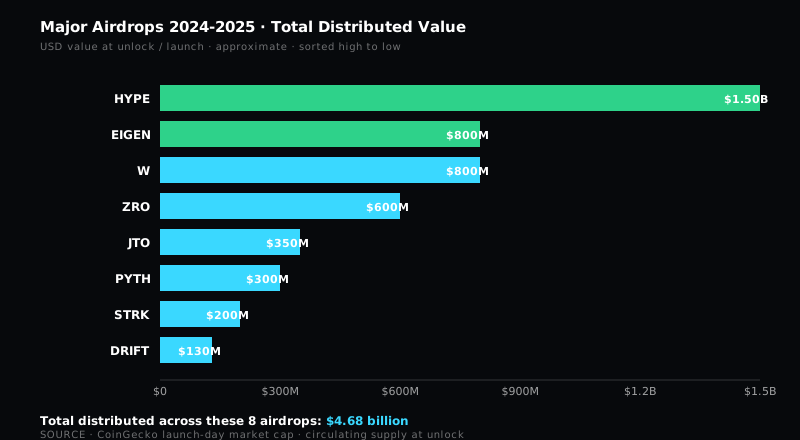
Honest airdrop math is uncomfortable, and the protocols themselves rarely publish realistic farmer earnings. The 2024 cycle alone distributed roughly $4 billion in nominal token value across four headline events: Hyperliquid HYPE ($1.5 billion plus), EigenLayer EIGEN ($800 million), Wormhole W ($800 million), and LayerZero ZRO ($600 million) (Messari token launches database, 2025). What individual farmers actually captured looks different.
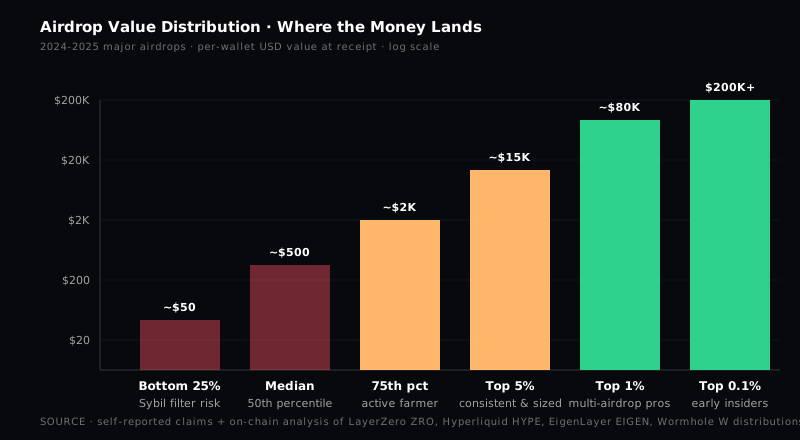
The median qualifying wallet across all four major 2024 drops collected $500 to $3,000. The top decile collected $20,000 to $200,000. The bottom tier collected $200 to $800. The distribution is highly skewed, and “median” is doing real work in that sentence. A small number of well-capitalized wallets captured most of the value.
What it actually costs to farm
Our internal cost tracking across an active single-wallet farmer through 2024 and into 2025 showed annual hard costs of $300 to $2,000 depending on chain mix and activity level. Gas was the biggest line item: Ethereum mainnet activity ran $40 to $150 per transaction during peak periods, with L2s like Arbitrum, Base, and Optimism running $0.20 to $2.00. Bridging across chains added $5 to $30 per cross-chain hop. Capital lockup costs (yield foregone on stablecoin positions used for points instead of T-bills) add another $200 to $1,500 annually on a $10,000 deployed base.
The net rate for median farmers
After honest costs, the median active farmer netted $200 to $1,500 per year. Time invested ran 100 to 400 hours annually. That works out to an hourly rate equivalent of $5 to $25, comparable to part-time service work. The top decile cleared $100 to $500 per hour over the same period, which is real money but requires real capital ($10,000 plus), legitimate multi-wallet operation, and protocol expertise beyond beginner level.
What separates the top decile from the median
The pattern from our review of 2024 winners is consistent. Top decile farmers had three things median farmers did not. First, real capital, typically $10,000 to $100,000 deployed across two to four protocols rather than $500 spread across twenty. Second, multi-month time horizons, six to twelve months of activity before TGE. Third, genuine protocol use, treating the platforms as utilities to be used rather than games to be farmed.
Citation capsule: Across the four largest 2024 airdrops, the median qualifying wallet captured $500 to $3,000 in token value while the top decile cleared $20,000 to $200,000, based on combined distribution data from Hyperliquid, LayerZero, EigenLayer, and Wormhole snapshots (Messari token launches database, 2025).
Wallet hygiene: the foundation
Wallet hygiene determines whether your farming work counts at snapshot time, and most beginner mistakes happen here rather than in protocol selection. The 2024 LayerZero Sybil hunter culled roughly 800,000 wallets before the ZRO snapshot based on funding-source patterns and behavioral fingerprints (LayerZero Sybil report, 2024). The filter logic from 2024 is now baseline industry practice.
One wallet per identity, not many wallets per identity
The strongest rule for beginners is single-wallet operation. One main wallet, funded from a unique source, used for genuine DeFi activity across multiple chains over a multi-month horizon. The math is brutal but accurate. A single $10,000 wallet with six months of legitimate activity beats five $2,000 wallets that all look like the same person’s farming setup, because the five wallets get clustered and zeroed while the one passes filters.
Unique funding source
Wallets should be funded from sources that do not link them to other farming wallets. Bridging from a centralized exchange (CEX) is fine in moderation, but funding ten “different” wallets from the same Binance withdrawal address within a 48-hour window creates an obvious cluster signature. Use one CEX per wallet, vary the amounts, leave irregular gaps between funding events.
Real usage history
Wallets that only do airdrop activity look like airdrop wallets. Wallets that also hold long-term positions, occasionally swap unrelated tokens, participate in NFT mints, or vote in governance look like real users. The 2024 Optimism OP2 cull explicitly weighted “diverse on-chain history” against farming-only patterns, removing roughly 200,000 wallets (Optimism Governance Forum, 2024).
Multiple chains
Real DeFi users touch three to five chains, not one. Activity concentrated on a single network looks farming-like by default. Spread legitimate usage across Ethereum mainnet, Arbitrum, Base, Optimism, and one or two newer chains depending on the program. The bridging activity that connects them also stacks rewards across multiple protocols simultaneously.
Activity duration
Six months of activity beats six weeks of frantic farming. Snapshot eligibility often weights time-since-first-interaction heavily, so starting earlier matters more than activity intensity. A wallet that did one transaction per week for nine months will usually score higher than a wallet that did fifty transactions in three days right before a snapshot.
Tooling that matters
Hardware wallet for the main address: Ledger or Trezor, protect the airdrop bag once it lands. Rabby for transaction simulation, so you see the actual state change before signing. DeBank for multi-chain dashboard tracking. DefiLlama for protocol research, including TVL trends and audit history. Browser hygiene: Brave or Firefox with a separate profile, no tracking extensions, no clipboard-watching add-ons. See our crypto trading glossary for definitions of the terms in this section.
Active programs worth farming in 2026
Ten programs make our 2026 shortlist based on a combination of expected token value, realistic eligibility thresholds, and protocol legitimacy. Total addressable token distribution across these programs is roughly $3 to $6 billion in 2026-2027 issuance, depending on TGE timing and market conditions (Aggregated Messari project pages, May 2026). Spread across more than three at once and you dilute returns.
LayerZero
LayerZero introduced an ongoing active-wallet emissions program in 2025 that pays ZRO monthly to wallets meeting cross-chain message thresholds. Real bridging activity across three or more chains counts. The 2024 ZRO TGE distributed 8.5 percent of supply across roughly 1.3 million wallets. The 2026 model is grind-not-lottery. See the full LayerZero airdrop guide for the active-wallet thresholds and partner-protocol stacking.
Hyperliquid Season 2
Hyperliquid’s November 2024 HYPE TGE distributed roughly 310 million tokens to 94,000 wallets, with median claims at $5,000 to $15,000. Season 2 points began accumulating shortly after with no published snapshot date as of May 2026. Trade real perpetual size and deposit into the HLP vault. The full Hyperliquid airdrop guide covers Season 2 thresholds and HLP yield math.
Berachain BGT farming
Berachain mainnet launched February 2025, and the network’s Proof of Liquidity model emits BGT (non-transferable governance token) to liquidity providers in validator-curated pools every block. BGT burns 1:1 for BERA. APYs in 2026 sit between 15 and 80 percent depending on validator votes. See the Berachain airdrop guide for pool rankings.
MegaETH testnet
MegaETH is a pre-TGE Ethereum L2 targeting sub-millisecond block times, with public testnet running through 2026. Testnet activity has been signaled to qualify for the future MegaETH token distribution, with no fixed snapshot date. See the MegaETH airdrop guide for testnet setup.
Monad
Monad is an EVM L1 targeting 10,000 transactions per second, with testnet active in 2026 and mainnet expected later in the year. The team has not committed to a token airdrop but the ecosystem expects one based on the funding round size ($225 million Series A) and the standard launch pattern of competing L1s.
Linea Surge and zkSync XP
Both networks ran multi-season point programs through 2025 and continued into 2026. Linea is the ConsenSys-built zkEVM, zkSync is the Matter Labs zkEVM. Eligible activity is bridge, swap, lend on native protocols. Snapshot dates not announced as of May 2026.
Scroll
Scroll is a separate zkEVM with its own point program, smaller than Linea or zkSync but still emitting through 2026. Lower competition can mean better per-dollar returns for early consistent farmers.
EigenLayer restaking rewards
The EIGEN TGE happened in October 2024 with subsequent season distributions for ongoing restakers. Restaking ETH or LSTs into EigenLayer continues to accrue rewards in 2026 across multiple Actively Validated Services (AVSs). Real restaking, not just deposit-and-wait, scores higher.
Symbiotic and Karak
Symbiotic and Karak are alternative restaking protocols positioned as EigenLayer competitors. Both run point programs in 2026 with smaller TVL but cleaner per-dollar economics. Pre-TGE, both have a higher expected return per deployed dollar than EigenLayer at current TVL.
Sui and Aptos ecosystem grants
Sui and Aptos run smaller ecosystem-grant programs for users of native dApps. Total prize pools are lower than EVM-side opportunities but the competition is also thinner. Useful as a portfolio diversifier rather than a primary play.
Citation capsule: Ten active 2026 farming programs (LayerZero, Hyperliquid, Berachain, MegaETH, Monad, Linea, zkSync, Scroll, EigenLayer, Symbiotic) collectively represent $3 to $6 billion in expected 2026-2027 token distribution based on aggregated project pages and funding-round implied valuations (Messari and DefiLlama, May 2026).
Step-by-step farming playbook
A realistic farming routine fits in five to ten hours per week for one well-organized wallet, and beginners should resist the urge to do more. The pattern that works for the median farmer across our 2024 to 2026 tracking is narrower than most online guides suggest. Pick fewer programs, allocate more capital per program, and stay consistent over a longer time horizon.
Pick 3-5 programs maximum
Spreading thin is the most common beginner failure. Twenty programs at $250 each catches nothing meaningful in any of them. Three programs at $3,000 each can land qualifying allocations in two of the three. The math favors concentration over diversification once you are above the qualifying threshold for any single program.
Allocate capital deliberately
A typical 2026 setup runs $5,000 to $50,000 split across three to five protocols. At $10,000 total, an allocation might look like $3,000 to Hyperliquid HLP vault, $3,000 to Berachain BGT pools, $2,000 to LayerZero active-wallet bridging activity, $1,500 to EigenLayer restaking, and $500 in reserve for gas and opportunistic testnets. The exact split depends on which programs you actually understand.
Set a calendar
Minimum two activity sessions per week per program, sustained over six or more months. Calendar entries beat ad-hoc memory. Real DeFi users do not concentrate all activity into one frantic session per month, so neither should you. Spread the work across the week and across different times of day to look more human.
Vary your patterns
Identical transaction sizes, identical times of day, identical hop sequences across “different” wallets are the fastest way to get clustered. A real user bridges $487 one week and $1,243 another, swaps at 2pm on a Tuesday and at 11pm on a Saturday, uses three protocols some weeks and one protocol others. Try to look like a real user because the easiest way to look like one is to be one.
Track in private
Keep a personal spreadsheet of wallet addresses, activity dates, capital deployed, and snapshot expectations. Do not use a public dashboard. Do not tweet about your farming wallets. Do not share screenshots that reveal addresses. The Sybil hunters of 2024 used public bragging as a signal source. The same trick still works in 2026.
Hold quality over quantity
Our research desk’s most consistent farming results across 2024-2025 came from genuinely using two protocols heavily rather than touching ten lightly. The Hyperliquid HLP vault with $8,000 deposited and active trading on top earned more than ten testnet faucet drips combined. Quality of usage beats quantity of programs every time.
Plan the off-ramp before TGE
Where will you sell the tokens when they land? Which exchange lists fastest? What tax does the sale trigger in your jurisdiction? Having answers to all three before TGE day prevents the panic-sell or panic-hold mistakes that destroyed many 2024 farmers. See our risk management guide for beginners for execution discipline.
Do not quit your day job
The median return is meaningful supplemental income, not life-changing money. Treat farming as a side stream that funds discretionary spending or a small portfolio addition. Quitting employment to farm full-time is a top-decile strategy at best, and most people are not top decile.
The Sybil filter playbook (what gets you culled)
Sybil filters in 2026 use four signal categories to identify clusters, and beginners need to understand each one before attempting any multi-wallet pattern. The 2024 cycle alone removed more than one million wallets across LayerZero, Optimism, and Hyperliquid pre-snapshot culls combined (LayerZero, Optimism Forum, Hyperliquid distribution post, 2024). The same techniques scale to every subsequent program.
Cluster signals
The clearest filter source. Multiple wallets funded from the same hot wallet within a short time window. Multiple wallets sending withdrawals to the same destination. Multiple wallets bridging through the same exchange deposit address. Same gas-funding wallet for ten “independent” farmers. Any of these patterns is sufficient for cluster identification, and modern tooling makes the analysis automatic.
Behavioral signals
Identical transaction sizes across allegedly independent wallets. Same hop sequences (bridge to chain A, swap, bridge to chain B in the same order every time). Same time-of-day activity across wallets. Same calendar gaps. Same first-week activity pattern after wallet creation. Real users have noise in their behavior. Bots and copycat farmers have suspicious regularity.
Account signals
Same email tied to multiple exchange accounts feeding different wallets. Same Discord ID linked to multiple wallet verifications. Same Twitter account used to verify multiple addresses for off-chain point programs. KYC overlap between supposedly different farmers. Most modern programs check at least some off-chain identity signals when off-chain accounts are involved.
Network signals
Same IP across multiple wallet sessions. Same browser fingerprint. Same time zone setting. Same device. Same VPN exit node. Network signals are weaker than the other three categories because they are easier to vary, but they still contribute to cluster scores in aggregate.
Historical cull numbers
Three documented 2024 culls give a sense of scale. LayerZero removed roughly 800,000 wallets before the June 2024 ZRO snapshot. Optimism OP2 removed roughly 200,000 wallets across two cull rounds in 2024. Hyperliquid removed roughly 12,000 wallets from the November 2024 HYPE snapshot. Each cull was based on cluster, behavioral, and signal data the filtered farmers thought was hidden.
The honest framing
If you are running five or more wallets to farm one protocol, you are not “hunting airdrops.” You are attempting to defraud the program’s distribution mechanism. Most modern programs detect this, and the time you invest in clustered wallets is mostly wasted. One genuine wallet that passes filters is worth ten clustered wallets that all get zeroed.
Common beginner mistakes
Six mistakes recur across nearly every new farmer’s first cycle, and avoiding them is more valuable than any specific protocol pick. The pattern is consistent enough that experienced farmers can predict where a beginner will lose money before they have lost it. Reading this list once may save you the cost of learning each lesson the expensive way.
Spreading capital too thin
Twenty programs at $250 each totals $5,000 deployed with no qualifying allocation anywhere. The minimum qualifying threshold for most 2026 programs sits at $500 to $2,000 of deployed value with sustained activity. Below that, you accumulate gas costs without crossing any payout floor. Concentrate.
Quitting too early
Most snapshot eligibility weights activity duration, and most programs run for six to eighteen months before a TGE. Quitting at two months because nothing has materialized is the most common reason new farmers fail. The grind is the entire point. If you cannot commit six months, the program is not for you.
Bot-pattern automation
The entire reason Sybil filters exist is to remove bot patterns. Running a script to repeat the same five transactions across ten wallets at noon every Sunday is exactly the pattern these filters were built to catch. The 2024 culls confirm the math: identical patterns get zeroed, and the gas spent is permanently lost.
Public bragging on Crypto Twitter
Tweeting “this is my farming wallet 0xabc…” is the fastest way to put yourself on a Sybil-hunter’s list. Public addresses get monitored, clustered, and filtered. Keep farming activity private. Do not screenshot specific wallet addresses. Do not share dashboards that link multiple wallets you control.
Tax surprise
Most airdrops are taxed as ordinary income at fair market value on the receipt date, not capital gains at sale. This means you can owe income tax even if you never sell the tokens, and even if the token price collapses before year-end. Plan the tax bill into your farming math before TGE day. See our country guides for Russia tax and Turkey tax.
Spending paper profits before selling
The “paper profits, real losses” pattern destroyed countless 2024 airdrop bags. Farmers saw their tokens worth $50,000 at TGE, mentally spent the money, then watched the price collapse 80 percent before they sold anything. Realize first, plan after. If you cannot bring yourself to sell at least 30 percent on TGE day, you are not managing risk.
Buying fake “airdrop checker” tools
Almost every paid airdrop checker, eligibility scanner, and farming-helper service is a scam, a data harvester, or both. Some inject malicious approvals through wallet-connect flows. Some sell your activity data to Sybil hunters. The legitimate way to check eligibility is the protocol’s own claim page. Treat third-party tools as compromised by default.
Off-ramp and tax
Selling airdropped tokens requires more thought than most beginners give it, and the difference between a clean exit and a destroyed bag is usually planning done before TGE day. Median 2024 airdrop tokens lost 40 to 70 percent of TGE-day value within six months (CoinGecko historical data, 2025). Selling some portion at receipt is not greed. It is risk management.
Sell partial immediately
A sensible default for liquid airdrops is selling 30 to 70 percent of the position within the first 72 hours of TGE. The exact percentage depends on your conviction about the protocol’s long-term value, but selling zero is almost never the right answer for a beginner. Use the tax-event nature of the airdrop as the trigger to realize a partial position regardless.
Hold the remainder only with a thesis
If you cannot articulate why the protocol’s token is worth holding beyond “the price might go up,” sell more aggressively. Real long-term holders have a thesis about adoption, fee accrual, governance value, or strategic positioning. “Diamond hands” is not a thesis. It is an unwillingness to manage risk.
Exchange options for selling
Liquid airdrop tokens typically list on major centralized exchanges within hours to days of TGE. Bybit, BingX, Bitget, OKX, and KuCoin have been fastest to list 2024-2025 tokens with non-KYC tiers available for some. Binance typically lists after the initial volatility but offers deepest liquidity. See our no-KYC exchange guide for jurisdiction-specific options.
DEX option for non-listed tokens
Some smaller airdrop tokens trade only on decentralized exchanges for their first weeks. Uniswap, Curve, and the protocol’s native DEX are typical venues. Slippage at the moment of TGE can be severe. Selling smaller batches across multiple hours reduces market impact.
Tax treatment
The standard rule across most jurisdictions: airdrop receipt is ordinary income at fair market value on the day of receipt. The cost basis equals that fair market value. Sale price minus cost basis equals capital gain or loss, taxed at capital-gains rates depending on holding period. This means you can owe tax even on tokens you never sell, and even on tokens that lose value before year-end.
Realistic verdict
Airdrop hunting in 2026 is profitable for a narrow set of participants and unprofitable for everyone else, and the dividing line is more predictable than the marketing makes it sound. Across our review of 2024-2025 farmer outcomes, four traits separate the winners from the losers. None of them are about picking the right protocol.
Who it works for
Active DeFi users who would use these protocols anyway. The airdrop becomes optionality on top of activity they value independently. People with $5,000 plus to deploy and five plus hours per week to maintain a real farming routine for six or more months. Long-term thinkers who can hold a position through volatility and grind through a multi-month timeline. Honest farmers running one wallet with real usage, accepting that one genuine identity outperforms five Sybil-pattern wallets.
Who it does not work for
“Set and forget” expectations. Airdrops are not a passive product. Sub-$1,000 capital spread across multiple programs catches nothing meaningful in any of them. Sybil patterns get culled and waste 100 percent of the time invested. Two-month attention spans cannot finish a typical six-to-eighteen-month farming cycle. If any of these describe you, the time investment is better spent learning spot trading or holding diversified positions through cycle exposure.
The honest summary
Treat airdrop hunting as a structured side income with predictable variance, not a lottery ticket. The math works at $5,000 plus capital with six plus months of patient activity. It does not work below those thresholds. Beginners who internalize this framing before deploying capital outperform beginners who chase every announced point program.
Frequently asked questions
Is airdrop hunting still profitable in 2026?
Yes, but only for a minority of participants who treat it seriously. The median active farmer captures $2,000 to $15,000 of airdrop value per year across all programs. The top decile sees $50,000 to $500,000. Most beginners lose money once gas, capital lockup, and the value of their time are honestly accounted for.
How much capital do I need to start airdrop farming?
A useful working minimum is $5,000 in deployable capital. Below that level, the cost of gas, bridging, and the spread between programs eats too much of the expected return. Around $5,000 to $10,000 sits in the band where the math starts working for an attentive single-wallet farmer. Below $1,000 the activity is more lottery than strategy.
How many wallets should I run as a beginner?
One. Beginners should start with a single legitimately funded wallet, use it for real DeFi activity across multiple chains, and build genuine usage history over six or more months. Running multiple wallets is not how new farmers add value. It is how new farmers get filtered out of every program they touch.
Are airdrops taxable income?
In most jurisdictions yes. The standard treatment is ordinary income at fair market value on the receipt date, with a fresh cost basis equal to that fair market value, and capital gain or loss on the delta when you sell. This means you can owe income tax even if you never sell, and even if the token price collapses by year-end.
What is the single most important rule for beginners?
Genuine protocol use beats farming pretense. Every successful 2024 airdrop went to wallets that looked like real DeFi users with varied transaction sizes, multiple chains, multi-month activity gaps, mixed protocol types, and unique funding sources. Treat protocols as worth using on their own merits and you accidentally pass most Sybil filters.
Bottom line: Airdrop hunting in 2026 is real but selective. Median farmers clear $2,000 to $15,000 per year, top deciles clear $50,000 to $500,000, and the boundary between the two is capital, time horizon, and Sybil discipline. Start with one wallet, $5,000 plus deployable capital, three to five programs, and a six-month horizon. Avoid the seven mistakes that wreck beginner farmers. Plan tax exposure before TGE day. Sell partial on receipt. Treat the activity as structured side income, not a lottery ticket. The math works for participants who treat it seriously and does not work for participants who do not. Choose accordingly, and read the risk management guide before deploying capital.
Frequently asked questions
Is airdrop hunting still profitable in 2026?
Yes, but only for a minority of participants who treat it seriously. The median active farmer captures $2,000 to $15,000 of airdrop value per year across all programs. The top decile sees $50,000 to $500,000. Most beginners lose money once gas, capital lockup, and the value of their time are honestly accounted for. The difference between the two groups is starting capital, time horizon, and discipline against Sybil patterns. Going in expecting a side-income result rather than a lottery ticket is the right framing.
How much capital do I need to start airdrop farming?
A useful working minimum is $5,000 in deployable capital. Below that level, the cost of gas, bridging, and the spread between programs eats too much of the expected return. Around $5,000 to $10,000 sits in the band where the math starts working for an attentive single-wallet farmer. Below $1,000 the activity is more lottery than strategy. Above $50,000 the returns scale but Sybil risk grows if you split across wallets. One funded wallet beats five thin ones in almost every modern program.
Can I farm airdrops without any money?
Sometimes, on testnets. Pre-mainnet networks like MegaETH and Monad distribute testnet gas free and reward genuine usage with eligibility for future allocations. The catch: testnet rewards are not guaranteed, the timeline is long, and converting time into expected value is hard. Some retroactive drops have rewarded purely zero-capital participants, but the wave of point-based and emissions-based programs in 2026 mostly requires deposited capital or trading volume. Treat zero-cost farming as long-shot optionality, not a primary income strategy.
What is a Sybil attack and why do projects filter Sybils?
A Sybil attack is one person creating many wallets to claim more of an airdrop than they would as a single identity. Projects filter Sybils because the alternative is a tiny number of farmers extracting most of the supply, leaving real users with negligible allocations. The 2024 LayerZero Sybil cull removed roughly 800,000 wallets pre-snapshot. The 2024 Optimism cull (OP2) removed roughly 200,000 wallets. Modern filters use funding-source clustering, timing patterns, and behavioral fingerprinting. Trying to defeat them is mostly wasted time.
How many wallets should I run as a beginner?
One. Beginners should start with a single legitimately funded wallet, use it for real DeFi activity across multiple chains, and build genuine usage history over six or more months. Running multiple wallets is not how new farmers add value. It is how new farmers get filtered out of every program they touch. Veterans with deep operational discipline sometimes run two or three legitimately differentiated identities, but that is an expert pattern, not a beginner one. If you cannot afford to lose the filter result on every wallet, do not split capital.
Are airdrops taxable income?
In most jurisdictions yes. The standard treatment is ordinary income at fair market value on the receipt date, with a fresh cost basis equal to that fair market value, and capital gain or loss on the delta when you eventually sell. This means you can owe income tax even if you never sell, and even if the token price collapses by year-end. This destroyed many 2024 farmers who held tokens that crashed before they could sell. See our country tax guides for [Russia](/blog/crypto-taxes-russia-2026/) and [Turkey](/blog/crypto-taxes-turkey-2026/) for specifics.
What is the difference between a retroactive airdrop and a points program?
Retroactive airdrops reward past users who already interacted with a protocol before any announcement, like the original Uniswap UNI drop in 2020 or the dYdX DYDX drop in 2021. Points programs publish live scoring rules and let participants accumulate points that convert to tokens at TGE. Hyperliquid, EigenLayer, and Berachain ran the largest points programs of 2024. Active emissions programs are a newer model where qualifying wallets receive ongoing token distributions monthly, pioneered by LayerZero in 2025.
Why do bots not work for airdrop farming anymore?
Modern Sybil filters are explicitly designed to detect bot patterns. Identical transaction timing, repeated round-number amounts, fresh wallets funded from a common source, and matching browser fingerprints across allegedly independent accounts all flag clusters. The 2024 LayerZero cull, the Optimism OP2 cull, and the Hyperliquid pre-TGE cull together removed more than a million bot-pattern wallets. Bots worked in 2020 and 2021. They mostly do not work in 2026, and the gas spent running them is a real loss against an expected zero payout.
How do I know which airdrops are legitimate?
Use protocol-native channels only. The legitimate way to participate in any airdrop is to use the protocol on its real website or app, with a wallet you control, on the official chain. Almost all promoted airdrop checker tools, claim sites linked in Discord DMs, and Telegram bots offering eligibility checks are scams. The honest test: if the activity requires connecting your wallet to a site you did not find through the protocol's own social channels, do not connect. Verify URLs against the project's pinned posts.
What is the single most important rule for beginners?
Genuine protocol use beats farming pretense. Every successful 2024 airdrop went to wallets that looked like real DeFi users. Real users have varied transaction sizes, multiple chains, multi-month activity gaps, mixed protocol types, and unique funding sources. Real users do not bridge identical $100 amounts every Tuesday at 3pm UTC. If you treat the protocol as something worth using on its own merits, you accidentally pass most Sybil filters. If you treat it as a farm to game, you mostly get culled.
#airdrop#beginners#guide#Sybil#farming#DeFi#testnet
Discussion
Loading comments…