
Hyperliquid’s November 2024 HYPE token genesis distributed approximately 310 million tokens (around 31 percent of supply) to roughly 94,000 wallets, with median claims landing in the $5,000 to $15,000 range at TGE price. That moment is gone. What remains in 2026 is a live perpetual DEX doing more than $10 billion in daily volume, an ongoing points program, and one of the more interesting passive-yield products in DeFi. This guide walks through what farming Hyperliquid actually looks like after the obvious airdrop window has closed: how Season 2 points accumulate, how the HLP vault generates returns, what gets a wallet Sybil-flagged, and whether the capital and time cost makes sense for retail traders. We cover the realistic math and the honest tradeoffs, including when this is not worth your time.
TL;DR: The HYPE TGE happened in November 2024 and the easy money on that distribution is gone. If you missed it, that allocation is closed. What is still emitting: Season 2 trading volume points (likely future HYPE allocation, no confirmed snapshot date), HLP vault yields running 8 to 35 percent APY through 2025, a 4 percent referral kickback structure with no time limit, and builder code points for frontends and API integrations. Hyperliquid is a real perpetual DEX with $10 billion plus in daily volume in 2026, so protocol use is profitable on its own merits. Layer airdrop optionality on top and the math becomes interesting at $5,000 plus in deployable capital.
Not financial advice. Crypto trading is high risk. Hyperliquid is non-custodial; user funds sit in wallets under sole user control and there is no support desk that can recover a lost seed phrase. Smart-contract risk on the Arbitrum bridge is real and not zero. The HLP vault can lose principal during sharp liquidation cascades (2024 max drawdown was approximately 12 percent). Future HYPE allocations are not guaranteed. Leveraged perpetual trading can wipe an account in minutes. Verify what is legal in your jurisdiction before depositing capital. Read the risk disclaimer.
What is Hyperliquid and why does it still matter
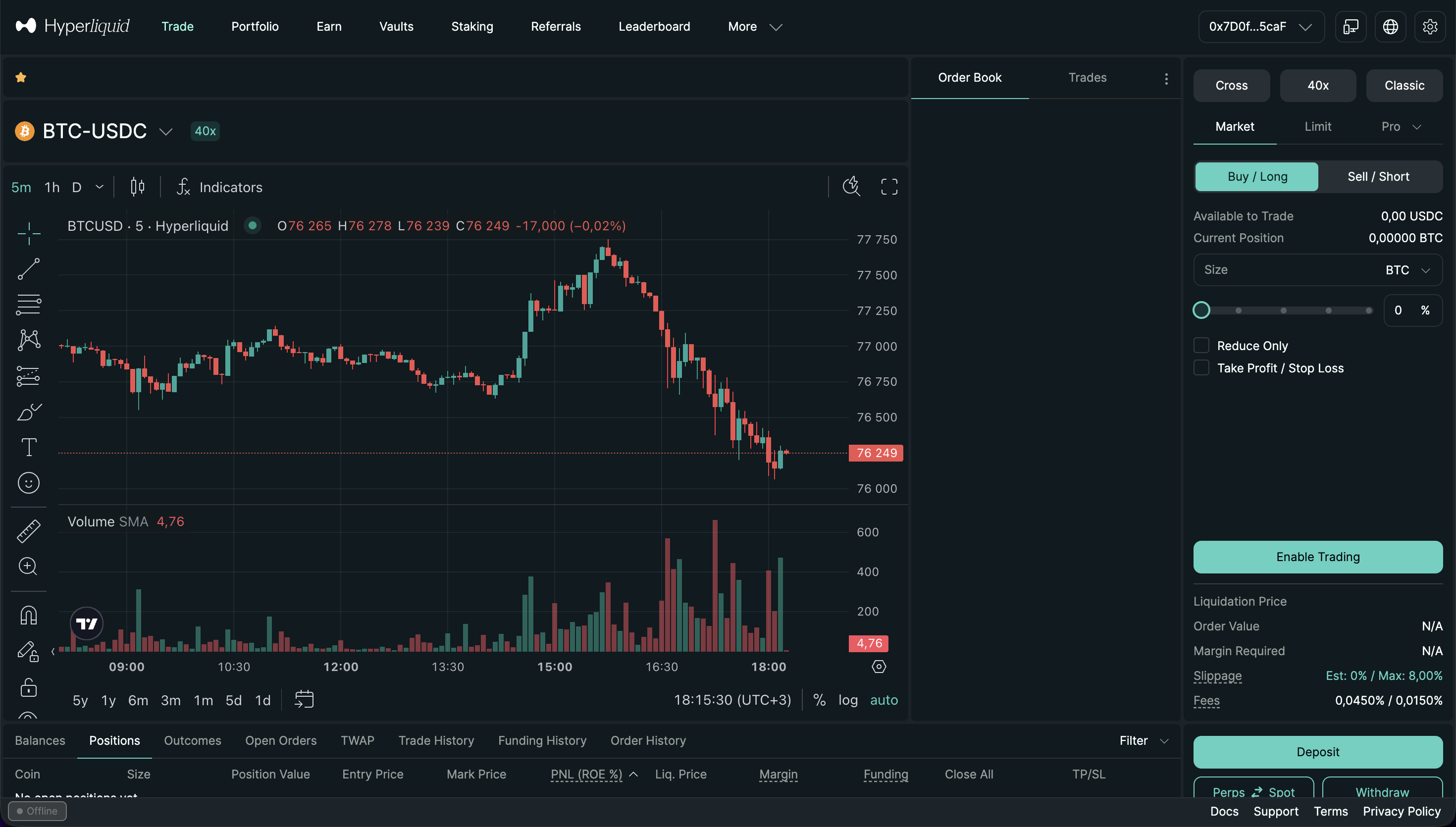
Hyperliquid is a perpetual-futures decentralized exchange running on its own purpose-built Layer 1 blockchain, with daily volume exceeding $10 billion through Q1 2026 (Hyperliquid stats dashboard, 2026). The platform was founded in 2022 by Jeffrey Yan and a pseudonymous co-founder, both ex-Hudson River Trading, with a singular product focus: a real on-chain central limit order book competitive with centralized exchanges on execution quality.
The architecture matters for airdrop farming because it changes the activity that counts. Order placement, cancellation, and matching are first-class operations baked into the consensus protocol through HyperBFT, not generic smart-contract calls layered on top of Ethereum. There are no gas fees on individual order operations. Spread tightness on BTC and ETH perpetuals is now within striking distance of Bybit and Binance at retail size.
What this means in 2026: Hyperliquid is not a points farm pretending to be a product. It is a product that happens to emit points. The protocol charges 0.025 percent taker and pays a 0.005 percent maker rebate on top pairs, which is among the lowest derivative fee structures globally. The HYPE token launched November 29, 2024, and the Layer 1 hosts a growing roster of perpetual pairs, an HLP vault, and a referral system that pays kickbacks indefinitely. For a deeper protocol breakdown see our Hyperliquid review and the Hyperliquid vs Bybit comparison.
The 2024 HYPE airdrop: lessons from what already happened
The November 29, 2024 HYPE TGE distributed approximately 310 million tokens (around 31 percent of total supply) directly to roughly 94,000 wallets, in one of the largest community airdrops in crypto history (Hyperliquid Labs official distribution post, November 2024). Snapshot eligibility ran on a documented points formula combining trading volume, open-interest contribution, and duration of platform activity through 2023 and 2024.
The tier breakdown matters because it sets expectations for any future allocation. Top 1 percent of eligible wallets claimed token packages worth $100,000 or more at TGE price of approximately $3.50. Median claim landed in the $5,000 to $15,000 range. Bottom tier of eligible wallets received allocations worth $500 to $2,000. The 31 percent community share was unusually large by airdrop standards; comparable distributions from 2023 to 2024 averaged 10 to 18 percent of supply (Messari token launches database, 2025).
How the points formula actually worked
The published points methodology assigned weight to three buckets: notional trading volume, open-interest contribution time-weighted, and HLP vault deposits. Maker volume earned higher per-dollar points than taker volume, which incentivized resting orders and tighter spreads. Long-duration HLP depositors received compounded points multipliers over the program’s runtime.
The Sybil cull that removed 12,000 wallets
Approximately 12,000 wallets were stripped from the snapshot for clustering patterns: multiple wallets funded from the same hot wallet within 48 hours, identical withdrawal addresses, matching trade timing across allegedly independent accounts. The exact filter logic was not published, but on-chain transparency made detection trivial relative to off-chain platforms. The honest lesson: one well-funded wallet with organic activity beat five mechanically similar wallets every time.
Post-TGE price action
HYPE opened at approximately $3.50 at TGE in late November 2024. It peaked near $35 in early 2025 during the broader crypto rally, before settling into a $15 to $25 range through 2026 (CoinGecko price data, May 2026). Holders who claimed the median allocation and sold at the peak realized roughly 10x on their farming. Those who held through 2025 captured most of the same upside with capital-gains tax efficiency depending on jurisdiction.
Season 2 and beyond: what is emitting now
Season 2 points began accumulating shortly after the November 2024 TGE, with no published snapshot date as of May 2026 (Hyperliquid Labs Discord, May 2026). The pattern from the original program (roughly 18 months between launch and TGE) suggests a Season 2 conversion event landing in mid-to-late 2026 or 2027, but Hyperliquid Labs has not confirmed this and the team has historically avoided explicit airdrop pre-announcements.
Based on our review of Season 2 points leaderboards through Q1 2026, the top decile of active traders by points accumulation runs approximately 4 to 8 times the volume of the median active wallet. The points-to-volume ratio favors makers by roughly 3 to 1 versus takers, mirroring the original season’s incentive structure. Wallets combining HLP vault deposits with active trading run roughly 2x the points of trading-only wallets at equivalent volume.
Trading volume points are the core driver
Volume is the base unit of points accumulation. Every dollar of notional traded contributes points, with the published multiplier favoring maker orders (resting limit orders that provide liquidity) over taker orders (market orders that consume liquidity). Long-duration position holding contributes additional weight relative to high-frequency in-and-out trading at identical notional. The exact emission formula is not disclosed, but the directional incentives are clear from leaderboard observation.
HLP vault deposits earn yield plus points
Depositing USDC into the HLP vault earns the underlying market-making yield (8 to 35 percent APY historical range) and contributes points at a 2x multiplier on protocol activity. This is the highest-leverage points farm for capital-heavy users who do not want to actively trade. We expand on the HLP mechanics in the next section.
Referrals pay 4 percent indefinitely
Hyperliquid referral codes pay 4 percent of all trading fees generated by referred accounts, with no time limit. This is one of the most generous referral structures in DeFi. Top referrers earned reported revenue of $10,000 to $100,000 per month through 2025 (public attestations from referral leaderboards). The structure compounds for content creators with audience reach; for individual users, using an existing code on signup unlocks a 4 percent fee discount on every trade.
Builder codes for technical integrations
Frontend builders, API integrators, and developers shipping Hyperliquid-routed products earn points through builder codes. This is a niche track but matters for the ecosystem build-out and likely receives proportional weight in any Season 2 distribution.
HLP vault: the underrated play
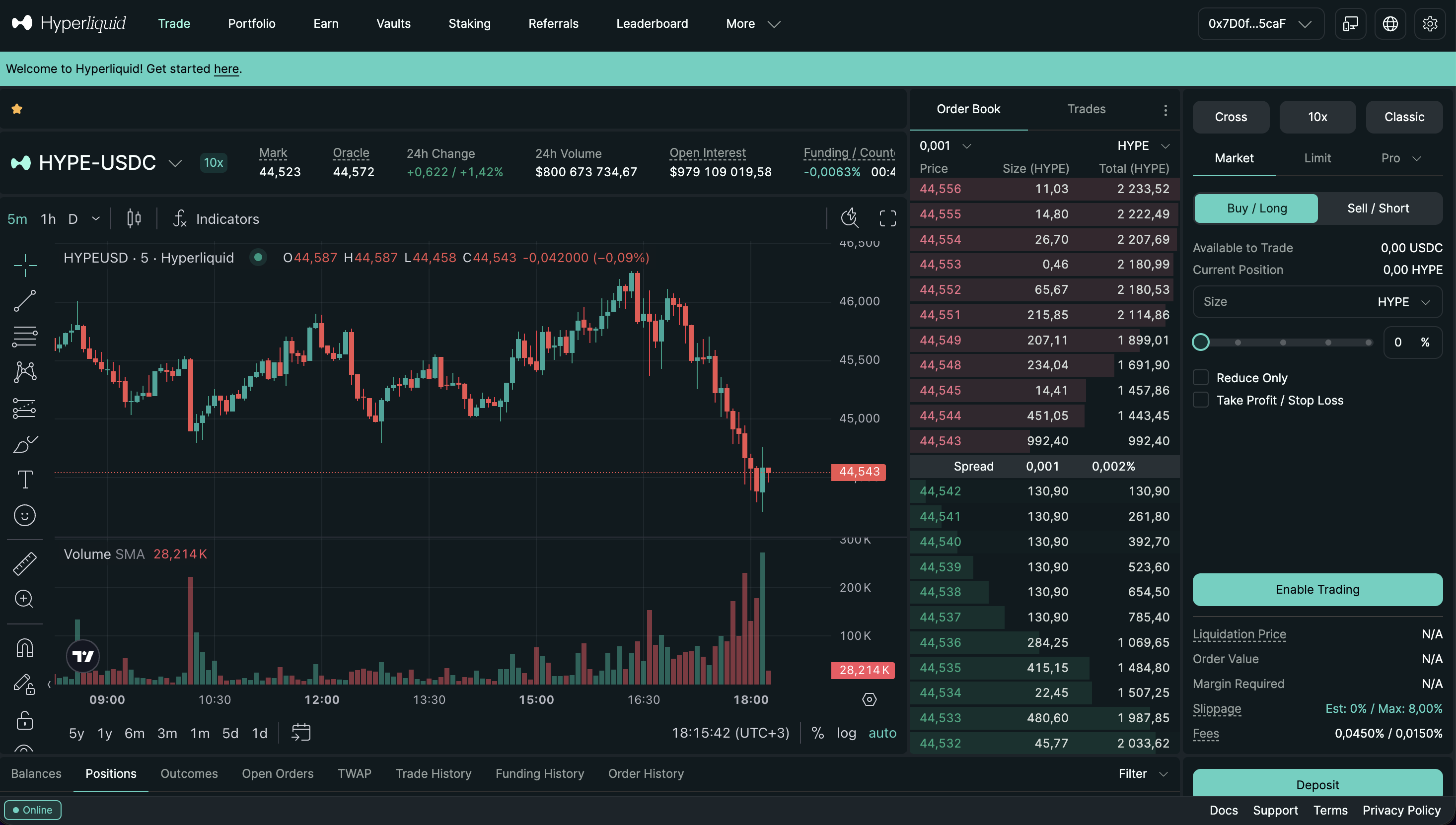
The Hyperliquid LP vault is the most interesting non-trading farm on the platform, with historical APY ranging from 8 to 12 percent in calm months and 15 to 40 percent during high-volatility periods through 2024 and 2025 (HLP performance dashboard, May 2026). HLP functions as the protocol’s house market-making book, deploying deposited USDC as two-sided liquidity across the order book and absorbing liquidations.
HLP is one of the few DeFi yield products where the underlying generator is a real trading activity rather than a token-emission flywheel. The yield comes from bid-ask spreads, funding-rate skew when the trader population leans net long or net short, and liquidation premiums collected when leveraged positions force-close. This is structurally similar to how a centralized exchange’s house market-maker earns money, except retail capital gets to participate.
How HLP deposits and withdrawals work
Depositing USDC into HLP issues vault tokens proportional to your share of the underlying book. Withdrawals carry a 24-hour lockup before USDC becomes claimable again. The vault rebalances continuously through its market-making logic, so depositor share value changes minute by minute based on book performance. There is no fixed APY: the displayed rate is a trailing 30-day annualized figure.
Where HLP returns actually come from
Three sources combined drive HLP yield. First, bid-ask spreads on resting orders. Second, funding-rate capture when the perpetual funding rate diverges from the spot index price, generating premium for the side absorbing the imbalance. Third, liquidation premiums when leveraged positions get force-closed and the vault books at favorable execution against retail liquidations.
The principal-loss risk is real
HLP can lose principal during sharp price moves. The vault writes uncovered liquidations during periods of extreme volatility, which means depositors absorb the loss if the liquidated position cannot be force-closed at the maintenance margin level. The 2024 maximum drawdown was approximately 12 percent during a leveraged-long liquidation cascade in mid-2024. This is not a stablecoin yield. It is a market-making book and behaves like one.
Minimum useful deposit is around $5,000
In our review of HLP positions through 2025, deposits below $5,000 USDC generate yield that gets meaningfully eaten by bridge gas costs and the time overhead of managing the position. At $5,000 with a 15 percent APY working assumption, annualized yield is approximately $750 before any HYPE airdrop optionality. The 2x points multiplier layered on top is the additional kicker. For yield-seekers, $5,000 to $50,000 is the practical sweet spot; below that, gas dominates; above that, slippage on HLP entry and exit starts to matter.
Step-by-step: active Hyperliquid farming 2026
The setup process for active Hyperliquid farming takes roughly 30 minutes from a cold start, with $5,000 to $50,000 in deployable USDC being the practical capital range where the math works (CopyTradeInsider field test, April 2026). Below $5,000, gas and time costs eat returns; above $50,000, slippage on HLP entry-exit and the 24-hour withdrawal lockup start mattering for capital flexibility.
Step 1: open an account
Navigate to https://app.hyperliquid.xyz and connect an EVM-compatible wallet (MetaMask, Rabby, or any wallet supporting Arbitrum). There is no KYC, no email, no liveness check. The wallet connection is the account. Geo-blocking applies to US IP addresses at the frontend level. See our no-KYC exchanges guide for the broader landscape on this.
Step 2: bridge USDC
Deposit USDC by bridging from Arbitrum, which is the canonical and cheapest route. Other chains can bridge USDC.e through standard cross-chain routes, but the Arbitrum path minimizes fee leakage. Allow approximately 5 to 10 minutes for the deposit to confirm on the Hyperliquid L1.
Step 3: split capital across HLP and active trading
The recommended structure is 30 to 50 percent of capital into the HLP vault for yield plus points, and 50 to 70 percent retained for active trading volume. The exact split depends on how much active trading you actually want to do. Pure passive farmers can lean 80 percent HLP; active traders can flip to 80 percent in trading capital.
Step 4: trade for volume points
The goal for active volume is approximately $100,000 to $1 million in monthly notional on $5,000 to $50,000 of capital, achieved through measured leverage of 3x to 10x. Use limit orders to be a maker rather than a taker, which both lowers fees and earns more points per dollar. Avoid identical position sizes day after day, identical timing offsets, and other patterns that look mechanical. Read our leverage primer and risk management guide before scaling notional.
Step 5: track points
Hyperliquid maintains a public points leaderboard at https://stats.hyperliquid.xyz where wallets can see their accumulated Season 2 points in near real-time. Track weekly to spot anomalies in your accumulation rate and adjust accordingly.
What to avoid
Sandwich-able patterns (predictable entry and exit points that a market-maker can front-run), identical position sizes across multiple wallets, same-time daily entries from the same IP, and any structure that looks like a bot script rather than a discretionary trader. The Sybil culling in November 2024 removed approximately 12,000 wallets for clustering patterns. The protocol’s transparency makes detection cheaper than on most other airdrop targets.
Referral structure: the under-talked-about edge
Hyperliquid referral codes pay 4 percent of all trading fees generated by referred accounts, with no time limit and no minimum activity threshold, which is among the most generous referral structures across all of DeFi in 2026 (Hyperliquid documentation, May 2026). The structure has two distinct uses depending on whether you are referring others or being referred yourself.
Setting up your own referral code
Generating a referral code takes one transaction in the Hyperliquid interface. Share the code through any audience channel you have (Telegram groups, Twitter, Discord, YouTube). Top referrers earn reported revenue of $10,000 to $100,000 per month, though these figures concentrate in the long tail of high-distribution content creators. For a typical individual user with modest reach, referral revenue is a small but real bonus.
Using an existing referral code on signup
Signing up under an existing referral code unlocks a 4 percent discount on every trade you place, indefinitely. This stacks with all other fee discounts and HYPE staking rebates. The math: on $1 million of annual notional volume at default 0.025 percent taker fee, the 4 percent referral discount saves approximately $10 per year. Trivial at low volume, meaningful at active-trader scale.
No KYC required
Both sides of the referral relationship are wallet-native. There is no identity verification, no minimum trading activity, and no jurisdiction restriction at the protocol level. The frontend geo-blocking applies to the trading interface, not to the referral relationship itself.
Sybil defense: what gets wallets removed
Approximately 12,000 wallets were removed from the November 2024 airdrop snapshot for documented Sybil clustering patterns, with the team applying on-chain forensic analysis to detect coordinated activity across allegedly independent accounts (Hyperliquid post-TGE disclosure, December 2024). The exact filter logic was not published, but the broad detection categories were communicated and the patterns are now well understood across the airdrop-farming community.
Common Sybil flags
The patterns that triggered removal in the original cull and likely apply to any future allocation: multiple wallets funded from the same hot wallet or exchange withdrawal within a 48-hour window, identical withdrawal destinations across multiple farming wallets, identical timing offsets on daily trading activity (e.g., always opening positions at 10:00 UTC across five wallets), matching position sizes and trade structure across allegedly independent accounts, and shared IP fingerprints during platform access.
Volume pattern matching
The protocol’s on-chain transparency makes clustering detection meaningfully cheaper than on off-chain centralized platforms. If five wallets all show the same trade size, the same entry timing, the same hold duration, and the same exit, they cluster regardless of the funding path. Visual pattern matching on volume time series is enough to flag many of these structures.
The honest take on multi-wallet farming
Running one well-funded wallet with organic activity and HLP exposure beats running five mechanically similar wallets that look like a bot script. The capital efficiency of multiple wallets gets eaten by the Sybil risk, by the bridge and gas costs of moving capital between them, and by the time overhead of managing the structure. For most retail farmers in 2026, single-wallet is the right answer.
Off-ramp: where to sell HYPE
HYPE is listed on all major centralized exchanges in 2026, with deepest CEX liquidity on Binance (listed June 2025) and deepest overall liquidity on Hyperliquid’s own spot market (CoinGecko market data, May 2026). The choice of off-ramp depends on size, on-chain versus off-ramp preference, and tax-optimal sequencing.
CEX listings supporting HYPE
The major venues supporting HYPE spot and perpetual markets in 2026:
- Bybit: high liquidity, spot plus perpetual
- BingX: spot and perpetual, deep order book on majors
- Bitget: spot plus perpetual, copy trading available
- OKX: spot plus perpetual, strong API
- KuCoin: spot, supports altcoin pairs
- Binance: listed HYPE in June 2025, deepest CEX liquidity
DEX option for large sells
For sells above approximately $100,000 notional, HYPE spot on Hyperliquid itself often executes with less market impact than a CEX route. The on-chain order book and limit-order tooling support patient execution at scale, and there is no withdrawal lockup on spot (unlike HLP’s 24-hour vault lockup).
Tax considerations
An airdrop receipt is generally treated as ordinary income at fair market value on the receipt date, with subsequent sale generating a capital gain or loss on the delta. In jurisdictions with separate short-term and long-term capital gains rates, holding for the long-term threshold can meaningfully reduce tax drag. See our crypto taxes Russia guide and the crypto trading glossary for terminology. Confirm with a local tax advisor; jurisdiction-specific rules vary substantially.
Verdict: who should farm Hyperliquid in 2026
Hyperliquid is one of the few post-TGE airdrop targets that is still worth farming in 2026, primarily because the underlying protocol use case is profitable on its own merits and the airdrop optionality is a free call option on top. Three structural reasons drive the conclusion.
First, trading the protocol is profitable independent of any future HYPE allocation. The 0.025 percent taker and 0.005 percent maker rebate structure is among the lowest in derivatives globally, and the no-KYC self-custody design fits an audience underserved by major CEXs. Second, HLP vault yields covered gas costs and time investment through 2025 without any HYPE upside, with historical APY of 8 to 35 percent. Third, the points-to-HYPE pipeline has precedent: the November 2024 TGE distributed roughly $1 billion of value to community users based on points earned in the preceding 18 months.
The honest tradeoff is capital requirement. Hyperliquid farming requires real deployed capital ($5,000 plus to clear gas overhead and lockup costs) and active engagement (volume points reward maker orders and discretionary trading patterns over bot-like activity). For users with less than $5,000 in deployable USDC, the time-to-yield ratio probably does not justify the effort. For users with $5,000 to $50,000 and willingness to trade actively, the combined HLP yield plus volume points plus referral kickback plus airdrop optionality stack is one of the better setups in DeFi in 2026.
Frequently asked questions
Did I miss the Hyperliquid airdrop?
Yes, if you mean the November 2024 HYPE TGE. The genesis snapshot closed in late October 2024 and approximately 310 million HYPE (about 31 percent of total supply) was distributed to roughly 94,000 wallets based on points earned through 2023 and 2024. Median claim landed around $5,000 to $15,000 at TGE price. That window is fully closed. What remains in 2026 are Season 2 trading points, HLP vault rewards, and referral revenue, which may or may not convert into a future HYPE allocation.
Will there be another HYPE airdrop?
Not officially confirmed by Hyperliquid Labs, but precedent points to yes. The original points program ran roughly 18 months before the November 2024 TGE, and Season 2 points began accumulating shortly after. As of May 2026, no Season 2 snapshot date has been published. Most observers expect a second allocation event in mid-to-late 2026 or 2027, sized smaller than the original because the obvious community distribution already happened. Treat any future allocation as a bonus, not a base case.
How does the HLP vault actually generate yield?
The Hyperliquid LP vault (HLP) is the protocol's house market-making book. Deposited USDC writes two-sided liquidity across the order book, captures bid-ask spreads, earns funding-rate skew when traders are net long or net short, and absorbs liquidation premiums when leveraged positions get force-closed. Historical APY ranged from 8 to 12 percent in calm months and 15 to 40 percent during high-volatility periods through 2024 and 2025. The 2024 maximum drawdown was approximately 12 percent during a leveraged-long liquidation cascade.
What is the minimum useful deposit for HLP farming?
Practically, around $5,000 USDC. Below that level the cost of bridging USDC from Arbitrum to the Hyperliquid L1, plus the time investment of managing the position and withdrawing through the 24-hour lockup, eats into net returns. At $5,000 with a 15 percent APY assumption, the position generates approximately $750 in annualized yield before any HYPE airdrop optionality. HLP holders also receive a 2x points multiplier on protocol activity, which compounds the trading-points farm running in parallel.
Do referral codes still pay out in 2026?
Yes, and the structure is one of the most generous in DeFi. Hyperliquid referral codes pay 4 percent of all trading fees generated by referred accounts, with no time limit and no minimum activity requirement. Top referrers across crypto Twitter and Telegram reportedly earned $10,000 to $100,000 per month in passive fee revenue through 2025. Referees receive a 4 percent fee discount when they sign up under an existing code. Both sides benefit, which is part of why referral attribution stays high relative to other perpetual venues.
What activity gets a wallet flagged as Sybil?
The 2024 Sybil cull removed approximately 12,000 wallets from the airdrop based on documented clustering patterns. Common triggers: multiple wallets funded from the same hot wallet within 48 hours, identical withdrawal destinations, identical timing offsets on daily activity, matching trade sizes across allegedly independent accounts, and shared IP fingerprints. Running one well-funded wallet with organic trading and HLP exposure beats running five mechanically similar wallets. The protocol's on-chain transparency makes clustering detection trivial relative to off-chain platforms.
Where do I sell HYPE if I receive an airdrop?
HYPE listed on all major centralized exchanges through 2025. Bybit, BingX, Bitget, OKX, KuCoin all support HYPE spot and perpetual markets. Binance listed HYPE in June 2025, which is the deepest CEX liquidity venue. The deepest sell venue for large size remains HYPE spot on Hyperliquid itself, where the order book and limit-order tooling allow execution without market impact. Tax treatment: an airdrop receipt is generally ordinary income at fair market value on the receipt date; subsequent sale is a capital gain or loss on the delta.
Is farming Hyperliquid worth it if no airdrop materializes?
Yes, if you trade perpetuals anyway. Hyperliquid charges 0.025 percent taker and pays a 0.005 percent maker rebate, which is among the lowest fee structures in derivatives globally. HLP vault yields covered gas costs and time investment without any HYPE upside through 2025. The 4 percent referral kickback compounds for active social distributors. Treat the airdrop optionality as a free call option on top of an already-profitable protocol use case. That framing avoids the trap of farming purely for an event that may not arrive.
#airdrop#Hyperliquid#HYPE#guide#DeFi#perpetuals#farming
Discussion
Loading comments…