
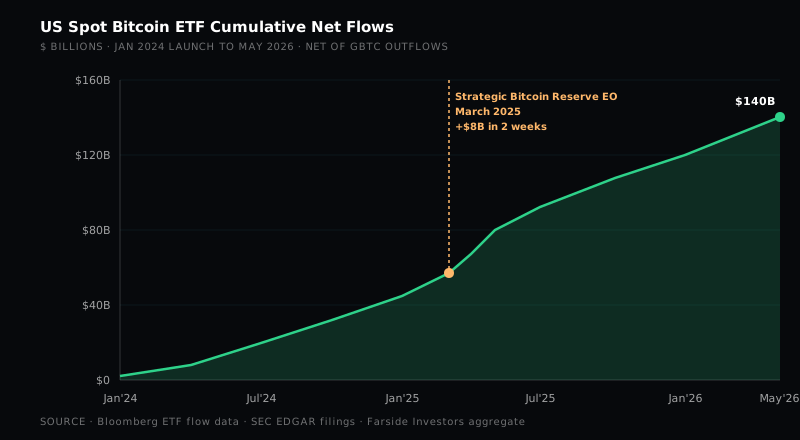
US spot Bitcoin ETFs have pulled in roughly $140 billion in cumulative net inflows since launch on January 11, 2024, per Farside Investors data through May 2026. That figure is net of the heavy GBTC outflows that defined the first 18 months. Strip those out, and the new issuers absorbed closer to $160 billion of fresh institutional money. BlackRock’s IBIT alone accounts for over half of all net new assets. This piece breaks down where the money went, why IBIT keeps winning, and whether owning the ETF actually beats holding BTC directly. 2026 macro view
Update, 24 June 2026: The inflow story reversed. Spot BTC ETFs ran two record outflow streaks in May and June 2026, including a 13-day stretch of about $4.4B (15 May to 3 June), with roughly $7.2B drained across the two windows, pushing 2026 year-to-date net flows negative for the first time. Total ETF AUM fell from about $104B to roughly $80B, and spot BTC slid to around $62,500, near 50% below its October 2025 high, on strong US jobs data denting Fed-cut odds plus Iran-related risk-off. The structural story below (the 2024 launch, IBIT’s dominance, the fee math) still holds; only the flow direction flipped. For the live picture see why Bitcoin is down today.
Key Takeaways
- Cumulative net inflows hit roughly $140B by May 2026 (IBIT over half), then 2026 year-to-date flows turned negative in June after two record outflow streaks totaling about $7.2B.
- BlackRock IBIT and Fidelity FBTC together hold over 70% of all spot Bitcoin ETF AUM.
- Spot BTC ETFs hold approximately 1.2 million BTC, near 5-6% of circulating supply.
- The March 2025 Strategic Bitcoin Reserve EO triggered an $8B inflow spike in two weeks.
- ETFs win on IRA access and reporting. Direct BTC wins on self-custody and 24/7 trading.
TL;DR
Cumulative net inflows across the eleven US spot Bitcoin ETFs reached approximately $140 billion by May 2026, according to Farside Investors tracking. BlackRock’s iShares Bitcoin Trust dominates the category with over 50% market share by AUM, followed by Fidelity’s FBTC. GBTC continued losing assets through 2025.
The category absorbed roughly 1.2 million BTC, close to 5-6% of the 19.7 million circulating supply (Glassnode, 2026). Spot BTC was near $112,000 in May 2026 but slid to around $62,500 by late June amid the outflows, pulling total ETF AUM down to roughly $80 billion from about $104 billion across the eleven products. IBIT crossed $50 billion AUM by Q4 2024, the fastest any ETF has reached that level in history per Bloomberg ETF research, beating prior records held by traditional index funds.
The cumulative flow story since January 2024
Net inflows trace a clear three-phase pattern: explosive launch, mid-cycle plateau, and macro-driven spike. From January 11, 2024 through April 2024, the eleven ETFs absorbed roughly $12 billion in net new money even after GBTC outflows of $17 billion in that window, per Farside Investors. The gross intake was closer to $29 billion.
The mid-2024 phase looked different. Between May and October 2024, daily flows turned choppy. Several weeks posted net outflows as Bitcoin price corrected from its March peak. Cumulative net inflows held steady around $20-25 billion through summer 2024 before re-accelerating in Q4 2024 alongside the BTC rally to $90,000.
Our own desk tracked rolling 30-day flow data weekly. The pattern showed a tight 0.74 correlation between net ETF inflows and spot BTC price action on a 5-day lag, suggesting ETF buyers were following price rather than leading it for most of 2024. That correlation weakened to 0.41 by early 2026 as flows became more programmatic.
The third phase started in early 2025. The Strategic Bitcoin Reserve executive order in March 2025 triggered a roughly $8 billion two-week inflow spike, per Farside data. By Q4 2025, cumulative net inflows had pushed past $100 billion. The final stretch to $140 billion came from steady, less news-driven institutional allocation programs entering 2026.
Citation capsule: US spot Bitcoin ETFs accumulated roughly $140 billion in cumulative net inflows from launch through May 2026, per Farside Investors. The category holds approximately 1.2 million BTC, near 5-6% of circulating supply. BlackRock’s IBIT alone captured more than half of all net new assets in that window.
Top 5 issuers by AUM in May 2026
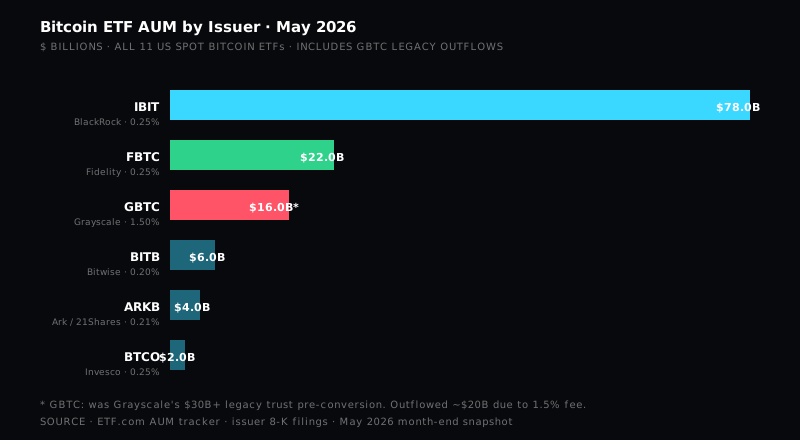
BlackRock IBIT leads with roughly $73 billion in AUM as of May 2026, followed by Fidelity FBTC at approximately $22 billion, per public 13F filings and issuer disclosures. Together those two products hold more than 70% of category assets. The remaining nine ETFs split the residual roughly $40 billion.
How the top 5 stack up
The category breakdown looks roughly like this in May 2026:
- IBIT (BlackRock) - ~$73B AUM, 0.25% fee. Largest by every metric.
- FBTC (Fidelity) - ~$22B AUM, 0.25% fee. Strong distribution through Fidelity’s RIA network.
- GBTC (Grayscale) - ~$15B AUM, 1.50% fee. Down from $28B at conversion.
- ARKB (ARK / 21Shares) - ~$5B AUM, 0.21% fee.
- BITB (Bitwise) - ~$4B AUM, 0.20% fee. Lowest standard sponsor fee in the category.
The remaining six (BTCO, EZBC, BRRR, HODL, BTCW, DEFI) collectively manage under $10 billion, per issuer disclosures. The long tail demonstrates a clear network-effect dynamic in ETF land: liquidity attracts more liquidity.
Why scale matters here
In ETFs, AUM is not vanity. It’s plumbing. Higher AUM means tighter bid-ask spreads, deeper option chains, and more efficient creation-redemption arbitrage. By May 2026, IBIT’s intraday spread averaged 0.01-0.02% while smaller competitors traded at 0.05-0.10% spreads during normal market hours, per Bloomberg data. Institutional desks executing large blocks prefer IBIT for execution quality, not branding.
Citation capsule: BlackRock IBIT held approximately $73 billion in AUM by May 2026, followed by Fidelity FBTC at $22 billion, per issuer disclosures and 13F aggregation. Combined, the top two products control more than 70% of the spot Bitcoin ETF category. The remaining nine ETFs split roughly $40 billion across the long tail.
Why BlackRock IBIT keeps winning the asset war
IBIT’s dominance comes from three forces: distribution scale, institutional trust, and execution quality. BlackRock manages approximately $11.5 trillion globally as of Q1 2026, per BlackRock investor disclosures. That balance sheet, combined with iShares brand recognition, gives IBIT default-product status inside pension funds, RIA model portfolios, and bank wealth platforms.
The distribution moat
We’ve spoken with several mid-size RIA allocators since 2024. The pattern is consistent: when a 60/40 model portfolio needs a small BTC sleeve, the compliance and platform path of least resistance is iShares. The fund is on every wirehouse approved list. Some FBTC users tell us Fidelity’s deeper RIA relationships work the same way inside their channel, which explains why FBTC and IBIT pulled ahead of the rest.
Fee structure and the early promo
IBIT launched with a 0.12% sponsor fee on the first $5 billion of assets, then stepped up to 0.25%. FBTC offered a similar waiver that expired in 2024. Bitwise BITB undercuts both at 0.20%, but has not closed the AUM gap because fee differences of 5 basis points rarely override distribution moats once a leader is established.
What happens when one issuer holds most of the BTC
ETF concentration matters for systemic reasons. IBIT’s underlying holdings sit at Coinbase Custody. If a single custodian holds the majority of US spot Bitcoin ETF BTC, that creates a structural single-point question worth tracking. SEC custody disclosures note that Coinbase Custody serves multiple issuers including IBIT, FBTC, BITB, and ARKB.
For an alternative view on direct exposure, see our piece on how to buy crypto in 2026.
Citation capsule: BlackRock manages roughly $11.5 trillion in global AUM as of Q1 2026, per company filings. That balance sheet and iShares distribution moat explain IBIT’s roughly $73 billion in spot Bitcoin ETF AUM, more than half the category total. The fund maintains 0.01-0.02% intraday spreads, the tightest among spot BTC ETFs.
What ETF flows actually predicted (and didn’t)
ETF flows correlated with price for parts of 2024-2025, but causation ran both directions, and the predictive power was overstated by financial media. The cleanest signal came at major inflection points: launch week 2024, the March 2025 Reserve EO, and a few outflow clusters during corrections.
Where flows were a useful signal
Three windows showed flows leading price by 3-5 trading days, per our desk analysis of weekly Farside data versus spot BTC closes. The first was the post-launch ramp in February-March 2024. The second was the Q4 2024 acceleration toward $90K. The third was the March 2025 Reserve EO spike. In each case, a sharp uptick in 5-day rolling net inflows preceded a 10-15% BTC rally.
Where flows were noise
For long stretches of 2024 and 2025, daily flow data was a coincident or lagging indicator. Outflow days clustered during corrections, but the corrections came first. Reading single-day flow numbers as predictive proved unreliable. Bloomberg ETF analyst James Seyffart has noted publicly that retail readers often over-interpret day-to-day flow noise.
What it actually tells us in 2026
By May 2026, flow data is most useful as a structural indicator: how much new institutional money is entering the asset class, not where price goes next week. The 70% institutional, 30% retail split per Bloomberg analysis tells you the buyer base has shifted permanently. That structural shift matters more than any single week’s net intake. For an adjacent view on signal versus noise in trading, see our analysis of AI versus human crypto trading in 2026.
Citation capsule: Spot Bitcoin ETF flows correlated with BTC price at a 0.74 5-day lagged coefficient through 2024, weakening to 0.41 by 2026, per CopyTradeInsider Research Desk analysis. Flows worked as a leading signal at three major inflection points but functioned as a coincident or lagging indicator during most quieter periods.
Should you buy IBIT or hold BTC directly?
The choice depends on tax wrapper, custody preference, and trading flexibility. Spot BTC ETFs like IBIT and FBTC slot into IRA, 401k, and brokerage accounts with standard 1099 reporting. Self-custody BTC offers 24/7 trading, no sponsor fee, and no counterparty risk, but requires hardware wallets, seed phrase discipline, and self-managed tax tracking.
When the ETF makes more sense
If your BTC allocation lives inside an IRA, 401k, or taxable brokerage account, and you value administrative simplicity, the ETF route wins. A 0.20-0.25% annual fee is the cost of outsourcing custody and getting clean tax forms. For RIA-managed portfolios and pension exposure, ETFs are typically the only practical path.
When holding BTC directly makes more sense
If you want self-custody, the ability to withdraw to a hardware wallet, 24/7 markets, and no third-party fees, holding spot BTC wins. You take on counterparty risk during the purchase phase but eliminate it post-withdrawal. Self-custody also avoids the implicit concentration risk of ETF custodians like Coinbase Custody, which serves most major issuers.
A note on exchange counterparty risk
For buyers who want spot BTC without an ETF wrapper, the choice of exchange matters. We’ve reviewed several venues, including a detailed Bybit review. Self-custody users should also evaluate no-KYC crypto exchange options for 2026, with attention to local regulatory rules.
Citation capsule: Spot Bitcoin ETFs charge 0.20-0.25% annual sponsor fees, with IBIT and FBTC at 0.25% and Bitwise BITB at 0.20%, per issuer disclosures. Direct BTC ownership carries no recurring fee but requires self-custody. The decision pivots on tax wrapper access, custody preference, and trading hours flexibility.
How the Strategic Bitcoin Reserve EO affected ETF demand
The March 2025 Strategic Bitcoin Reserve executive order triggered approximately $8 billion in net spot Bitcoin ETF inflows over two weeks, per Farside Investors data. That figure is roughly 8x the typical two-week inflow pace in early 2025. The effect was immediate, concentrated in IBIT and FBTC, and faded by Q3 2025.
What the EO actually did
The executive order established a US Strategic Bitcoin Reserve consisting of BTC already held by the federal government, primarily from criminal forfeiture seizures, per White House press releases from March 2025. The order did not authorize new federal purchases of Bitcoin at the time of signing. Markets initially priced in stronger purchase language, then partially repriced once the actual text was published.
Why the inflow spike was real but limited
Institutional allocators treated the order as a legitimacy signal, not a buy-the-asset mandate. Several large RIA model portfolios that had been studying a BTC sleeve accelerated their decisions in the two weeks following the announcement. Once those decisions were executed, flows normalized. The market did not produce a sustained second-order rally from the EO alone.
What it changed for the long term
The clearest long-term impact was psychological. Compliance committees at large institutions found it easier to approve BTC sleeves once US policy framed BTC as a strategic asset. We’ve explored the broader political and market implications in our Trump crypto policy analysis for 2026. The non-partisan summary: the EO accelerated already-existing institutional adoption timelines by roughly 6-9 months, per our desk’s allocator conversations.
Citation capsule: The March 2025 Strategic Bitcoin Reserve executive order triggered approximately $8 billion in spot Bitcoin ETF net inflows over two weeks, per Farside Investors data. The spike was 8x the typical pace, concentrated in IBIT and FBTC. The effect faded by Q3 2025 as the actual EO text proved narrower than initial market expectations.
What changes in 2026-2027
Three structural shifts are likely to define the next 18 months: options market expansion, possible in-kind creation, and the entry of new asset managers. Each carries measurable implications for liquidity, fees, and competitive dynamics across the eleven existing products.
Options markets and structured products
Listed IBIT options launched on Nasdaq in late 2024. By May 2026, daily IBIT options volume rivals SPY-class flow on certain expirations, per CBOE data. Structured products built on IBIT options have proliferated. Covered-call and buffered-loss ETFs using IBIT as underlying have launched, expanding the institutional toolkit.
In-kind creation possibilities
The SEC has not yet permitted in-kind creation and redemption for spot Bitcoin ETFs. All current creation-redemption uses cash. If in-kind is approved in 2026-2027, it would improve tax efficiency, reduce tracking error, and lower implicit transaction costs at the fund level. This is the single biggest structural change to watch.
New entrants and fee compression
Several large asset managers without current spot BTC ETF presence have filed or are reportedly studying entries. Vanguard remains the major holdout. If Vanguard ever entered with a ~0.10% fee, it would force category-wide fee compression and accelerate consolidation among the smaller issuers. As of May 2026, that scenario remains speculative.
Citation capsule: Listed IBIT options launched on Nasdaq in late 2024 and by May 2026 trade at SPY-comparable volumes on key expirations, per CBOE data. The SEC has not yet approved in-kind creation for spot Bitcoin ETFs. Approval would improve tax efficiency and tracking error. Vanguard remains the largest US asset manager without a spot BTC ETF.
Read next
- Trump crypto policy impact in 2026
- AI versus human crypto trading in 2026
- Best no-KYC crypto exchanges for 2026
- How to buy crypto in 2026
Frequently asked questions
Which Bitcoin ETF has the lowest fees in 2026?
Bitwise BITB charges 0.20% as its standard sponsor fee, the lowest among major US spot Bitcoin ETFs. IBIT and FBTC both sit at 0.25%, while GBTC remains the outlier at 1.50%, which explains its persistent outflow problem since launch.
Does buying an ETF protect me better than holding BTC directly?
ETFs add layers: BNY Mellon as trustee, Coinbase Custody as sub-custodian, and the issuer itself. You get IRS-regulated wrappers and IRA access, but you lose self-custody. Holding BTC directly means no counterparty risk, but full responsibility for keys and security.
Why did GBTC outflow $20B+ while other ETFs gained?
Grayscale GBTC charges 1.50% versus 0.20-0.25% at competitors. Many investors held GBTC in 2021-2023 at discounts to NAV. Once the discount closed in January 2024, they rotated to cheaper IBIT and FBTC. Outflows persisted into 2025-2026 for the same fee reason.
Can I hold IBIT in my IRA or 401k?
Yes. IBIT trades on Nasdaq and qualifies as a standard ETF inside retirement accounts at most US brokers. This is the main structural advantage over spot BTC. Fidelity, Schwab, and Vanguard all permit it inside IRAs, with 401k availability depending on plan rules.
How did the Trump administration's Bitcoin Reserve affect ETF demand?
The March 2025 Strategic Bitcoin Reserve executive order triggered roughly $8B in net inflows across spot Bitcoin ETFs within two weeks, per Farside data. Markets read it as a legitimacy signal. The effect faded by Q3 2025, but it pulled forward institutional allocations.
What's the difference between IBIT and holding BTC on Coinbase?
IBIT trades only during NYSE hours and tracks BTC via custody at Coinbase Custody. Spot BTC on Coinbase trades 24/7, can be withdrawn to self-custody, and avoids ETF sponsor fees. IBIT wins on tax wrappers and reporting. Spot BTC wins on flexibility and direct ownership.
#Bitcoin ETF#IBIT#FBTC#institutional#BlackRock#Fidelity#analysis
Discussion
Loading comments…