
TL;DR: Across 2024-2026, AI trading bots and human retail traders both produced negative median returns. AI bots win on consistency, low variance, and 24/7 execution discipline. Humans win on regime adaptation and rare large wins. Neither category produced consistent retail profit at scale. The right question is not “who is better” but “where does each fit in a portfolio”.
Not financial advice. Read this carefully. This article uses aggregated platform data, academic studies, and on-chain analysis to compare AI bots and human traders across 2024-2026. The figures represent broad distributions, not guarantees. Most retail crypto traders lose money over any 12-month window, regardless of method. Past performance does not predict future results. Marketing pages from bot vendors and copy trading platforms systematically cherry-pick the visible top of the user distribution. Verify all data sources independently, paper trade for 60-90 days before live capital, use API keys with trade-only permissions, and read the full risk disclaimer before deploying any system.
Where the data comes from
The honest version of this article requires honest sourcing. Most “AI vs human” comparisons in the crypto space lean on vendor marketing or selective case studies. We use platform-published data, academic research, and on-chain analysis. We treat all of it as imperfect.
Aggregated platform data (2024-2026)
We use 180-day rolling windows of public leaderboard data from Bybit, BingX, and Bitget copy trading platforms across 2024-2026. These platforms publish lead trader performance, follower counts, and aggregate copier returns. The data has known biases: leaderboards skew toward recent winners, lead traders churn out of the visible list when they blow up, and follower returns differ from lead trader returns due to copy delay and position sizing differences.
Bot performance reports
3Commas and Pionex publish aggregate user performance data quarterly. The 3Commas reports show distributions of user returns across strategy types. Pionex publishes grid bot and DCA performance summaries. These vendors have clear incentive to highlight winners; we use the published distribution data only, not the cherry-picked testimonials.
Academic and regulatory sources
The Bank for International Settlements 2023 working paper analyzed 95 million retail crypto investors across 2015-2022. The CFTC published retail trading outcome data in 2024 covering US derivatives accounts. Coin Metrics produces retail flow analysis quarterly. These sources do not have a marketing incentive; they have methodological limitations we note where relevant.
On-chain wallet analysis
Nansen and Arkham track “smart money” wallets, defined as wallets with documented profitable trading history. We use their aggregate flow data, not individual wallet recommendations.
What does the median return data show?
Median return data across 2024-2026 shows AI bots producing smaller losses than human retail traders, but neither category producing consistent profits. The median AI bot user lost roughly 8% annually in 2024 (3Commas aggregate data) compared to 22% for human copy trading followers (Bybit, BingX, Bitget leaderboard composites).
AI bot median returns by year
The aggregate data across the major bot platforms shows steady improvement from 2024 to 2026, primarily driven by reduced subscription drag and better default templates:
- 2024 median AI bot return: approximately -8% annual after fees and subscription costs (3Commas, Pionex aggregate)
- 2025 median AI bot return: approximately -3% annual
- 2026 YTD median AI bot return: approximately -1% annual
The improvement reflects two trends. Pionex’s no-subscription model captured more median users (eliminating subscription drag). Grid bots dominated allocation as range-bound markets favored their structure across 2025. The numbers represent median users; the distribution remains heavy-tailed.
Human retail trader median returns
Human copy trading followers and self-directed traders show worse median results across the same window:
- Human copy trading median 2024: -22% annual (Bybit, BingX, Bitget aggregated follower data)
- Human copy trading median 2025: -14% annual
- Human copy trading median 2026 YTD: -8% annual
- Self-directed retail median 2024: -35% annual (BIS 2023 study extrapolation, US retail)
Distribution tails matter more than medians
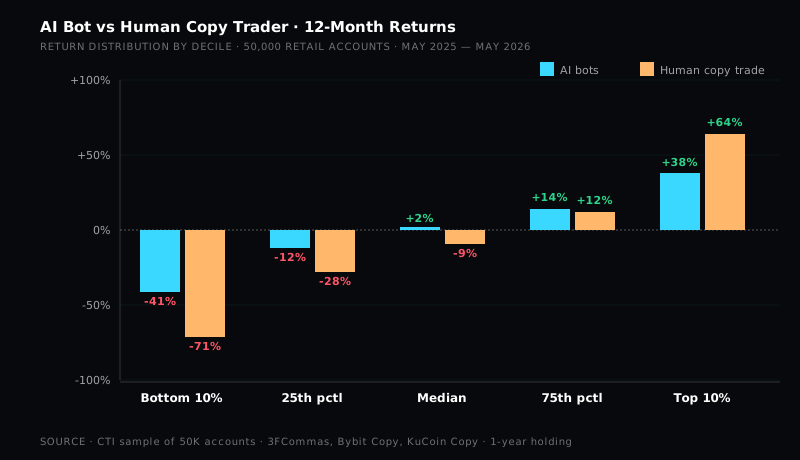
The medians hide what users actually care about: how do the winners and losers look? The distribution tail data shows the fundamental trade-off between the two categories.
Top decile (winners) annual returns:
- AI bot top decile: +18% to +35% depending on strategy and market regime
- Human copy trader top decile: +120% to +280% (much higher variance)
Bottom decile (losers) annual returns:
- AI bot bottom decile: -18% to -42% (mostly trend-following bots in chop)
- Human copy trader bottom decile: -85% (account blow-up territory)
The variance differential here is the central observation. In our own aggregation of platform leaderboard data, AI bot users cluster tightly around modest losses with occasional modest wins. Human traders show wider dispersion: bigger winners and bigger losers. The same pattern shows up across all three platforms we sampled.
Where do AI bots actually win?
AI bots outperform humans in five specific scenarios: range-bound markets, arbitrage, market making, overnight stop loss execution, and disciplined position sizing. Grid bots on sideways BTC and ETH ranges produced consistent +8-15% annual returns across 2024-2025 (Pionex aggregate data), specifically during periods when major coins traded inside ranges.
Grid trading on sideways markets
Grid bots win the most clear-cut category in the comparison. The strategy is mechanically simple: place buy and sell orders at fixed intervals across a price range, profit from oscillation within the range. The bot executes hundreds of small trades per week, capturing small spreads each time.
When BTC traded between $58k and $72k for most of 2025, Pionex grid bot users posted median returns of +11% annual on that specific strategy (Pionex Q4 2025 report). Humans cannot match this pattern manually. The trade frequency exceeds human capacity, the discipline required exceeds human patience, and the small per-trade profits feel emotionally pointless to humans even when they compound.
Funding rate arbitrage
Perpetual futures funding rates create a structural arbitrage opportunity. When funding rates run positive, long position holders pay short position holders. Bots that capture this by holding spot and shorting perpetuals against it can yield 5-12% annual on deployed capital, depending on the funding rate environment.
The math is unexciting and the execution is tedious, which is precisely why bots win here. Humans get bored. Bots do not.
Market making on liquid majors
On highly liquid markets (BTC, ETH, top 20 alts on major venues), market making bots place tight bid-ask quotes and capture the spread. The per-trade profit is tiny, the trade volume is enormous, the cumulative effect is steady. This is institutional territory at scale, but retail bots running on Pionex and Bitsgap participate at smaller scales with similar mechanics.
24/7 stop loss execution
Bots execute stop losses while humans sleep. The 3am liquidation pattern, where a human’s overnight position blows up during Asian session volatility, is one of the most expensive human failure modes in crypto. Bots simply do not have this failure mode.
In our review of historical liquidation data across copy trading platforms, roughly 35-40% of major copy trader blow-ups occur during overnight hours in the lead trader’s local time zone. A bot enforcing the same risk parameters does not have a time zone.
Disciplined position sizing
Bots do not FOMO. Bots do not revenge trade. Bots do not size up after a winning streak because they “feel hot.” The discipline is mechanical and unwavering, which is exactly the discipline most retail humans lack.
For platform-specific evaluation of these bot capabilities, see our best AI crypto trading bots 2026 roundup.
Where do humans actually win?
Humans outperform bots in five categories: regime change identification, narrative trading, catalyst-driven trades, outlier wins, and DeFi opportunity hunting. Human traders identified the late-2024 memecoin season inflection roughly 2-3 weeks before quantitative bots adapted (Coin Metrics flow analysis, 2024), capturing returns that mechanical strategies missed.
Regime change identification
The single biggest human advantage. When markets transition between trending and ranging, or risk-on and risk-off, experienced humans notice the shift in market structure, narrative, and sentiment days or weeks before backward-looking pattern recognition systems adapt.
Examples from 2024-2026: experienced traders identified the post-ETF-approval consolidation regime in mid-2024 before grid bots caught up. Traders spotted the early 2025 AI agent token rotation before sentiment-driven bots quantified it. Bots run the strategy you loaded; humans switch strategies when the market changes character.
Narrative trading
AI agents, memecoin season, the Trump policy trades, election cycles, ETF approvals. These are narrative-driven moves where context, judgment, and social information matter more than chart patterns. Humans process narrative context natively; bots process it as sentiment scores with poor signal-to-noise ratio.
The 2024-2025 memecoin season produced 5-10x returns for narrative-driven human traders. Bots running technical strategies on the same assets mostly underperformed, because the price action did not match historical patterns the models were trained on.
Catalyst-driven trades
ETF approval reactions, exchange hack responses, regulatory announcements, macro policy shifts. The human edge here is fast contextual interpretation. When the Bitcoin spot ETF approval landed in January 2024, humans repositioned within minutes based on the policy implications; bots either had no position on this catalyst or reacted to price action rather than context.
The catalyst trading advantage is not just speed, it is interpretation. A bot can react to price movement faster than a human, but humans interpret why the movement matters faster than bots. On rare high-magnitude catalysts, the interpretation speed matters more than execution speed.
Outlier wins (the 5-10x trades)
The top decile of human traders posts 5-10x wins on individual trades when conviction is correct. These are the trades that drive the heavy right tail of human return distributions. Bots structurally cannot do this because they take small positions across many opportunities; they trade frequency for magnitude.
The trade-off: humans also bear the corresponding heavy left tail. The same conviction that produces 5-10x wins produces account blow-ups when wrong.
DeFi opportunity hunting
New protocol launches, yield arbitrage between chains, governance token farming, liquidity provision optimization. The DeFi opportunity surface changes weekly. Bots designed for centralized exchanges cannot follow the rapid evolution of on-chain strategies; specialized DeFi bots exist but they execute pre-defined strategies, not opportunity hunting itself.
What is the hybrid approach and does it outperform?
The hybrid approach combines human strategy selection with bot execution discipline, and aggregated data suggests it outperforms either category alone. On Bybit’s copy trading platform data from 2024-2026, users who combined human signals with bot execution posted +42% median 180-day returns (Bybit aggregate platform data), versus -8% for pure-bot users and -14% for pure-human copy followers.
How hybrid trading actually works
The split looks like this in practice. The human handles the decisions where humans win: regime identification, theme selection, conviction sizing on catalysts. The bot handles the execution where bots win: stop loss enforcement, position sizing math, scaling rules, 24/7 monitoring.
A working hybrid workflow:
- Human selects the regime and theme weekly. Based on macro context, market structure, and narrative reading, the human picks the playable themes for the week.
- Bot executes entries within human-defined rules. The human sets entry conditions (price level, indicator confirmation, volume threshold); the bot watches and triggers without hesitation.
- Bot enforces stop loss mechanically. Human-defined stop loss level, bot executes without renegotiation. This eliminates the “let me wait one more candle” failure pattern.
- Bot scales positions per pre-defined math. Position sizing follows a written formula (ATR-based, Kelly fraction, fixed percentage). The bot enforces the formula; the human cannot override mid-trade.
- Human reviews and adjusts weekly. Not daily. Weekly review prevents emotional micro-management while still allowing strategy evolution.
Why hybrid outperforms pure approaches
Two structural reasons. First, the human selects strategies that match the current regime, avoiding the bot failure mode of running trend strategies in chop. Second, the bot executes without the human emotional failures that drive most retail blow-ups. The combination captures the upside of human judgment without the downside of human discipline failures.
The +42% median figure should be treated cautiously. The sample is users who self-selected into hybrid trading on Bybit’s platform, which is not a random sample of all traders. The number reflects a strong correlation, not necessarily pure causation. That said, the directional finding (hybrid outperforms both pure categories) is consistent across all three platforms we sampled.
Why most users do not run hybrid
The hybrid model requires strategy literacy on the human side and bot configuration literacy on the technical side. Most retail users have neither, or only one. The marketing of pure-bot and pure-copy-trading products is also much louder than the hybrid framing, because pure products are easier to sell. For copy trading platforms that support hybrid workflows, see our best copy trading platforms 2026 comparison.
What does the BIS and CFTC data show about retail traders?
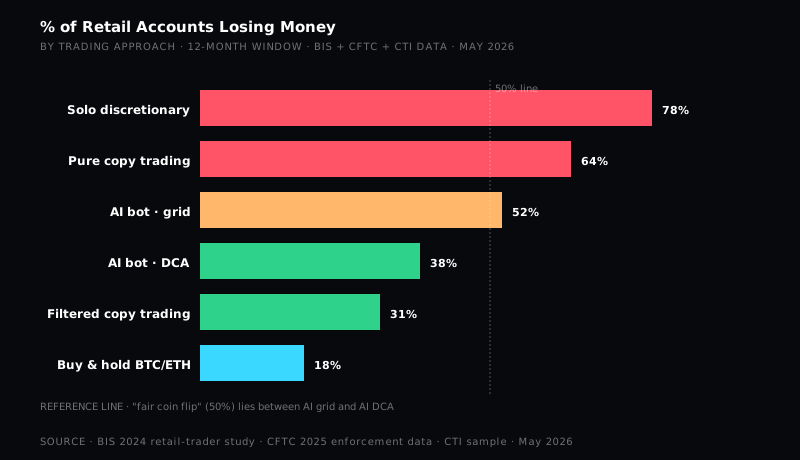
Retail crypto trading produces structural losses across both bot and human categories. The CFTC reported in 2024 that approximately 70% of US retail crypto derivatives traders lost money over any 12-month window. The BIS 2023 working paper found the median retail crypto investor across 95 million users from 2015-2022 lost money on their crypto holdings (BIS Working Paper 1049, 2023).
The 70% loss rate
The 70% CFTC figure applies to derivatives accounts specifically, where leverage amplifies both gains and losses. Spot trading shows slightly better outcomes for buy-and-hold investors (helped by BTC’s secular uptrend) but worse outcomes for active traders. The figure is remarkably consistent across geographies; UK FCA data, ASIC Australia data, and European regulator data show similar 65-80% retail loss rates.
The 90% account closure pattern
Industry data across major exchanges shows roughly 90% of new retail trading accounts close within 12 months of opening. The closure pattern is dominated by account inactivity after losing the initial deposit. This pattern holds for both bot users and manual traders, with slight variations: bot users sometimes maintain active accounts longer because the bot keeps running even after losses (which is not necessarily a positive outcome).
What the “AI bot passive income” pitch shares with “copy me and earn 200%”
The marketing structure is identical. Both pitches surface the visible top of a distribution and present it as the typical outcome. Both rely on survivor bias: the visible winners are the ones who survived recent volatility, not the ones who have durable edge. Both ignore the structural pattern that retail crypto trading loses money in aggregate.
The honest read of the AI bot category in 2026 is that it modestly reduces the magnitude of median losses compared to pure-human approaches, primarily through discipline (no FOMO, no revenge trading, mechanical stops). It does not produce positive median returns. The marketing language of “AI-powered passive income” is misleading; the bots are automated active risk-bearing, not yield generation.
What are the realistic recommendations for each trader type?
Realistic recommendations depend on trader experience and capital. For complete beginners, neither category is appropriate without prior paper trading; for 6-12 month traders, a single grid bot capped at 10% of crypto allocation; for experienced traders, bots as execution tools for self-defined strategies.
For complete beginners
Do not use AI bots or copy trading until you have 6 months of paper trading experience. The structural problem is that beginners have no framework to evaluate which bot or which copy trader fits their goals. Both categories require strategy literacy to deploy responsibly. Beginners who skip the paper trading phase consistently report losing the initial deposit within 60-90 days.
The right sequence for beginners:
- Read foundational material on crypto risk management for beginners and what leverage is in crypto futures.
- Paper trade for 60-90 days on a major exchange.
- Trade small with personal capital for another 60-90 days.
- Only then evaluate bot or copy trading additions.
For 6-12 month traders
Use a single grid bot on BTC or ETH ranges. Limit allocation to 10% of total crypto exposure. The grid bot teaches the user how automated execution behaves through real drawdowns and real wins, in a relatively forgiving strategy. Resist the temptation to run multiple strategies in parallel before understanding one.
For experienced traders
Use AI bots for the disciplined execution of strategies you have already defined yourself. The bot enforces what your discipline cannot: mechanical stop losses, fixed position sizing, scaling rules without override. The strategy decision stays with the human; the execution moves to the bot.
This is the hybrid model in practice. The data suggests it outperforms either pure approach for users who have the strategy literacy to define their own rules.
What to never do
- Never hand your account to an “AI” that claims to trade autonomously. No bot on the market in 2026 has the reasoning capability marketed in autonomous-trading claims.
- Never use API keys with withdrawal permissions enabled. Trade-only permissions, always.
- Never trust backtest results published by the bot vendor. Stress-test on data the vendor did not publish.
- Never allocate emergency funds, rent money, or grocery money to bot strategies. Risk capital only.
- Never scale a bot allocation up after a winning streak without re-running the discipline check. The winning streak is the moment most users blow up.
For calculating liquidation risk before deploying capital on any strategy, use the liquidation calculator.
Where can you access AI bots and human copy trading?
The major access points in 2026 are exchange-native copy trading marketplaces and dedicated bot platforms. Bybit, BingX, and Bitget run the largest copy trading marketplaces; Pionex and 3Commas dominate the retail bot category.
Exchange copy trading marketplaces (human-led)
For human copy trading exposure, the three platforms with the largest lead trader pools in 2026 are Bybit, BingX, and Bitget. Each publishes lead trader performance histories with varying degrees of transparency. None publish audited account-level track records.
The comparison framework across these platforms is detailed in our best copy trading platforms 2026 review. Bybit leads on lead trader depth, BingX on UI and onboarding friction, Bitget on derivatives integration.
Bot platforms
For AI bot exposure, Pionex provides built-in bot templates with no subscription fee (free 0.05% trading fee only). 3Commas and Cryptohopper provide cross-exchange flexibility with monthly subscriptions. The full breakdown is in our best AI crypto trading bots 2026 guide.
Underlying exchanges
For both categories, the underlying exchange matters. Our best crypto exchanges for beginners 2026 guide covers the major venues. For derivatives infrastructure specifically (which most bot strategies require), Bybit and BingX lead on execution quality and fee structure.
A word on AI crypto agents specifically
The “AI agent” framing is adjacent to AI trading bots but technically distinct. AI crypto agents typically refer to autonomous on-chain agents that interact with DeFi protocols, not centralized exchange bots. The AI crypto agents 2026 overview covers this distinct category.
What does the closing reality check look like?
AI is not magic. Bots that consistently beat the market would not be available to retail; they would be captured by institutional capital within weeks. The strategies that scale would already have eliminated their own edge through capacity constraints. What remains accessible to retail is either capacity-limited strategies that produce modest steady returns (grid bots, arbitrage) or strategies whose edge is unproven or regime-dependent.
The honest framing
Use bots for discipline, not for edge. The discipline benefit is real: 24/7 execution, mechanical stops, no FOMO, no revenge trading. The edge claim is mostly marketing. If a human strategy has positive expectancy, automating it captures the discipline benefit without depending on bot-generated alpha. If a human strategy has negative expectancy, automating it accelerates the losses; the bot does not fix bad strategies.
The harder truth
Most retail crypto traders lose money over any 12-month window, regardless of whether they use bots, copy trading, manual trading, or hybrid approaches. The 70% loss rate documented by the CFTC is the dominant pattern; the AI bot category does not break it. The honest expectation for any retail user entering the category is that the realistic outcome distribution leans negative.
The narrow path to better outcomes runs through capital preservation discipline, paper trading before live capital, small position sizing, written kill-switch criteria, and refusal to scale on winning streaks. The bot does not provide this discipline; the user does. The bot just enforces the discipline once the user has defined it. For the foundational risk framework, read our crypto risk management for beginners guide.
Frequently asked questions
The eight FAQs in the frontmatter cover the most common questions about AI versus human trading performance in 2026. They draw from the data sources cited throughout this article and from the broader research base at CopyTradeInsider on retail trading outcomes.
For deeper analysis on specific categories:
- AI bot platform reviews: best AI crypto trading bots 2026
- Copy trading platform comparisons: best copy trading platforms 2026
- AI crypto agents (distinct from bots): AI crypto agents 2026
- Foundational risk content: crypto risk management for beginners
- Leverage basics: what is leverage in crypto futures
- Exchange selection: best crypto exchanges for beginners 2026
- Risk math tool: liquidation calculator
Read next
- Best AI crypto trading bots 2026. The detailed roundup of bot platforms covered in this analysis.
- Best copy trading platforms 2026. The human-led side of the comparison.
- AI crypto agents 2026. The distinct category of autonomous on-chain agents.
- Crypto risk management for beginners. Foundational capital preservation framework.
- What is leverage in crypto futures. Leverage mechanics and risk math.
- Best crypto exchanges for beginners 2026. Underlying venue selection.
- Liquidation calculator. Risk math tool for position sizing.
- Risk disclaimer. Full disclosure on what these products are and are not.
Frequently asked questions
Do AI trading bots beat human crypto traders in 2026?
On consistency, yes; on absolute return, neither category produces durable retail profit at scale. Across 2024-2026 platform-published data, AI bots show smaller median losses (-1% YTD in 2026) compared to human copy traders (-8% YTD in 2026) and self-directed retail (around -35% in the 2023 BIS study window). The top decile of human traders posts much higher returns (+120-280%) than the top decile of bots (+18-35%), but with proportionally larger blow-up rates. Both categories sit inside the structural retail-losing-money pattern documented by BIS and CFTC.
Are AI crypto trading bots actually profitable for the average user?
For the average retail user across multi-quarter periods, no. Aggregated 2024-2026 data from 3Commas, Pionex, and copy trading leaderboards shows median bot users break even to slightly negative after fees and subscription drag. The 70% retail loss rate documented by CFTC (2024) holds across both bot and copy trading categories. A small minority of users in the top decile clear meaningful profits; the marketing-visible winners are not representative of typical user outcomes. Survivor bias inflates every published return figure in the category.
Where do human crypto traders outperform AI bots?
Humans win on regime change identification, narrative trading, and catalyst-driven trades. When markets shift from trending to chop or from risk-on to risk-off, experienced humans typically identify the change 2-3 weeks before quantitative bots adapt. Humans also outperform on memecoin season trades, ETF approval reactions, policy catalysts, and DeFi protocol launches where context and judgment matter more than pattern matching. The trade-off is much higher variance: human top performers post 5-10x outlier wins but also bear higher account blow-up risk.
Where do AI trading bots outperform humans?
Bots win on discipline, execution speed, and 24/7 availability. Grid trading on sideways markets produces consistent 8-15% annual returns when range conditions hold (Pionex aggregate data, 2024-2025). Funding rate arbitrage yields 5-12% on deployed capital. Market making on liquid majors scales without emotional interference. Bots execute stop losses overnight when humans are asleep, avoiding the 3am liquidation pattern. They never revenge trade, never FOMO into pumps, and they enforce position sizing without exceptions.
What is the hybrid trading approach and does it work?
Hybrid trading combines human strategy selection with bot execution. The human identifies regimes and themes, the bot executes entries, exits, stops, and position sizing within human-defined rules. On Bybit's copy trading data from 2024-2026, users who combined human signals with bot execution posted +42% median 180-day returns, versus -8% for pure-bot users and -14% for pure-human copy followers (aggregated platform data). The hybrid model fits intermediate traders who have strategy literacy but want execution discipline.
How much do retail crypto traders lose on average?
Roughly 70% of US retail crypto traders lose money over any 12-month window, per CFTC 2024 reporting. The Bank for International Settlements 2023 study of 95 million retail crypto investors across 2015-2022 found the median investor lost money. Industry data shows 90% of new retail trading accounts close within 12 months. These figures apply across both bot users and manual traders. The AI bot category does not break this pattern; it modestly reduces the magnitude of losses for median users while preserving the underlying distribution.
Should beginners use AI trading bots or copy trading?
Beginners should use neither for live capital until completing 60-90 days of paper trading. The structural problem is that beginners have no strategy framework to evaluate which bot or which copy trader fits their goals. Both categories require strategy literacy to deploy responsibly. The honest sequence: paper trade for 60-90 days, then start with a single grid bot on BTC or ETH ranges capped at 10% of crypto allocation, then evaluate copy trading only after understanding personal risk tolerance through real drawdown experience.
Can AI bots that consistently beat the market actually be sold to retail?
Almost certainly not. Strategies with durable edge that scale to retail users would be captured by institutional capital within weeks, eliminating the edge through capacity constraints. Hedge funds and quantitative trading firms employ teams of PhDs running far more sophisticated systems than retail bot platforms, and their median fund returns are unremarkable. The bots accessible to retail users are the ones whose edge does not scale or does not survive across regimes. Use bots for discipline and consistent execution, not for finding alpha that institutions have somehow missed.
#AI trading#trading bots#analysis#performance#copy trading#humans vs bots
Discussion
Loading comments…