
Trading bots are one of the loudest themes in crypto right now, and the grid bot is the one most people meet first. The pitch sounds great: let software buy low and sell high all day while you do nothing. The reality is more nuanced and worth understanding before you switch one on. In plain terms, a grid trading bot automates buying and selling inside a price range you choose, harvesting small profits from the price bouncing around. This guide explains how grid bots work, when they win, when they quietly lose, and where to run one.
Not financial advice. This is general education, not a recommendation to run a bot or trade any asset. Automation does not remove risk, it can amplify a bad strategy, and you can lose money. Read our risk disclaimer and do your own research first.
Key takeaways
- A grid bot splits a price range into levels and repeats buy-low-sell-high automatically as the price oscillates.
- It is built for sideways, ranging markets. In a strong trend it underperforms or accumulates a losing position.
- A spot grid risks holding a fallen asset. A futures grid adds leverage and liquidation risk.
- It automates execution, not judgment: you still pick the pair, the range, and when to stop.
- Bots are not free money. Profit depends on the market, the range, and fees, not on the bot being clever.
What a grid trading bot is
A grid bot is a simple rule running on repeat. You pick a price range, say a coin you expect to trade between two levels, and the bot divides that range into a grid of evenly spaced lines. It places buy orders at the lower lines and sell orders at the upper ones. Every time the price dips to a buy line it buys, and every time it rises to a sell line it sells what it just bought a little lower. Each completed pair banks a small profit from that one swing.
The appeal is that it never sleeps and never gets emotional. It does not panic-sell or chase a pump. It just mechanically harvests the chop. The catch, which the hype tends to skip, is that this only works while the price actually stays in the range.
How a grid bot works
The mechanic is easier to see than to describe.
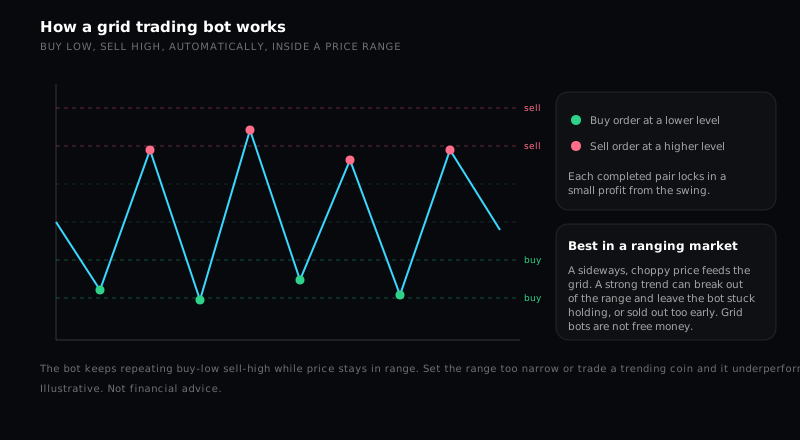
As the price wanders up and down inside the range, the bot fills buys near the bottom and sells near the top, again and again. More grid levels mean denser, smaller trades, fewer levels mean bigger, rarer ones. The whole strategy lives or dies on one assumption: that the price keeps coming back into the range.
When grid bots win and when they lose
This is the part that separates people who profit from bots from people who blame them. A grid bot wins in a sideways, choppy market, the kind that frustrates manual traders, because every wiggle is a chance to bank a small gain. It loses, or at least disappoints, in a trend.
In a strong uptrend, the bot sells its coins at the lower sell lines and then watches the price leave the range without it, so it underperforms simply holding. In a sustained downtrend, it keeps buying at each lower level, so you end up averaging into a position that just keeps falling. The bot did exactly what it was told. The market just was not the one it was built for. Match the tool to the market, and most disappointment disappears.
Spot grid vs futures grid
There are two flavours and the risk gap between them is huge. A spot grid trades coins you actually own, so the worst case is being left holding an asset that dropped. A futures grid runs the same idea with leverage, which magnifies the small swings it harvests but also magnifies losses, and a move that breaks your range can trigger a liquidation that wipes your margin. If you do not yet understand how a margin call and liquidation work, you are not ready for a futures grid. Learn on spot first.
Grid vs DCA bot
People often confuse the two. A grid bot actively trades a range to profit from swings. A DCA bot passively buys a fixed amount on a schedule to build a long-term position, ignoring the short-term noise. Grid suits a sideways market, DCA suits long-term accumulation regardless of timing. They solve different problems, and plenty of people use DCA for the core stack and a grid only when they specifically expect chop.
The risks
- Trend risk. The big one: a breakout from your range turns the strategy against you.
- Leverage risk. Futures grids can liquidate. A losing spot grid only leaves you holding.
- Fee drag. Frequent trades mean fees add up, so a thin profit per swing can be eaten alive.
- Range error. Set it too narrow and the price leaves immediately, too wide and trades are rare.
- Automation bias. A running bot feels safe, which tempts people to stop watching the market.
Where to run a grid bot
The cleanest option is a built-in bot on a mainstream exchange, where there is no separate subscription and you are not handing API keys to a third party. BingX offers Spot, Futures and Infinity Grid plus an AI assistant, covered in our BingX trading bots guide, and you can trade on BingX or read our BingX review first. KuCoin has its own grid, DCA and rebalance bots, and our best AI crypto trading bots roundup compares third-party options and their real limits. Whatever you pick, start small, and if you fund with stablecoins see is USDT safe.
Bottom line
A grid trading bot is a clean way to automate buy-low-sell-high inside a range, and in a sideways market that can quietly work. But it is a strategy, not a money printer: it underperforms in trends, a futures version can liquidate, and frequent trades rack up fees. Understand the market it is built for, set the range with care, start small, and remember the bot automates your plan, it does not supply the judgment. Used with eyes open, it is a useful tool. Treated as free money, it is a fast way to learn an expensive lesson.
This article is general information, not financial advice. Trading bots and leverage carry real risk and you can lose money. Read our risk disclaimer, do your own research, and never trade money you cannot afford to lose.
Frequently asked questions
What is a grid trading bot?
A grid trading bot is automation that buys and sells inside a price range you set. It splits the range into levels, places buy orders at the lower ones and sell orders at the upper ones, and repeats buy-low-sell-high as the price oscillates. The point is to harvest small profits from choppiness without you placing each order by hand. It is a strategy on autopilot, not a profit guarantee.
Are grid trading bots actually profitable?
They can be in a sideways, ranging market, which is exactly what they are built for, but they are not free money. A grid bot underperforms in a strong trend: if the price breaks above your range it sells too early and misses the upside, and if it breaks below, the bot keeps buying into a falling market. Profitability depends on picking the right market, range, and fees, not on the bot being magic.
What is the difference between a grid bot and a DCA bot?
A grid bot trades a range, buying and selling repeatedly to profit from swings, so it suits sideways markets. A DCA bot simply buys a fixed amount on a schedule to build a long-term position, ignoring short-term wiggles. Grid is active range-harvesting, DCA is passive accumulation. Many people use DCA for long-term holding and a grid only when they expect a coin to chop sideways.
When do grid bots lose money?
Mostly in trending markets. In a sustained downtrend the bot keeps buying at each lower level, so you accumulate a losing bag. In a sharp uptrend it sells out near the bottom of the move and watches the price run away. Setting the range too narrow, trading an illiquid coin, or ignoring fees on frequent trades also eats returns. Grid bots reward range, they punish trends.
Is a futures grid bot riskier than a spot grid bot?
Yes, much. A spot grid uses your own coins, so the worst case is holding an asset that fell. A futures grid adds leverage, which magnifies both the swings it harvests and the losses, and a move that breaks your range can trigger liquidation and wipe the margin. Beginners should learn on spot grids first, if at all, and treat futures grids as high risk.
Do I need to watch a grid bot or is it fully automatic?
It runs automatically, but it is not set-and-forget. You still choose the pair, the range, and the number of levels, and you need to react when the market clearly leaves your range, otherwise the bot keeps executing a plan that no longer fits. Think of it as automating the execution of your strategy, not as replacing your judgment about the market.
Where can I run a grid trading bot?
Several mainstream exchanges have built-in grid bots with no extra subscription, just standard trading fees. BingX offers Spot, Futures and Infinity Grid plus an AI assistant, and KuCoin has grid, DCA and rebalance bots. Running a bot on the exchange avoids handing API keys to a third party. Always start small and check the live fees. This is general information, not financial advice.
#grid trading#trading bots#automation#AI trading#crypto#2026
Discussion
Loading comments…