
Leverage is what turns a calm crypto position into one that can be wiped out in seconds, and a margin call is the alarm bell along the way. In plain terms, a margin call is a warning that your leveraged position is running low on collateral, telling you to add funds or cut size before the exchange closes the position for you. Understanding how it works, and how liquidation follows, is the difference between managing risk and getting caught out. This guide explains margin calls, how liquidation happens, and the practical ways to avoid it.
Not financial advice. This is general education, not a recommendation to use leverage or trade derivatives. Leverage multiplies losses as well as gains, liquidations are common, and most leveraged retail traders lose money. Read our risk disclaimer and do your own research first.
Key takeaways
- A margin call warns that your equity has fallen to the maintenance margin and you must add funds or reduce the position.
- Liquidation is what follows if you do not act: the exchange force-closes the position to stop further loss.
- Higher leverage means a smaller gap to the liquidation price, so a small move can wipe out the margin.
- You avoid it with lower leverage, a margin buffer, a stop-loss, and isolated margin.
- Leverage is high risk and unsuitable for most beginners. Spot trading is far more forgiving.
What a margin call is
When you trade with leverage, you put up some collateral, called margin, and the exchange lets you control a larger position. That magnifies both gains and losses. As a losing trade eats into your collateral, your account equity falls. A margin call is the point where that equity drops to the maintenance margin, the minimum the exchange requires to keep the position open. It is a warning: add more margin or reduce the position, or you risk being closed out.
How a margin call leads to liquidation
The path from a healthy position to a liquidation is short and worth picturing clearly.
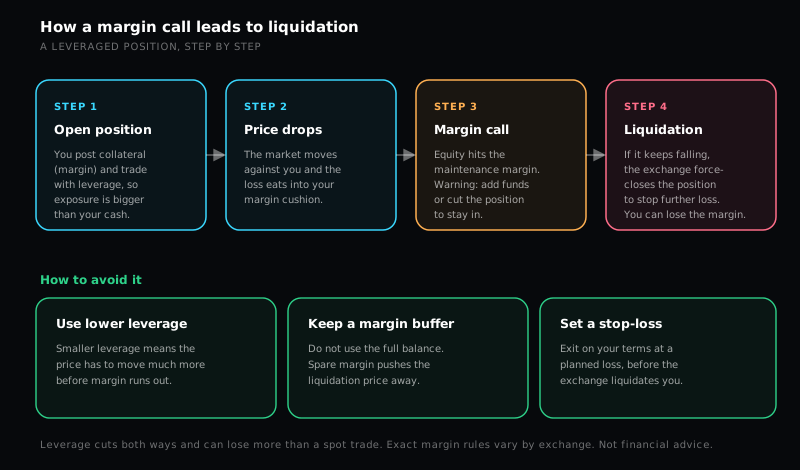
You open a leveraged position backed by margin. The price moves against you, and the loss eats into that margin. When your equity reaches the maintenance level, you get the margin call. If you add funds or cut the position, you stay in. If you do nothing and the price keeps falling, the exchange liquidates: it force-closes the position at the market price to prevent your balance going negative, and you can lose the margin on that trade. In fast markets, the warning and the liquidation can arrive almost together.
Margin call vs liquidation
People use the terms loosely, but they are not the same. The margin call is the warning, the moment your equity hits the maintenance margin. Liquidation is the action, the forced close that happens if you do not respond. The practical lesson is not to count on the warning buying you time. In a sharp move there may be no meaningful gap between the two, so your risk controls have to be set in advance, not improvised when the alert fires.
Why liquidations happen
- High leverage. The more leverage, the smaller the distance between your entry and your liquidation price, so a small move is enough.
- Volatility. Crypto can wick hard and fast, hitting liquidation levels in seconds.
- Thin buffer. Using your whole balance as margin leaves no room to absorb a move.
- Funding costs. On perpetuals, funding payments quietly drain margin if you hold against the crowd.
- Cross margin. Cross margin can pull from your entire balance, turning one bad trade into a bigger loss.
How to avoid liquidation
- Use lower leverage. This is the single biggest lever. Lower leverage pushes the liquidation price far from the current price.
- Keep a margin buffer. Do not deploy your full balance. Spare margin moves your liquidation price away.
- Set a stop-loss. Decide your exit before you enter, and leave on your terms at a planned loss rather than waiting for a force-close.
- Prefer isolated margin. It caps the loss to the margin on one position instead of risking your whole balance.
- Watch funding. On perpetuals, check the funding rate so costs do not erode your margin while you wait.
We compare trading and funding costs across venues in BingX vs Bybit vs KuCoin fees, and if your collateral is a stablecoin, see is USDT safe.
A note on leverage and risk
It is worth being blunt: leverage is high risk, and the majority of leveraged retail traders lose money. The math is unforgiving, because a loss that would be a scratch on a spot position can be a full wipeout with leverage. If you are still learning, spot trading without leverage is far more forgiving, and building a watchlist matters more than chasing leverage, as we cover in the best crypto to buy in June 2026. If you ever do use leverage, start tiny and treat strict risk controls as mandatory.
Bottom line
A margin call is the warning that your leveraged position is running out of collateral, and liquidation is the forced close that follows if you ignore it. The mechanics are simple, but they move fast, and high leverage leaves almost no room for error. If you trade with leverage, the defenses are equally simple: smaller leverage, a real buffer, a stop-loss set in advance, and isolated margin. When you are ready to check the live figures, you can review them on BingX or read our BingX review first.
This article is general information, not financial advice. Leverage is high risk and can lead to rapid, total loss of your margin, and it is unsuitable for most people. Read our risk disclaimer, do your own research, and never trade money you cannot afford to lose.
Frequently asked questions
What is a margin call in crypto?
A margin call is a warning that your leveraged position is running low on collateral. When losses push your account equity down to the maintenance margin, the minimum the exchange requires to keep the position open, you are told to add funds or reduce the position. If you do nothing and the price keeps moving against you, the exchange liquidates the position to stop further loss.
What is the difference between a margin call and liquidation?
A margin call is the warning, liquidation is the action. The margin call says your equity has fallen to the maintenance level and you need to add margin or cut size. Liquidation is what happens next if you do not, the exchange force-closes the position at the market price. In fast crypto markets the two can happen almost together, so do not rely on having time to react.
How do I avoid liquidation in crypto trading?
Use lower leverage so the price has to move much further before your margin runs out, keep a buffer instead of using your full balance, and set a stop-loss to exit on your own terms before the exchange does. Using isolated margin caps the loss to one position, and watching funding costs on perpetuals stops them quietly draining your margin. The simplest protection is smaller size.
What is maintenance margin?
Maintenance margin is the minimum equity you must keep to hold a leveraged position open. As losses eat into your collateral and your equity approaches that floor, you get a margin call. Drop below it and liquidation follows. Higher leverage means a thinner gap between your entry and the maintenance level, so the price does not have to move much to put you at risk.
Can I lose more than I put in with leverage?
On most major crypto venues, liquidation is designed to close your position before your balance goes negative, so your loss is usually capped at the margin on that position. But in extreme, fast moves a position can be closed at a worse price than the liquidation level, and some products or venues differ. Treat leverage as capable of wiping out the full margin quickly, and never assume you are fully protected.
Why did I get liquidated so fast?
Usually a mix of high leverage and a sharp move. With high leverage the distance between your entry and your liquidation price is small, so a quick wick can hit it in seconds. Thin liquidity, a funding payment, or using cross margin that pulls from your whole balance can speed it up. Lower leverage and a margin buffer are the main defenses against fast liquidations.
Is leverage trading a good idea for beginners?
For most beginners, no. Leverage multiplies losses as much as gains, liquidations are common, and the majority of leveraged retail traders lose money. If you are learning, spot trading without leverage is far more forgiving. If you ever do use leverage, start very small, use strict risk controls, and only risk money you can afford to lose. This is education, not financial advice.
#margin call#liquidation#leverage#futures#risk#2026
Discussion
Loading comments…