
Not financial advice. This is a research note for educational purposes only. Nothing here is a recommendation to buy, sell, or hold TRX or any other asset. Crypto is highly volatile and you can lose your entire investment. Past performance does not predict future results. Always do your own research (DYOR), consult a qualified financial advisor, and verify what is legal in your jurisdiction. Read the risk disclaimer before continuing.
TL;DR
If you searched “TRX price prediction July 2026,” you want a number, and we are not going to invent one. What we can tell you is why Tron is the odd one out. While Bitcoin fell to around $62,500 by late June 2026 and high-beta alts fell harder, TRX held near $0.33. That is not luck. It is what happens when a token is tied to stablecoin settlement revenue rather than pure speculation.
The short version: TRX trades near $0.33 as July opens, it is the rank-8 asset by market cap, and its price is anchored to one real-world thing, the enormous volume of USDT moving across Tron. The catalysts to watch are the staked-TRX ETF process, the quantum-resistance upgrade, and stablecoin volume itself. Read this as a map of those drivers, not as a forecast.
Key takeaways
- This is a framework, not a target. We do not print a July TRX price or assign probabilities.
- TRX trades near $0.33 going into July 2026 and stayed unusually stable through the market drawdown.
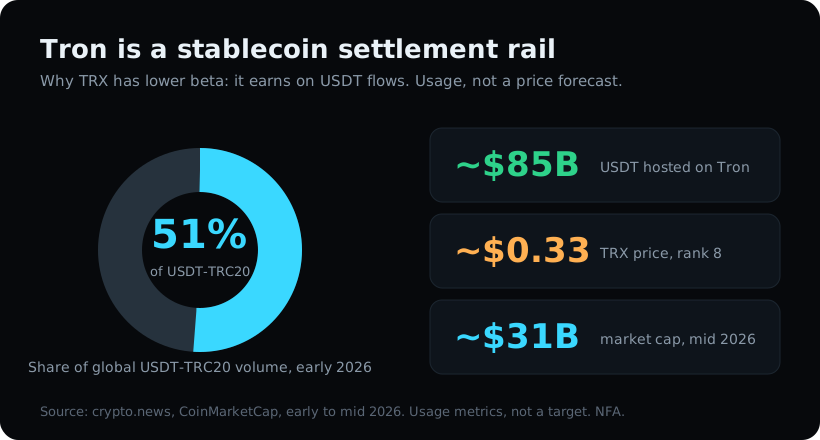
- Tron hosts roughly $85 billion in USDT and handled about half of global USDT-TRC20 volume in early 2026.
- Catalysts in play: the Canary staked-TRX ETF filing, a quantum-resistant upgrade, and stablecoin volume trends.
- Lower volatility is not low risk. Founder concentration and stablecoin regulation are real risks. NFA. DYOR.
Where TRX sits going into July 2026
The headline fact is the one most coins cannot claim in mid 2026: relative stability. TRX trades near $0.33 as July opens (CoinMarketCap, June 2026), with a market cap around $31 billion and a rank of 8. Through a year when the broad market fell hard, including Bitcoin dropping to roughly half its October 2025 high, TRX moved far less than high-beta names like SOL. For the macro behind the wider sell-off, see why Bitcoin is down.
Why the calm? Because TRX is less a bet on a narrative and more a claim on a cash-flowing network. That changes how you should think about it. The questions that matter for TRX are not “what is the next hype cycle” but “is stablecoin volume growing, is the revenue holding, and what could break the rail.” Those are answerable, durable questions, which is exactly why the price is steadier.
What actually drives TRX: USDT settlement
Most layer-1 tokens are valued on future promise. Tron has an unusual amount of present-tense usage, and it is concentrated in one thing: moving stablecoins.
- The USDT base. Tron hosts roughly $85 billion in USDT and handled about half of all global USDT-TRC20 transfer volume in early 2026 (crypto.news). For large parts of the world, Tron is the default rail for moving dollars on-chain, because fees are low and settlement is fast.
- Revenue, not just narrative. That volume generates real, recurring network fees. A token tied to settlement revenue has a floor of demand that a pure-speculation token does not, which is the mechanical reason TRX has lower beta.
- Staking yield. Holders can delegate TRX to a Super Representative, keep custody, and earn a protocol yield plus Bandwidth and Energy for fee-free transactions. Yield supports the long-term holding case, though it never cancels price risk.
If you track one thing for TRX, track USDT volume on Tron. It is the engine. When it grows, the bull case strengthens. If it migrates to other chains, the core thesis weakens.
What is happening for TRX in July 2026
The near-term, datable items for the month are a mix of catalysts and ongoing trends.
- The staked-TRX ETF. Canary Capital filed an amended S-1 for a staked-TRX ETF on May 15, 2026. Any progress, delay, or decision is a sentiment catalyst, and a US product would widen access. The process, not a guaranteed approval, is what to watch.
- The quantum-resistance upgrade. Tron has targeted a quantum-resistant testnet in Q2 2026 and mainnet in Q3, positioning itself as an early mover on post-quantum security. July sits in the window where milestone headlines can land.
- Stablecoin volume and regulation. The USDT base is the foundation, so its growth trend matters every month. Stablecoin regulation cuts both ways: clear rules can legitimize the rail, harsh rules can pressure it.
- The macro tide. Even a lower-beta token moves with broad risk appetite. A risk-off month still drags TRX, just typically less than it drags the high flyers.
How to read any TRX price prediction
Same caution as every coin, with a Tron-specific twist. The general caution: analyst targets are right maybe 35 to 45 percent of the time over a few months, and published 2026 TRX ranges disagree widely. We cover why prediction fails in can AI predict crypto prices.
The Tron-specific twist: because TRX is lower-volatility, predictions can look more precise and more confident than they deserve to. A tight range around $0.33 feels safe, but it is still a guess, and it can be wrong in either direction if the stablecoin thesis or the leadership story changes. When you read a TRX target, check whether it is built on the revenue story or just a chart. If it ignores USDT volume and the founder-concentration risk, it is ignoring the two things that actually decide Tron’s path.
What each side needs in July (conditional, not predicted)
Instead of a number, here is what would have to be true for each path. Neither is a forecast.
- For a stronger July, TRX would lean on growing USDT settlement and fees, positive ETF progress, a clean quantum-upgrade milestone, and broad risk-on. The revenue link makes the bull case more durable than a hype-driven one when conditions cooperate.
- For a weaker July, TRX would face shrinking stablecoin volume or migration to rival chains, stablecoin or Tron-specific regulatory pressure, any governance or key-man shock, and broad risk-off. Steady is not bulletproof.
How to use this
A monthly TRX guess is not a plan. Two things are. First, size the position for the risk that actually exists here, which is not daily volatility but thesis risk: founder concentration and stablecoin regulation. Our crypto risk management basics cover sizing that survives a thesis breaking. Second, if you stake TRX for yield, remember a yield on a falling asset can still lose money in dollars, so treat staking as a feature, not a hedge. For how to weigh any coin rather than chase a ranking, see our best crypto to buy watchlist.
TRX is liquid on every major venue. BingX and KuCoin both run deep TRX markets for spot and staking. Where you trade is a detail. Whether you understood what you were buying, a stablecoin toll road with real revenue and real key-man risk, is the part that matters.
Not financial advice. Nothing above is a recommendation. This article does not predict the July 2026 TRX price and does not assign probabilities to any outcome. Crypto is highly volatile and you can lose everything. Do your own research and speak to a qualified advisor before investing. Read the full risk disclaimer.
Frequently asked questions
What is the TRX price prediction for July 2026?
We do not publish a single number, on purpose. Honest answer: TRX trades near $0.33 going into July 2026, and it has been unusually stable while the rest of the market fell hard. Where it goes next depends on USDT settlement volume, the staked-TRX ETF process, the quantum-resistance rollout, and the broad market, none of which is knowable in advance. This article maps those drivers instead of inventing a target.
Why did TRX hold up while other coins crashed in 2026?
TRX behaves less like a speculative tech token and more like a toll road on stablecoin flows. Tron hosts roughly $85 billion in USDT and handled about half of global USDT-TRC20 transfer volume in early 2026, which generates steady network revenue regardless of price. That revenue base gives TRX lower beta than high-volatility alts like SOL. It still falls in a broad sell-off, just usually less far.
What is driving Tron in July 2026?
Four things. The volume of USDT settling on Tron and the fees that produces, the progress of the Canary staked-TRX ETF filing from May 2026, the quantum-resistant upgrade (testnet in Q2 2026, mainnet targeted for Q3), and the broad crypto risk environment. The stablecoin-rail revenue is the foundation, the ETF and upgrade are potential catalysts on top, and macro is the tide under all of it.
Can I earn yield staking TRX?
Yes. You can delegate TRX to a Super Representative while keeping custody of your keys, earning a protocol yield plus Bandwidth and Energy that let you transact without paying standard fees. Staking yield is part of the long-term TRX case, but it does not protect you from price drawdowns. A yield on a falling asset can still lose money in dollar terms. Treat yield as a feature, not a safety net.
How accurate are TRX price predictions?
Historically poor, like all crypto targets. Studies put named analyst accuracy near 35 to 45 percent over a few-month horizon, missing both direction and magnitude more often than not. TRX is lower-volatility than many alts, which can make ranges look tighter, but tighter ranges are not the same as accurate ones. Treat any specific July TRX figure as a guess, and focus on the drivers instead.
What would move TRX higher in July 2026?
The bullish case leans on growing USDT settlement volume and fees, positive progress on the staked-TRX ETF, a clean quantum-upgrade milestone, and broad crypto risk-on. Because TRX is revenue-linked, sustained stablecoin growth is the most durable tailwind. None of this is a promise, and a single regulatory or execution setback can offset the rest.
What are the main risks for TRX?
Several. Key-man and governance risk given founder Justin Sun's central role, regulatory risk around stablecoins and around Tron itself, competition from other chains chasing stablecoin settlement, and broad crypto risk-off. Lower volatility is not low risk. If the stablecoin-rail thesis or the leadership story breaks, the revenue base that supports TRX can weaken. Size accordingly and do your own research.
#Tron#TRX#USDT#stablecoins#price prediction#DYOR
Discussion
Loading comments…