
Not financial advice. This is a research note for educational purposes only. Nothing here is a recommendation to buy, sell, or hold XMR or any other asset. Crypto is highly volatile and you can lose your entire investment. Privacy-coin rules vary widely by country. Always do your own research (DYOR), consult a qualified financial advisor, and verify what is legal in your jurisdiction. Read the risk disclaimer before continuing.
TL;DR
If you searched “XMR price prediction July 2026,” here is the honest version. Monero trades near $310 as July opens, down from roughly $447 in January 2026 but standing up better than most of the market given what it is up against. We are not going to print a target, because Monero’s price is driven less by charts and more by something charts cannot model: regulation and exchange access.
The thing to understand about XMR is that its biggest catalysts are not on-chain. They are in policy offices and exchange compliance departments. Delistings, anti-money-laundering rules, and where you can still legally trade it move XMR more than any technical level. Read this as a map of those drivers, not as a forecast.
Key takeaways
- This is a framework, not a target. We do not print a July XMR price or assign probabilities.
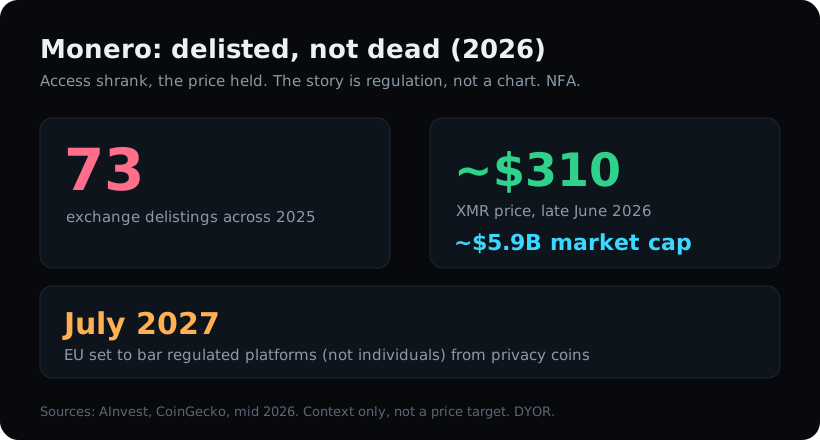
- XMR trades near $310 going into July 2026, down from about $447 in January, with a market cap near $5.9 billion.
- Regulation and exchange access, not chart patterns, are Monero’s dominant price drivers.
- XMR saw 73 exchange delistings in 2025, and the EU is set to bar regulated platforms from privacy coins from July 2027.
- Fragmented liquidity makes XMR price discovery and predictions noisier than for liquid large caps. NFA. DYOR.
Where XMR sits going into July 2026
Monero trades near $310 as July 2026 begins (CoinGecko, June 2026), with a market cap around $5.9 billion. That is down from roughly $447 in January 2026, in line with the broad market drawdown that pulled Bitcoin to around $62,500 by late June. What stands out is not the fall but the resilience: an asset delisted from dozens of major exchanges still holds a multi-hundred-dollar price and hundreds of millions in daily volume. That tells you there is durable demand for what Monero does.
One honest caveat up front. Because XMR liquidity is now spread across fewer venues, quotes vary more between sources than they do for a coin like SOL or BTC. Different trackers showed XMR anywhere from roughly $309 to $333 on the same late-June day. That spread is small, but it is a preview of a bigger theme: with Monero, even the current price is a little fuzzier than usual, and any prediction inherits that fuzziness.
The thing that actually drives XMR: regulation and access
Most coins are driven by adoption, liquidity, and macro. Monero has all of those, but they sit underneath a bigger force. Monero’s defining feature, on-chain privacy, is exactly what makes it hard for regulated exchanges to list. That single fact shapes everything.
- Delistings. The count of XMR exchange delistings reached 73 across 2025 alone (AInvest), as exchanges removed it to avoid anti-money-laundering and travel-rule exposure. Each delisting trims accessible liquidity.
- EU rules. The EU’s anti-money-laundering regulation is set to bar regulated platforms, not individuals, from handling anonymity-enhancing coins from July 1, 2027. That deadline keeps European listing pressure pointed one way.
- US and elsewhere. The US position from the SEC and FinCEN stays cautious rather than settled, while Switzerland and parts of Asia are more permissive. The map is fragmented, and fragmentation itself is a risk because rules can tighten with little warning.
If you only track one thing for XMR, track regulation and listings. They are the swing factor, and they do not show up on a price chart until after they have already moved the price.
What is happening for XMR in July 2026
The datable, near-term items for the month are mostly about access and demand, not upgrades.
- The access trend. Watch whether the listing situation stabilizes or worsens. Each major exchange decision either preserves or removes a chunk of liquidity, and that matters more for XMR than for almost any other large cap.
- Privacy demand. Monero’s case rests on people who want financial privacy. Renewed attention to surveillance, data, or capital controls tends to lift interest in the category. It is a real, recurring driver, and an unpredictable one.
- Supply dynamics. Monero uses tail emission, a small fixed block reward, so new supply trickles in steadily rather than arriving in the large scheduled unlocks that hit many other tokens. There is no big July unlock cliff to fear here, which is a structural difference worth knowing.
- The macro tide. Like every crypto asset, XMR still moves with broad risk appetite set by Bitcoin and Fed expectations. A risk-on month helps, a risk-off month hurts, regardless of the privacy story.
How to read any XMR price prediction
The usual warning applies, then a Monero-specific one on top. The usual warning: crypto analyst targets are accurate maybe 35 to 45 percent of the time over a few months, and published 2026 XMR ranges run from under $200 to well over $400, which means the authors disagree by a wide margin. We unpack why forecasting fails in can AI predict crypto prices.
The Monero-specific warning: thinner, fragmented liquidity makes XMR both more volatile around news and harder to price precisely, so a target built on a clean chart is even shakier than usual. When you see an XMR prediction, the useful question is not “what is the number” but “does this account for regulation and access, or is it just a chart.” If it ignores the listing environment, it is ignoring the main thing that moves Monero.
What each side needs in July (conditional, not predicted)
Rather than a target, here is what would have to be true for each path. Neither is a forecast.
- For a stronger July, XMR would lean on renewed privacy demand, any regulatory clarity or easing in a major market, broad crypto risk-on, and liquidity proving durable despite delistings. The scarcity-plus-utility story can work when sentiment cooperates.
- For a weaker July, XMR would face more delistings, harsher rules, broad risk-off, and thinning depth that widens spreads and amplifies drops. Fewer venues cuts both ways, and it cuts harder on the way down.
How to use this
Two things matter more than any monthly guess. First, position sizing: privacy coins can move violently on news, so size XMR as the higher-risk holding it is and decide your invalidation before you enter. Our crypto risk management basics cover sizing that survives being wrong. Second, self-custody: if you hold XMR for its privacy properties, holding it on an exchange undercuts the point, so learn proper storage. Our cold wallet guide is a starting point.
Where you can actually buy XMR (the honest answer)
Access has narrowed, not closed. KuCoin remains one of the main centralized venues still trading XMR in 2026, with privacy-coin withdrawals requiring Level 2 verification, so it is not a no-KYC route. Beyond centralized exchanges, decentralized exchanges, atomic swaps that send BTC or ETH directly to XMR from your own wallet, peer-to-peer, and instant-swap services are the common paths. Notably, XMR is not listed on every major exchange, BingX among them as of this writing, so do not assume your usual venue carries it. Check availability and legality in your own region first.
Not financial advice. Nothing above is a recommendation. This article does not predict the July 2026 XMR price and does not assign probabilities to any outcome. Privacy-coin rules vary by country and can change quickly. Crypto is highly volatile and you can lose everything. Do your own research and speak to a qualified advisor before investing. Read the full risk disclaimer.
Frequently asked questions
What is the Monero (XMR) price prediction for July 2026?
We do not publish a single target, on purpose. Honest answer: XMR trades near $310 going into July 2026, down from roughly $447 in January but resilient given its headwinds. Where it ends the month depends far more on regulatory and exchange-access headlines than on chart patterns, and none of that is knowable in advance. This article explains the real drivers instead of inventing a number.
Why is Monero delisted from so many exchanges?
Monero's on-chain privacy makes it hard for regulated exchanges to meet anti-money-laundering and travel-rule requirements, so they remove it to reduce compliance risk. The count of XMR exchange delistings hit 73 across 2025 alone. The EU's anti-money-laundering regulation is set to bar regulated platforms, not individuals, from handling anonymity-enhancing coins from July 1, 2027, which keeps pressure on listings.
Where can I actually buy XMR in 2026?
Access has narrowed but not closed. [KuCoin](https://www.kucoin.com/r/af/CXEBGAS3) remains one of the main centralized venues still trading XMR in 2026, with privacy-coin withdrawals requiring Level 2 verification. Beyond that, decentralized exchanges, atomic swaps (BTC or ETH directly to XMR from your own wallet), peer-to-peer, and instant-swap services are the common routes. Availability varies by region, so check what is legal where you live.
Is Monero illegal?
Holding or using Monero is not broadly illegal for individuals in most places as of 2026, but the regulatory picture is fragmented. The EU's MiCA framework imposes stringent reporting rather than an outright ban, the US position from the SEC and FinCEN remains cautious, and Switzerland and parts of Asia are more permissive. Exchange-level restrictions, not personal bans, are the main practical limit. Verify the rules in your own jurisdiction.
How accurate are Monero price predictions?
Lower than usual, and XMR has an extra problem. Crypto analyst targets miss direction and magnitude often, with all-in accuracy near 35 to 45 percent over a few-month horizon. On top of that, XMR liquidity is now fragmented across fewer venues, so price discovery itself is noisier and quotes vary more between sources. That makes any precise XMR target even less reliable than a typical large-cap forecast.
What would move XMR higher in July 2026?
The bullish case leans on privacy demand and scarcity narratives: renewed interest in financial privacy, any easing or clarity in a major jurisdiction, broad crypto risk-on led by Bitcoin, and the fact that delistings have not killed liquidity. Monero's tail emission means low, steady new supply rather than sharp unlock shocks. None of this is a promise, and regulatory headlines can overwhelm all of it.
What would move XMR lower in July 2026?
The bearish case is mostly access and regulation: more exchange delistings, harsher rules in a major market, broad crypto risk-off, and thinning liquidity that widens spreads and amplifies moves. Privacy coins can fall hard precisely because fewer venues means less depth to absorb selling. Treat lower as a real scenario and size any position so a sharp drawdown is survivable.
#Monero#XMR#privacy coins#price prediction#regulation#DYOR
Discussion
Loading comments…