
TL;DR: ChatGPT (GPT-5) and Claude (Sonnet 4.5, Opus 4.6) are useful for crypto research when pointed at the right tasks. They are not good at price prediction, signal generation, or anything requiring live market data. They are good at synthesizing tokenomics, summarizing whitepapers, surface-level smart-contract review, multi-jurisdiction tax math, and prompt-driven research workflows that compress hours of reading into focused output. This playbook covers what works, what does not, the seven prompts worth memorizing, and the mistakes that cost retail researchers real money. The trader who used to spend three hours reading documentation and now spends thirty minutes is the same trader; the language model is an accelerator, not a substitute for judgment.
Not financial advice. Large language models confidently produce wrong answers, especially for obscure tokens, recent events, and any number the model invented instead of read. Verify every figure, contract address, project name, and quoted statistic against a primary source before acting on it. The chat window is a research tool, not an oracle. Read the full risk disclaimer before deploying capital on anything you researched with the help of an AI assistant.
What LLMs are actually good at for crypto
The honest list of things ChatGPT and Claude do well in 2026 is shorter than the marketing implies but longer than the skeptics admit. Both models in their current generation handle synthesis, structured reasoning, and language translation at a level that compresses hours of human research into minutes of focused conversation. The trick is staying inside that envelope and refusing to let the conversation drift into prediction or signal generation.
Synthesis tasks where LLMs add real value
Seven workflows consistently produce useful output:
- Whitepaper digest. Paste a 30-page PDF and ask for a five-bullet summary that covers token utility, supply schedule, team transparency, monetization, and the single biggest risk. The model produces a usable summary in under thirty seconds.
- Tokenomics comparison. Drop in vesting schedules and supply curves from three or four competing projects and ask for a side-by-side comparison table. The model does the alignment work a human researcher would spend twenty minutes on.
- Multi-jurisdiction tax math. Give the model your residence, your trading gains, and the relevant tax brackets, and ask for the effective tax owed with the math shown. This is where Claude and GPT-5 genuinely earn their subscription cost.
- Surface-level smart-contract review. Paste Solidity or Rust code and ask the model to flag owner-only functions, mint capability, fee toggles, transfer pause, and blacklist functions in plain English. This is not a substitute for a formal audit but it catches obvious red flags.
- Documentation summaries. Convert sprawling protocol docs into a structured outline. Useful when researching a new chain or DeFi protocol before spending real time on it.
- Translation. Russian, Chinese, Japanese, and Korean crypto announcements translated into clean English with the technical terms preserved. This replaces specialized translation services for most retail use cases.
- API query writing. Generate Dune SQL, The Graph subgraph queries, or Helius RPC calls from a plain-English description of the on-chain data you want. Saves twenty minutes per query if you do not write SQL daily.
The pattern across all seven: the model is doing language work, not financial work. It is reading, summarizing, comparing, translating, and structuring. Those are tasks where the technology has a real edge over reading documents yourself.

What LLMs are NOT good at
The no-list matters more than the yes-list because the costliest mistakes happen on the no-list. Both ChatGPT and Claude will produce confident-sounding answers to questions they have no business answering, and the user pays for that overreach with real money. Treat the following queries as red flags. If you find yourself typing them, stop and reframe the question.
Six things the model cannot do
- Predict price direction. Even with “all available context,” the model has no edge over the trillions of dollars of capital already trying to predict the same prices. The answer is fluent prose that pattern-matches training data, not a forecast.
- Generate trading signals. A model asked to produce a buy or sell signal for a specific token will produce one, because that is what the prompt asked for. The signal carries no predictive weight. The model is performing the role of “person who gives signals,” not actually analyzing risk and reward.
- Answer “should I buy this token.” Wrong question, wrong tool. Whether you should buy a position depends on your portfolio, your risk tolerance, your time horizon, your country, your tax situation, and your liquidity needs. The model knows none of that.
- Provide real-time market data. Base model knowledge ends at a cutoff date somewhere in 2024 or 2025. Even with browsing enabled, the data is slower and patchier than going directly to CoinGecko or a block explorer.
- Identify rug pulls from a name plus description. The patterns of fraudulent projects are nuanced and adversarial. The model can flag obvious red flags in contract code, but it cannot read social signals, founder backgrounds, or the texture of community behavior that experienced researchers use.
- Read sentiment from Twitter. The model has no real-time access to social posts, no understanding of crypto Twitter’s irony and in-jokes, and no way to distinguish a serious post from a shitpost. Sentiment analysis prompts produce confident output that is mostly noise.
The summary: if the answer requires the model to know what is happening right now, or to forecast what will happen next, you are using the wrong tool.
The 7 prompts I actually use
Seven prompts cover roughly 90 percent of the useful crypto research workflows for both ChatGPT and Claude. Each one is structured to extract specific output and to constrain the model from drifting into prediction territory. Copy these, adapt them to your tokens, and iterate over time. The prompts work better when you paste raw source material into the conversation alongside the instruction.
1. Whitepaper digest
Summarize this whitepaper in 5 bullets. Highlight:
token utility, supply schedule, team transparency,
monetization model, single biggest risk.
Plain language, no fluff.
This is the prompt that does the most work per minute. Paste a full whitepaper as PDF or text and the model returns a structured digest in under a minute. The “plain language, no fluff” line is the key constraint. Without it the output drifts into marketing copy.
2. Tokenomics audit
Calculate the actual circulating supply for [token]
using these inputs: [insert team allocation, vesting
schedule, investor unlocks, treasury, ecosystem fund].
Then calculate the dilution rate over the next 12 months.
Use this when a project publishes a confusing supply table. Paste the table directly. The model does the addition and the time-weighted dilution math, both of which are tedious and error-prone by hand. Verify the final number against on-chain data before acting on it.
3. Multi-jurisdiction tax math
I'm a [country] resident. I made $X in crypto gains in 2025.
Calculate my effective tax owed including [TDS/withholding/
PIT brackets/social contributions]. Show the math step by step.
This is where the language model genuinely earns the subscription cost. Tax math across brackets is mechanical and tedious, and the model does not make arithmetic errors on simple percentage math. Specify country, year, and bracket structure. Always cross-check the final number against your local tax authority’s published guidance.
4. Smart-contract red flags
Read this contract code. Flag in plain English:
owner-only functions, mint capability, fee toggle,
transfer pause, blacklist, hidden approve patterns.
Don't audit; just flag.
The “don’t audit; just flag” line keeps the model in surface-review mode. A full audit is not the goal and the model is not qualified to do one. Surface-level red flags catch the obvious bad contracts that retail investors lose money on every week.
5. News synthesis
Read these 3 articles. Summarize the actual news
versus editorial framing. Identify which specific
claims have data sources and which are speculation.
Paste the article text. The model is good at separating reported facts from opinion overlay, and at flagging unsourced claims. Useful when researching a news event covered across multiple outlets with different framings.
6. Strategy stress-test
I'm considering strategy X with these parameters.
Steelman why it might fail in the next 6 months.
Cover regime change, liquidity, execution, tail risk.
Be brutal.
The word “steelman” matters. It forces the model to make the strongest possible case against your idea rather than the easiest one. The output is often uncomfortable, which is the point.
7. DCA backtest math
Calculate what a $100/week DCA into BTC starting
[date] would be worth today at [current price].
Show monthly accumulation, average entry, current value.
The model handles the math reliably if you specify the start date and end price. Use it for sanity-checking DCA plans rather than as a forecasting tool. Past returns do not predict future returns, but knowing what a strategy would have produced historically helps calibrate expectations.
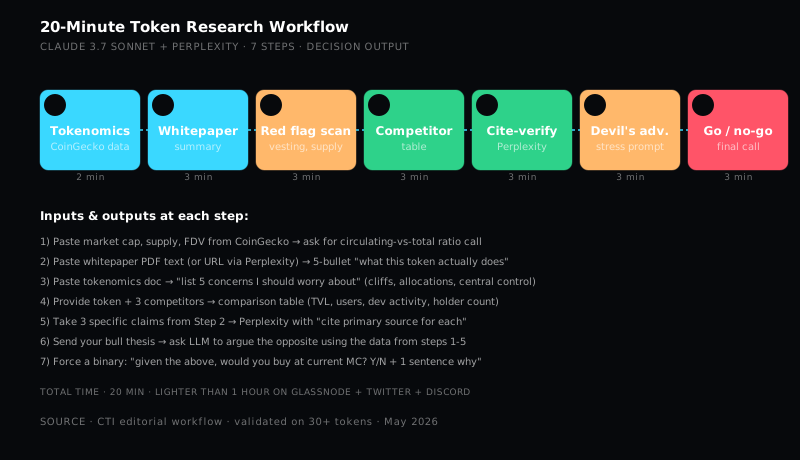
Real workflow: how I research a token in 20 minutes with Claude
A complete token research pass that used to take three hours of reading can be compressed to about twenty minutes when the language model is doing the synthesis work alongside primary-source verification. The workflow below is the one our research desk runs before deciding whether a new token is worth deeper analysis. The model accelerates the reading, but the decision-making stays human.
The 20-minute token research pass
-
Minutes 0 to 5: Primary source overview. Open CoinGecko for the token’s market cap, supply, and historical price action. Open DefiLlama for protocol TVL and chain context if applicable. Note the headline numbers in a scratchpad. This step is non-negotiable and the model cannot do it for you.
-
Minutes 5 to 8: Whitepaper digest. Paste the project’s whitepaper or pitch deck into Claude with the whitepaper digest prompt from the previous section. Read the five bullets. If the “single biggest risk” bullet is “team is anonymous and supply is highly concentrated,” that is enough to pass on most projects.
-
Minutes 8 to 13: Tokenomics audit. Paste the supply table and vesting schedule. Run the tokenomics audit prompt. The output is the dilution rate over the next 12 months. If forward dilution exceeds 50 percent, the token has structural sell pressure that price action has to overcome before you make money.
-
Minutes 13 to 16: Steelman the bear case. Run the strategy stress-test prompt against the project’s value proposition. The model produces three or four critical angles. Two of them are usually weak; one or two land hard. Take those seriously.
-
Minutes 16 to 20: Manual on-chain check. Open Etherscan or the relevant explorer. Verify the contract address from the project’s official channels (not from a chat window output, ever). Check the top 10 holders and the contract verification status. Check GitHub for recent commits and contributor activity.
-
End of 20 minutes: Decide. Buy, pass, or watch. If you cannot decide in twenty minutes after this pass, the answer is usually pass.
The point of this workflow is not that the language model does the research. The point is that the language model does the reading, leaving the human researcher to do the verification and the judgment. Those two activities are where retail investors actually lose or save money.
Where LLMs replace expensive tools
Several paid crypto research tools become redundant when ChatGPT or Claude can do the same work for a fraction of the cost. Not all of them, and not at the same quality, but enough that the cost-benefit math shifts for retail-scale researchers. Below are the four categories where the language model has measurably displaced specialized services.
Translation services for foreign-language crypto news
Russian-language Telegram channels, Chinese WeChat crypto news, Japanese exchange announcements, and Korean DeFi documentation routinely contain information that takes hours to translate professionally. Both Claude and ChatGPT translate technical crypto content with high fidelity and with the jargon preserved. This replaces specialized translation services for retail research budgets.
Tokenomics math and dilution calculators
Paid analytics dashboards offer dilution calculators and vesting schedule visualizers. For straightforward math (total supply, circulating supply, monthly unlock, time-weighted dilution rate), the language model does the work in one prompt. The paid dashboard still wins for visualization and for tracking dilution against price action over time, but for one-off math, the chat window is enough.
Surface-level Solidity code review
Specialized Solidity reviewers cost hundreds of dollars per contract for surface-level red-flag scans. The language model does surface review for free, with the explicit understanding that this is not a production audit. For deployment of contracts that custody real value, a formal audit from firms like OpenZeppelin or Trail of Bits is still required. The cost-benefit shift is on first-pass triage, not on production security.
Retail-scale strategy backtesting
For DCA backtests, simple moving-average crossover backtests, and historical position-sizing exercises, the language model writes Python that runs the math without you opening a Jupyter notebook. This does not replace serious quantitative tooling, but for retail-scale “what would have happened if” questions, it works. See our crypto risk management guide for the position-sizing math worth backtesting.
Critical limits and pitfalls
Six failure modes account for almost every costly mistake that retail researchers make when using language models for crypto research. Knowing the failure modes is the difference between a useful research tool and a confident-sounding source of bad information. The model is wrong in specific, recognizable patterns, and each pattern has a counter-habit.
The six failure modes that lose money
-
Hallucination of numbers, addresses, and project names. Ask GPT-5 for the contract address of an obscure token and the model produces a 42-character hex string that looks correct, compiles in your mental model, and is completely invented. Always copy contract addresses from official project channels or block explorers, never from chat output.
-
Stale training data. GPT-5 and Claude Sonnet 4.5 both have training cutoffs somewhere in 2024 or 2025. Any question about events, prices, or project status that depends on recent reality will produce a confident answer based on outdated context. Verify timeline-sensitive claims against current sources.
-
No real-time price awareness. The model does not know the current price of anything. If a calculation depends on current price, paste the number from CoinGecko yourself. Asking the model for a price is the most common preventable error.
-
No on-chain reads without explicit tools. The base model cannot query Etherscan, read wallet balances, or check transaction history. If your question depends on on-chain state, fetch the data yourself and paste it into the conversation.
-
Confident wrong answers on obscure tokens. The smaller the token’s footprint in the training data, the more likely the model is to confidently invent facts about it. This is especially severe for tokens launched in the last 12 months. Treat any model output about a small-cap token as a hypothesis to verify, not a fact.
-
Prompt injection from untrusted content. Pasting a screenshot of a malicious site, or the text of a phishing email, into the conversation can carry adversarial instructions that the model may follow. Never paste content from sources you do not trust into a chat window where you intend to act on the output.
The defense against all six failure modes is the same: the language model is a synthesizer, not a source of truth. Every numerical claim, every address, every project name needs to be verified against a primary source before any capital moves. See our crypto trading glossary for the terminology that the model often gets right but is worth knowing yourself.
Free vs paid: what’s worth it
Both ChatGPT and Claude offer free tiers that handle basic crypto research with rate limits, and both offer paid tiers at 20 dollars per month that remove the worst limits and unlock advanced features. The cost-benefit math depends on how much research time you log per week and which capabilities matter for your workflow. For most retail researchers, one paid subscription is sufficient, and both is overkill.
Free vs paid quick guide
-
GPT-5 free tier. Usable for short queries and basic synthesis. Rate limits hit fast on long documents. Image input is restricted on the free tier. Good for occasional research, frustrating for sustained work.
-
ChatGPT Plus (20 USD per month). Worth it for advanced reasoning modes, image and chart understanding, custom GPT creation, and longer rate limits. The image input is the killer feature for crypto research because you can paste screenshots of charts, dashboards, and contract diagrams directly into the conversation.
-
Claude Pro (20 USD per month). Worth it for the 200K token context window (whole whitepapers in a single prompt), strong code analysis, and the slightly more cautious tone that produces fewer overconfident claims. Better for long-form synthesis and document-heavy work.
-
For most retail researchers: pick one. Both subscriptions costs 40 USD per month, which is 480 USD per year. That money is better spent on data sources (a TradingView subscription, a Dune Analytics seat) or on the trading account itself. Verify your platform of choice supports your country before subscribing; for spot trading with a real account, our Bybit review covers the relevant due diligence.
The exception is researchers who log more than 10 hours per week on crypto specifically, work across multiple chains and protocols, and write code as part of the workflow. For those users, both subscriptions can be justified. For everyone else, one is enough.
One honest closing thought
Large language models do not make you a better trader. They make you a more efficient researcher. Those two things look similar from a distance and are very different when capital is on the line. The trader who used to spend three hours reading project documentation and now spends thirty minutes is the same trader at the end of the workflow, holding the same risk tolerance, the same portfolio constraints, and the same temptation to over-trade.
The compression of research time is real and valuable. It frees hours per week for verification work, for on-chain checks, for reading primary sources directly, and for thinking about position sizing and risk. Those are the activities that actually move the needle on retail outcomes. Use the time the model saves you for those activities, not for placing more trades on shakier theses.
Do not outsource judgment. The model is a synthesizer, a translator, a calculator, and a draft-writer. It is not a researcher, an analyst, or an investor. Those roles stay yours. For the broader picture on how this category is evolving in 2026, see our AI crypto agents guide and the parallel coverage of AI trading bots for execution-side automation. For the foundations of risk control that no language model can replace, the risk management primer covers the discipline side. Use the fees calculator and liquidation calculator for the math that should never be guessed.
Read the risk disclaimer in full before any capital moves. Verify everything. Trust nothing the model says about a number, an address, or a current event without checking the primary source yourself.
Frequently asked questions
Can ChatGPT or Claude predict crypto prices?
No, and anyone telling you otherwise is selling something. Large language models have no access to live market data, no causal model of price formation, and no edge over the trillions of dollars of capital already trying to predict the same prices. When you ask GPT-5 or Claude Sonnet 4.5 for a price target, the model produces plausible-sounding text by pattern-matching against training data that ends months in the past. The answer feels confident because the model is built to sound confident, not because the answer is grounded in anything predictive.
Which is better for crypto research, ChatGPT or Claude?
For long documents like full whitepapers, Claude wins because the 200K token context window handles a 40-page PDF without truncation. For image understanding (charts, screenshots, contract diagrams), ChatGPT with GPT-5 has stronger multimodal handling and a more mature image input flow. For raw reasoning on tokenomics math and tax math, both are close enough that the choice does not matter. Most retail researchers should pick one and learn its prompt patterns deeply instead of paying for both.
Is it safe to paste my wallet address or private data into ChatGPT?
Never paste private keys, seed phrases, or anything that grants account access. Public wallet addresses are already on-chain and pasting them carries no incremental risk. API keys for exchanges should not go into chat windows under any circumstances, even read-only keys, because the chat history is logged on the provider's servers. Treat the chat input as you would treat a public forum post: anything you type may be stored, indexed, and used for training depending on your account settings.
How do I stop ChatGPT from hallucinating crypto data?
Three habits help. First, paste the raw data yourself instead of asking the model to recall it; the model is much more accurate as a synthesizer than as a retrieval system. Second, ask the model to cite the source for every numerical claim and reject any answer that cannot name where the number came from. Third, verify every contract address, supply figure, and team name against a primary source like Etherscan, CoinGecko, or the project's own documentation before acting.
Can I use ChatGPT to write Solidity smart contracts?
For learning Solidity and reviewing simple contracts, yes. For deploying contracts that custody real value, no, and this is non-negotiable. Both GPT-5 and Claude produce Solidity that compiles and looks reasonable but routinely misses subtle bugs around reentrancy, integer overflow on edge cases, oracle manipulation, and access control. Production smart contracts need formal audits from firms like OpenZeppelin or Trail of Bits. Treat the language model output as a draft for a human auditor, not as deployable code.
What is the context window and why does it matter for crypto research?
The context window is the amount of text the model can hold in memory for a single conversation. Claude Sonnet 4.5 handles around 200,000 tokens (roughly 150,000 words), enough for a full whitepaper plus supporting documents in one prompt. GPT-5 standard is around 128,000 tokens. For crypto research, this matters when you want the model to cross-reference a long whitepaper against a tokenomics doc and an audit report in a single conversation without losing the early context.
Does ChatGPT or Claude have access to real-time crypto prices?
Not by default. The base models have a knowledge cutoff somewhere in 2024 or 2025 depending on version, and they do not browse the internet unless you explicitly enable the browsing or search tool. Even with browsing enabled, the response is slower and the quality of the live data depends on which sites the model decides to read. The reliable workflow is to copy the current price from CoinGecko or Binance into your prompt and let the model do the math on a number you trust.
How much does it cost to use ChatGPT and Claude for crypto research?
Free tier on both works for basic queries with rate limits. ChatGPT Plus and Claude Pro both cost 20 dollars per month at the time of writing and remove the worst rate limits, enable longer documents, and add advanced reasoning modes. For a retail crypto researcher doing under 10 hours per week, one paid subscription is enough; both is overkill. Power users running heavy on-chain analysis can use API access on either platform with pay-per-token pricing, but that is rare territory for retail.
#ChatGPT#Claude#LLM#AI#guide#research#tools
Discussion
Loading comments…