
TL;DR: MEXC still operates a meaningful no-KYC tier in 2026 with spot trading, perpetual futures up to 200x leverage, partial copy trading access, and withdrawals up to a regional lifetime cap commonly cited around 30 BTC equivalent before mandatory verification. The historical 10 BTC per day ceiling that defined MEXC’s no-KYC reputation through 2023 was replaced in 2025 by the lifetime-cap model. US users are blocked at signup. Launchpad participation, fiat on-ramps, OTC desk access, and some copy trading profiles require Primary KYC. EU users hit tighter restrictions under MiCA pressure than users in Russia, Turkey, MENA, or Southeast Asia. Treat the current posture as a transitional window rather than a permanent feature.
Not financial advice. Crypto trading is high risk. No-KYC paths carry their own risk shapes: regulatory uncertainty, retroactive KYC requirements, jurisdictional restrictions, and freeze risk on tainted deposits. This guide describes operational reality as of May 2026 and does not constitute legal advice. Verify country availability and current policies directly on MEXC before depositing. Read the risk disclaimer before scaling capital. For our broader no-KYC ranking with side-by-side platform comparison, see best no-KYC crypto exchanges 2026.
Current state at a glance
The table below is the practical 2026 reality for using MEXC without KYC. It reflects the platform’s posture as of May 2026 and reflects regional variation observed across user reports from non-restricted jurisdictions.
| What | No-KYC | Primary KYC | Blocked entirely |
|---|---|---|---|
| Spot trading (2,800+ pairs) | Yes | Yes | n/a |
| Perpetual futures (up to 200x) | Yes | Yes | n/a |
| Copy trading (as follower) | Partial | Yes | n/a |
| Copy trading (as lead trader) | No | Yes | n/a |
| Crypto deposits | Yes, no limit | Yes, no limit | n/a |
| Crypto withdrawals | Up to ~30 BTC lifetime | Higher tier | n/a |
| Fiat on-ramp (card, SEPA) | No | Yes | n/a |
| P2P fiat marketplace | No | Yes | n/a |
| Launchpad participation | No | Yes | n/a |
| MEXC Kickstarter voting | Partial (MX-holding) | Yes | n/a |
| OTC desk | No | No | Advanced KYC required |
| US user access | Blocked at IP | Blocked at IP | Blocked at all tiers |
| Sanctioned jurisdiction access | Blocked at IP | Blocked at IP | Blocked at all tiers |
The pattern is consistent with peer platforms but more permissive at the trading layer. Spot and futures are open without KYC; everything that touches fiat, project allocations, or institutional rails requires verification.
What this guide covers, and what it doesn’t
This is an operational guide for users in jurisdictions where MEXC is available and where local rules permit individual crypto trading without exchange-side KYC. It is not legal advice. Three caveats matter before continuing.
First, terms of service. MEXC reserves the right to require KYC at any moment, to lower the no-KYC ceiling without prior notice, or to add jurisdictions to the restricted list. Operating an unverified account is doing so under the platform’s discretion, not as a guaranteed feature.
Second, jurisdictional risk. Some jurisdictions (the US most prominently, certain sanctioned countries entirely) treat exchange access as a binary disqualification. Using a VPN to bypass geo-blocking violates the terms and creates retroactive freeze risk. This guide does not endorse VPN use for jurisdiction bypass.
Third, freeze risk during incidents. Even on a working unverified account, the platform can freeze withdrawals pending review if AML signals trigger, if a deposit address is later flagged as sanctioned or mixer-tainted, or if the operating environment changes (regulatory action, banking-partner pressure, internal compliance review). Plan for the possibility and keep balances modest relative to the regional cap.
For users who accept these caveats, the operational paths below are documented as observed in May 2026.
MEXC’s no-KYC posture in 2026 vs historical
MEXC built its retail base on the most generous no-KYC ceiling among large centralized exchanges. From 2018 through 2023, unverified accounts could withdraw up to roughly 10 BTC per day without identity verification, with no lifetime cap on the unverified tier. Compared to Binance’s 0.06 BTC daily ceiling for non-KYC accounts at the peak of its permissive era, or Bybit’s near-zero unverified ceiling by 2024, MEXC’s posture was an order of magnitude more permissive.
The 2024-2025 tightening was progressive rather than sudden. Through 2024, regional ceilings began to diverge: EU and UK users saw daily caps drop materially under MiCA preparation; users in Southeast Asia, MENA, Russia, and Turkey retained closer to the historical 10 BTC daily ceiling; other regions sat between. The 10 BTC daily structure remained the headline number in most public coverage of MEXC’s no-KYC posture through that window.
In 2025, the structural model shifted. The daily-cap framework was replaced (in most observed regions) by a lifetime-cap framework: unverified accounts can withdraw up to a cumulative ceiling, commonly cited at around 30 BTC equivalent, before mandatory verification triggers. The lifetime cap is more permissive for users who withdraw infrequently but more restrictive for active high-volume traders who would have cycled through the previous daily ceiling repeatedly. Regional variation continued: the 30 BTC equivalent figure is a midpoint estimate, with non-restricted jurisdictions running slightly higher and tighter-regulated regions running lower.
For 2026, the practical implication is twofold. First, the no-KYC capability still exists for users in non-restricted jurisdictions with realistic withdrawal volumes. Second, the trajectory points one direction. Each iteration of MEXC’s KYC policy through 2024-2025 narrowed the unverified scope rather than expanding it. The realistic expectation is continued tightening: lower lifetime caps, more region-specific restrictions, more product surfaces moved behind Primary KYC. Users planning extended no-KYC operations should treat the current posture as a window that may close further within 6-12 months.
The structural drivers of the tightening are external to MEXC. MiCA in the European Union, FATF travel rule enforcement, growing pressure from banking and payment-processor partners requiring identity-attested user bases, and the post-Bybit-2025-incident industry-wide compliance acceleration all push centralized exchanges toward narrower no-KYC scopes. MEXC has resisted the trend longer than most peers but is not exempt from it.
What works no-KYC
Spot trading is the headline capability that survived the 2025 tightening. All approximately 2,800 spot trading pairs listed on MEXC are accessible to unverified accounts in non-restricted jurisdictions. Order types include limit, market, stop-limit, OCO (one-cancels-the-other), and trailing stop. Default trading fees are 0 percent maker and 0.1 percent taker, with many promotional pairs running at 0 percent both sides on a rotating monthly schedule.
Perpetual futures are also fully accessible to unverified accounts. Roughly 800-1,000 perpetual contracts cover essentially every actively traded token with spot liquidity. Leverage reaches 200x on majors (BTC, ETH, SOL) with lower limits on smaller pairs. USDT-margined and USDC-margined perpetuals are both available. Futures fees at default tier are 0 percent maker and 0.02 percent taker, the lowest headline futures fee among major CEXs. The MX token discount of 20 percent applies if you hold any MX balance and toggle the fee setting.
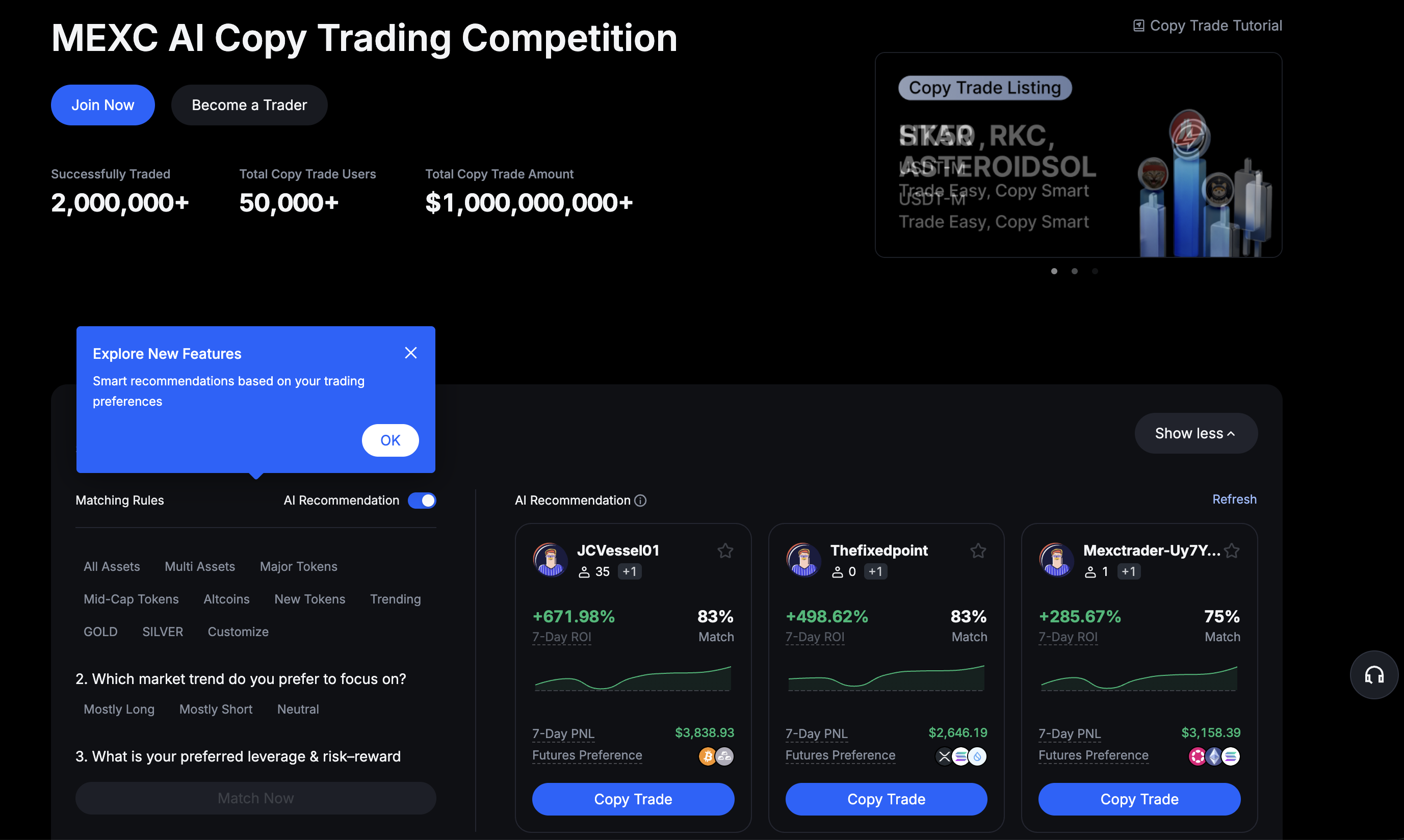
Copy trading is partly accessible without KYC. Following lead traders generally works on the unverified tier for most lead-trader profiles, though some lead traders restrict their copy followers to KYC-verified accounts. Becoming a lead trader yourself requires Primary KYC, which is a structural compliance requirement rather than a soft restriction. The marketplace exposes around 3,000-4,000 active lead traders as of Q1 2026, smaller than BingX or Bitget but functional for users who want the product alongside MEXC’s altcoin breadth.
Deposits have no platform-level limit at any tier. You can deposit any amount of crypto on any supported network: BTC on mainnet, USDT on Tron / Ethereum / Solana / BSC, ETH on mainnet and L2s, and the full range of supported chains. The realistic constraint on deposits is the cap on withdrawals: depositing more than you can withdraw under the unverified ceiling means you are committing to verify later or absorb the friction. For most users, depositing roughly the amount you plan to actively trade plus a 20-30 percent buffer for position rotation is the operational model that works.
Withdrawals up to the regional cap work without verification. The cap is commonly cited at around 30 BTC equivalent in lifetime volume as of May 2026, with regional variation. Below the cap, withdrawals process on the standard CEX timeline: typically minutes to a few hours for crypto withdrawals, depending on the network and the platform’s manual review threshold. Once the cap is approached, the platform prompts for KYC; further withdrawals require completing Primary KYC at minimum.
Spot conversion and basic exchange features work without KYC. The simple buy/sell flow, market pair conversion, and standard portfolio tracking are all available on the unverified tier. Earn products (fixed-term staking, flexible savings) are partially accessible: some yield products require Primary KYC, others do not. Always check the specific product page for the verification requirement before allocating.
For users whose trading pattern fits within these capabilities and within the regional cap, the no-KYC experience on MEXC in 2026 is comparable to a fully verified account at most peer platforms. The capability gap shows up in fiat on-ramps, launchpad participation, OTC desk access, and the highest withdrawal tiers, all of which sit on the next side of verification.
What requires KYC
Higher withdrawal limits beyond the unverified cap require at minimum Primary KYC. The exact tier-by-tier limits adjust based on regional rules and the user’s verification level, but the structural pattern is that Primary KYC unlocks a daily-cap structure of meaningful size (commonly cited in the hundreds of BTC equivalent daily), and Advanced KYC unlocks the highest tier including institutional rails.
Fiat on-ramp access via card payment, SEPA bank transfer, Faster Payments, or other regional fiat rails requires Primary KYC. The on-ramp itself is operated by third-party payment processors (Simplex, Banxa, Mercuryo, regional partners) that have their own KYC requirements on top of MEXC’s; even users who would tolerate exchange-side KYC may find the payment processor’s identity verification more demanding than the exchange’s.
P2P fiat marketplace participation requires Primary KYC. This includes both buying crypto from sellers using local payment rails and posting your own offers to buy or sell. The P2P system on MEXC operates in many regional currencies and is the primary fiat on-ramp for users in jurisdictions where card processors are unavailable, but the verification requirement gates access entirely.
Launchpad participation requires Primary KYC. MEXC operates a Launchpad and the related Kickstarter pipeline for project allocations to MX holders. Participating in launches, claiming Kickstarter allocations, and accessing project-specific airdrops all require verification at the Primary tier at minimum. Some specific high-value launches require Advanced KYC.
Certain copy trading lead-trader profiles require KYC-verified followers. The lead trader sets the requirement on their profile; some accept unverified followers, others require Primary KYC. The marketplace surfaces this requirement at the profile level, so unverified users can see which lead traders accept their tier and which do not. Lead traders themselves are all Primary KYC verified as a structural compliance rule.
The OTC desk requires Advanced KYC, including liveness selfie and proof of address. This is the standard institutional-rail requirement at every major CEX and is non-bypassable. For users who would route large block trades through the OTC desk to minimize market impact, the verification is a precondition rather than an optional step.
Some Earn products require KYC. Fixed-term staking products, structured products, and certain dual-investment offerings gate access at the Primary or Advanced tier depending on the product. Flexible savings on majors is typically accessible to unverified accounts but the menu of products opens significantly with verification.
The pattern is consistent. Anything that touches fiat rails, institutional flow, project allocations, or the highest crypto-denominated transaction sizes sits behind verification. Anything that stays within crypto-only spot, futures, and basic trading on the unverified tier remains accessible.
What’s blocked entirely
US users are blocked at the IP level regardless of verification status. MEXC does not operate a US-licensed product, US IPs are blocked at signup, and the terms of service explicitly prohibit US persons. Even completing every tier of KYC would not unlock US access; the geo-block is binary. Using a VPN to bypass it violates the terms and creates withdrawal risk if the platform later identifies the account as US-resident through IP correlation, KYC information, or partner-data signals.
Sanctioned jurisdictions are blocked at IP entirely. The list aligns with the standard sanctions universe: Cuba, North Korea, Iran, Syria, the Crimea region, certain other partial-sanctions zones. Users with IPs from these regions cannot complete signup at any tier. The block is enforced at the network level rather than the application level, so VPN bypass attempts run into the same verification-side detection that catches US-VPN users.
The KYC1 path for fiat is not bypassable. There is no email-only path to fiat on-ramps on MEXC; the payment processor relationships require identity verification at a minimum. Users who want to convert fiat to crypto without any KYC must use an external on-ramp (a P2P trade off-platform, a fiat-friendly DEX bridge, or a cash-to-crypto path) and deposit the resulting crypto to MEXC.
Several other jurisdictions sit in a partial-access category that operates between fully blocked and fully accessible. UK retail access is restricted under FCA rules for certain product categories, particularly derivatives. Canada has tightened access for crypto-asset platforms generally. Singapore and Hong Kong have varying retail restrictions. Japan’s regulatory regime restricts most international exchanges. Users in these jurisdictions can sometimes complete signup but may find specific products blocked at the account level.
For users in any of the fully-blocked categories, MEXC is not the answer. For US-based traders, the right answer is a US-licensed venue: Kraken, Coinbase, or Gemini. For users in sanctioned jurisdictions, the realistic answer is decentralized exchanges accessed via self-custody wallets, accepting the operational complexity and smart contract risk that comes with that path.
Regional differences
The regional variation in MEXC’s no-KYC posture is the single most important practical detail that most coverage misses. The same platform behaves differently for users in different jurisdictions, and the trajectory is regional rather than uniform.
EU member states sit at the tightest end. MiCA implementation through 2024-2025 pressured all crypto service providers serving EU users to register as VASPs and to mandate KYC across most product surfaces. MEXC’s response was progressive tightening for EU users: lower no-KYC withdrawal caps, more product surfaces moved behind verification, and in some specific countries (Germany, France, the Netherlands) effectively impossible to operate at the unverified tier for any meaningful volume. The 6th AML Directive and the related travel-rule provisions compress no-KYC scope further in 2026.
The UK runs parallel to the EU under FCA rules. Derivatives access is restricted for retail users, financial-promotion rules limit how MEXC can market in the UK, and the no-KYC scope is tighter than the global default. The UK is not as universally blocked as the US, but operational friction is materially higher than in non-Western jurisdictions.
Russia and Turkey sit at the most permissive end among large user bases. Adoption in both countries has driven a meaningful share of MEXC’s user growth through 2024-2026, and the platform’s no-KYC posture remains closer to the historical 10 BTC daily ceiling for users in these regions. The political-economic context (ruble volatility, lira instability, sanctions adaptation) creates structural demand for crypto venues with low KYC friction, and MEXC has retained a permissive posture in response.
MENA (Middle East and North Africa) has comparable permissiveness to Russia and Turkey, with regional partner-bank relationships supporting fiat on-ramps once users complete verification. The unverified ceiling for crypto-only operations remains generous in most MENA jurisdictions.
Southeast Asia is the most variable region. Vietnam, Indonesia, the Philippines, and Thailand have growing regulatory regimes that pressure exchange compliance, but enforcement is uneven and the practical no-KYC scope can be larger than the regulatory text suggests. Malaysia and Singapore are tighter; Singapore retail in particular has substantial restrictions. The regional pattern is changing month-to-month as local rules iterate.
Latin America has been growing as a MEXC user base with broad no-KYC accessibility for crypto-only operations. Brazil has the most-developed regulatory regime in the region; Argentina, Mexico, Colombia, and Peru run more permissively. The unverified ceiling and product scope are closer to the global default than to the EU-tightened tier.
The practical takeaway: before depositing material capital, verify the current no-KYC scope and withdrawal ceiling in your specific country directly on MEXC. Public coverage and global default numbers diverge from regional reality, and the divergence has widened through 2025-2026 as regional rules iterate independently.
Step-by-step signup without KYC
The signup flow is short. Email, password, captcha, and you have an unverified tradable account in under 10 minutes. The steps below describe the operational sequence with the security and privacy practices that matter most.
Step 1. Choose a clean email. Use an email address you control, that is not tied to your real-name identity if anonymity is a goal, and that you can access reliably for password recovery. ProtonMail, Tutanota, or a self-hosted domain are common choices for users who want email-layer privacy. Avoid using the same email across multiple no-KYC exchange accounts; platforms cross-reference and one account triggering KYC can flag others.
Step 2. Set a strong password. Use a randomly generated password of at least 16 characters, stored in a password manager (1Password, Bitwarden, KeePass). Do not reuse passwords from any other service. Password compromise is one of the most common attack vectors on CEX accounts, and a unique strong password is the baseline defense.
Step 3. Complete signup at mexc.com/register. Use the registration link, enter your email and password, complete the captcha, and verify the email through the link MEXC sends. The platform does not require any identity information at this step.
Step 4. Enable two-factor authentication via TOTP, not SMS. Once logged in, navigate to security settings and enable two-factor authentication via an authenticator app (Google Authenticator, Authy, 1Password’s built-in TOTP, or any compatible TOTP generator). Do not use SMS-based two-factor; SIM-swap attacks remain the most common vector against SMS-2FA on crypto accounts. If your account holds any meaningful balance, also enable hardware-key two-factor (FIDO2 / WebAuthn) using a YubiKey or comparable hardware key.
Step 5. Set an anti-phishing code. MEXC supports an anti-phishing code that gets embedded in every legitimate email the platform sends. Set this in security settings. Emails missing the code or containing a different code are phishing attempts. This is one of the highest-value security settings on any CEX and takes 30 seconds to configure.
Step 6. Decide on VPN use. If you are in a jurisdiction where MEXC operates normally, a VPN adds privacy at the connection layer but is not required for access. If you are in a jurisdiction where MEXC is restricted, VPN use to bypass the geo-block violates the terms of service and creates withdrawal risk. The privacy use case (hiding your IP from MEXC’s logs to limit data exposure) is legitimate; the bypass use case (accessing the platform from a prohibited jurisdiction) is not.
Step 7. Deposit USDT on Tron for the cheapest network. Tron USDT is the cheapest meaningful network for moving USDT to and from MEXC; typical withdrawal fee is 1 USDT flat with confirmation in under a minute. Always confirm the network on both ends before sending. Wrong-network sends (USDT on Tron sent to an Ethereum address, or vice versa) are the single most common user-error fund loss on every CEX and are typically unrecoverable. If you are funding from a self-custody wallet, generate the deposit address fresh on MEXC and verify the network selector matches your sending wallet’s network.
Step 8. Test a small withdrawal early. Before scaling the account balance, send a small test withdrawal (say, $50 of USDT on Tron) back to a self-custody wallet you control. Verify the withdrawal completes within the expected window. This is the single most important operational check on any new CEX account; it confirms the withdrawal path works and surfaces any account-level review or freeze that the platform applies to new users.
Step 9. Start trading. Spot pairs are accessible immediately. Futures requires accepting the standard derivatives risk disclosure (a clickthrough on first use). Copy trading is partly accessible; start by browsing the marketplace and verifying which lead-trader profiles accept unverified followers if that is your use case. Begin with small position sizes regardless of strategy; the cumulative cost of a single bad lesson on 200x leverage exceeds the cumulative cost of a year of platform fees at conservative sizing.
The full sequence from signup to first trade typically takes 10-20 minutes depending on email verification latency and the user’s familiarity with crypto wallets. For users new to CEX onboarding, plan for 30-45 minutes to work through the security settings carefully.
Real risks
The no-KYC path on MEXC carries operational risks beyond the standard CEX custody risk shape. Four risks matter most.
Terms of service breach if jurisdiction restricted. If you are in a jurisdiction where MEXC does not operate (US most prominently, certain sanctioned regions), using a VPN to bypass the geo-block violates the terms. The platform reserves the right to freeze withdrawals indefinitely if it later identifies the account as resident in a prohibited jurisdiction. The detection signals are multiple: IP correlation over time, KYC information if verification is later triggered, partner-data signals from third-party services, and behavioral patterns. The risk shape is: account works for months or years, then a compliance review surfaces the jurisdictional mismatch and freezes funds. Recovery typically requires the documents the user was trying to avoid in the first place, plus often a legal channel that may not exist in the prohibited jurisdiction.
Freeze risk on chain-tainted USDT. If a deposit address on your MEXC account receives USDT (or any token) that was previously associated with a sanctioned wallet, mixer output, hacker address, or other AML-flagged source, the platform’s compliance screening can freeze the deposit pending review. The screening operates at the address-graph level; even if you received the funds in good faith from a legitimate sender, the platform may freeze pending evidence of provenance. Mitigation: deposit from clean sources, prefer exchange-to-exchange transfers from major venues over peer-to-peer transfers from unknown sources, and avoid receiving tokens that have transited mixer services. For users buying crypto via P2P or local cash channels, ask the seller for the deposit’s recent transaction history before accepting.
Transparency gap versus Binance and Coinbase. MEXC publishes proof of reserves but on a less rigorous cadence than Binance, Coinbase, or even peer mid-tier CEXs. The Merkle-tree attestation cadence has been described by independent observers (Chainalysis, Nansen, and the proof-of-reserves auditor community) as less frequent and less granular than top-tier peers. This is not evidence of dishonesty; it is a gap in the available evidence for verifying solvency. The implication is that long-duration custody on MEXC carries higher information asymmetry risk than the same custody on Binance or Coinbase. Mitigation: keep on-platform only what you have actively allocated to open positions or short-term yield products; withdraw the rest to self-custody.
Support quality during freezes. User reports across social channels (Reddit, Twitter, dedicated community forums) consistently describe slower response times during high-volume events, less detailed root-cause explanations during outages, and longer resolution windows for individual-account issues. This is comparable to KuCoin and below Binance or Coinbase. For users who hit a freeze or account-level issue, the realistic expectation is days to weeks for resolution rather than hours, with escalation paths that depend on the specific issue and account state. The implication: account-level issues that get resolved easily on tier-one venues can become extended ordeals on MEXC. Mitigation: keep the account simple, avoid behaviors that trigger AML review, and have a backup venue ready in case primary access is interrupted.
A fifth, smaller risk worth noting: the listing-speed mechanic that defines MEXC’s altcoin advantage also means the long tail of tradable tokens includes a higher share of rug-pull and low-liquidity assets. This is a trading risk rather than a no-KYC risk specifically, but users running altcoin-heavy strategies on MEXC should size positions accordingly. A token that lists on MEXC within hours of mainnet launch and is still listed three months later has cleared one survival filter; a token that lists and delists within weeks is the failure mode.
For users who accept these risks within a defined operational discipline (clean sources, conservative balances, ready KYC documents, backup venues), the no-KYC capability on MEXC remains a meaningful tool in 2026. For users who would treat the platform as a primary custodial venue or who would scale to very large balances without verification, the risk-adjusted answer is to complete Primary KYC and operate on the verified tier.
When to verify anyway
The no-KYC path on MEXC is the right answer for some users and the wrong answer for others. Four conditions push the decision toward completing Primary KYC despite the available no-KYC capability.
Planning size above the regional cap. If your expected withdrawal volume over the account’s lifetime exceeds the 30 BTC equivalent ceiling (or whatever the regional cap is in your jurisdiction), you will hit verification eventually. Completing it before depositing avoids the friction of having funds parked above the cap waiting for the verification process. The same logic applies to active traders running high-velocity strategies that cycle the account through significant volume even if individual withdrawals are smaller.
Using launchpad or Kickstarter. MEXC’s launchpad and Kickstarter pipelines require Primary KYC for participation. If new-token allocations and the related airdrop mechanics are part of your strategy, the no-KYC tier blocks access to a meaningful share of MEXC’s distinctive product surface. The fee-discount and M-Day mechanics from holding MX work on the unverified tier, but participating in launches does not.
Fiat off-ramp eventually. If you plan to eventually convert MEXC balances back to fiat through the platform’s on/off-ramps (card payouts, SEPA transfers, P2P fiat sales), Primary KYC is a precondition. Some users solve this by operating fiat conversion entirely off-platform (sending crypto to a fiat-friendly exchange or to a P2P channel), but for users who want the convenience of in-platform fiat rails, verification is the gating step.
Corporate or institutional use. Operating an MEXC account on behalf of a corporate entity, a fund, an institutional treasury, or any structure beyond a personal individual account requires Advanced KYC including corporate documents (certificate of incorporation, beneficial ownership disclosure, proof of corporate address). The no-KYC tier is structurally restricted to individual retail users; the moment a use case involves any entity beyond an individual, verification is mandatory.
A fifth condition is more subjective but practical: if the no-KYC friction exceeds the verification friction, verify. For some users, the operational discipline of staying under regional caps, watching for AML signals on deposits, and maintaining backup venues consumes more attention than the one-time Primary KYC submission would. If you find yourself spending material time managing no-KYC operations rather than trading, the calculation has flipped.
For users who do not fit any of these conditions, the no-KYC tier remains a defensible choice in 2026. For users who do, completing Primary KYC early avoids retroactive friction and unlocks the full product surface.
Comparison to other no-KYC paths
MEXC is one of several viable no-KYC paths in 2026. The table below summarizes the practical alternatives with their core trade-offs.
| Platform | KYC tier | Headline capability | Trade-off |
|---|---|---|---|
| MEXC | Email-only with ~30 BTC lifetime cap | 2,800+ spot pairs, 200x futures, partial copy trading | Lifetime cap, regional variation, transparency gap |
| BingX | Email-only Standard tier | ~50,000 USDT daily withdrawal, full copy trading | Smaller altcoin catalog, daily cap recurs |
| Hyperliquid | Wallet-only (DEX) | Perpetuals with up to 50x leverage, no platform cap | Smart contract risk, no spot, no copy trading |
| Uniswap / GMX / dYdX | Wallet-only (DEX) | Spot swaps and perpetuals, full anonymity | Smart contract risk, worse liquidity on long tail |
| KuCoin | Tightened post-CFTC | Limited unverified scope | Materially restricted from historical posture |
| Bitget | Lite tier (email + phone) | Lower daily limits than 2023 | Compressed scope, regional variation |
| Bybit / Binance / OKX | Mandatory KYC | n/a for no-KYC use case | Verification required for meaningful access |
The framework most retail users settle into is multi-venue: a primary no-KYC CEX for ease of use (BingX or MEXC depending on use case), a decentralized perpetuals venue for hedge exposure (Hyperliquid), and a self-custody wallet for the bulk of holdings. Pure single-platform concentration is rare among users who have operated through the 2024-2025 tightening cycle and learned the discipline of distributed custody.
For users whose primary motivation is copy trading specifically, BingX has the deeper marketplace; see our BingX no-KYC registration guide for the equivalent walkthrough on that platform. For users focused on decentralized perpetuals, see our Hyperliquid review for the full feature breakdown. For the broader picture of the no-KYC landscape with side-by-side comparison, see best no-KYC crypto exchanges 2026. For the current state of KuCoin’s verification tiers specifically, see KuCoin no-KYC 2026.
The trajectory through 2026-2027 is continued compression. Each year of regulatory pressure narrows the no-KYC capability set further. Users planning multi-year operations should treat the current posture as a window rather than a permanent feature, and should have verification documents ready for the realistic case that one or more current no-KYC paths closes during the operating window.
Bottom line
MEXC’s no-KYC capability in 2026 remains meaningful for users in non-restricted jurisdictions with operational discipline and conservative balances. The historical 10 BTC per day ceiling that defined the platform’s reputation through 2023 was replaced in 2025 by a lifetime-cap framework, commonly cited around 30 BTC equivalent before mandatory verification, with regional variation. Spot trading on 2,800+ pairs, perpetual futures up to 200x leverage, and partial copy trading access all work without KYC. Launchpad participation, fiat on-ramps, OTC desk, and the highest withdrawal tiers require verification.
The trajectory points one direction. Through 2024-2025, every iteration of MEXC’s KYC policy narrowed the unverified scope rather than expanding it. MiCA in the European Union, FATF travel rule enforcement, banking-partner compliance pressure, and the post-Bybit-2025-incident industry-wide acceleration all push centralized exchanges toward narrower no-KYC scopes. MEXC has resisted longer than most peers but is not exempt from the trend. The realistic expectation for 2026-2027 is continued tightening: lower lifetime caps, more region-specific restrictions, more product surfaces moved behind verification.
For users who fit the no-KYC profile (retail volumes, non-restricted jurisdiction, comfortable with the operational discipline), MEXC is one of the strongest available paths in 2026. The combination of broad altcoin coverage, aggressive fee economics, working perpetuals, and a still-meaningful unverified ceiling is rare. For users who do not fit the profile (high volumes above the cap, restricted jurisdictions, copy trading as primary use case, fiat-off-ramp dependency), other paths fit better. BingX for retail copy trading with the simpler daily-cap experience. Hyperliquid for decentralized perpetuals with no KYC at any level. A US-licensed venue for US-based traders.
Treat the current state as a window rather than a permanent feature. Verify the regional cap in your jurisdiction before depositing material capital. Keep balances modest, deposit from clean sources, enable strong account security, and have verification documents ready for the realistic case that the platform requests upgrade during your usage window. Operating discipline matters more than venue selection for users in the no-KYC tier; the platform’s posture sets the ceiling, but the user’s practices determine the realized outcome.
For the full MEXC feature breakdown (fees, MX token mechanics, copy trading depth, security track record, comparison to peers), see our MEXC review 2026. For our broader no-KYC ranking with the comparison matrix across BingX, MEXC, Hyperliquid, and the DEX stack, see best no-KYC crypto exchanges 2026. For evaluation methodology and the framework we apply across all platform reviews, see methodology. For the underlying risk considerations across crypto trading generally, see risk disclaimer.
Open account: Register on MEXC to start at the unverified tier. See the affiliate disclosure for full detail on our partnership status.
Read next
- MEXC review 2026. Complete feature breakdown, fee structure, MX token mechanics, copy trading depth, and peer comparison.
- Best no-KYC crypto exchanges 2026. Ranking matrix across BingX, MEXC, Hyperliquid, and the DEX stack with daily limits and trade-offs.
- Hyperliquid review 2026. Decentralized perpetuals with no KYC at any level, with smart contract risk as the meaningful trade-off.
- KuCoin no-KYC 2026. Current state of KuCoin’s verification tiers after the 2024 CFTC settlement.
- Methodology. How we evaluate platforms across the review series.
- Risk disclaimer.
Frequently asked questions
Can I use MEXC without KYC in 2026?
Yes, partially. MEXC still operates an unverified tier that allows spot trading, perpetual futures up to 200x leverage, deposits without limit, and withdrawals up to a regional cap commonly cited around 30 BTC equivalent in lifetime volume before mandatory verification triggers. The historical 10 BTC daily ceiling that defined MEXC's no-KYC reputation through 2023 was replaced in 2025 by a lifetime-cap model with regional variation. Copy trading is partly accessible, launchpad and fiat ramps require Primary KYC, and US users are blocked at signup regardless of verification status.
What's the current no-KYC withdrawal limit on MEXC?
Roughly 30 BTC equivalent in lifetime withdrawals before mandatory verification, with regional variation as of May 2026. This replaced the previous 10 BTC per day ceiling that ran through 2023-2024. Some jurisdictions (parts of Asia, MENA, Russia, Turkey) see slightly higher effective ceilings; EU and UK users hit lower ceilings or cannot complete signup at all without KYC. Always verify the current limit in your specific region on the MEXC withdrawal page before depositing material capital, as the platform adjusts the cap without prior notice.
Can I trade futures on MEXC without verification?
Yes. Perpetual futures with up to 200x leverage on majors (BTC, ETH, SOL) work without KYC for unverified accounts. USDT-margined and USDC-margined perpetuals are both accessible. Futures fees at default tier are 0 percent maker and 0.02 percent taker, the lowest headline futures fee among major CEXs. The realistic constraint is not access; it is risk management. 200x leverage liquidates a position on a 0.5 percent move against you. Most retail users who lose money on MEXC futures lose it to leverage, not to platform issues.
Does copy trading work without KYC?
Partly. Following lead traders on MEXC's copy trading marketplace generally works on the unverified tier with some lead-trader profiles restricted to KYC-verified followers. Becoming a lead trader yourself requires Primary KYC. The marketplace exposes around 3,000-4,000 active lead traders as of Q1 2026, which is smaller than BingX (50,000+) or Bitget (80,000+). If copy trading is your primary use case, BingX still has the deeper marketplace; if you want copy trading as a secondary feature alongside MEXC's altcoin breadth, the product is functional.
Will MEXC freeze a no-KYC account?
It can, under specific triggers. Three patterns most commonly cause freezes: AML pattern detection (rapid in-out flows, structured deposits, links to flagged addresses), deposits of tainted USDT from sanctioned wallets or mixer outputs, or jurisdictional changes that retroactively require verification. A clean, low-frequency trading account in a permitted jurisdiction with deposits from a verified source rarely sees freeze events. The freeze risk is real but predictable. Keep funds at or under the regional cap, deposit from clean sources, and have KYC documents ready in case the platform requests upgrade.
Can US users use MEXC no-KYC?
No. MEXC blocks US IPs at signup and the terms of service explicitly prohibit US persons regardless of verification status. Using a VPN to bypass the geo-block violates the terms and creates withdrawal risk if the platform later identifies the account as US-resident through KYC, IP correlation, or partner-data signals. For US-based traders, the right answer is a US-licensed venue such as Kraken, Coinbase, or Gemini for centralized exchange access, or Hyperliquid and Uniswap for decentralized perpetuals and spot without any KYC at the wallet level.
How do I sign up on MEXC without ID?
Use the registration link at mexc.com/register, enter an email you control with a strong password, complete the captcha, and verify the email. Skip the verification prompts after first login and you have an unverified tradable account. Enable two-factor authentication via TOTP authenticator app (Google Authenticator, Authy) rather than SMS, set an anti-phishing code, and enable hardware-key two-factor if your balance justifies it. Deposit USDT on Tron for the cheapest meaningful network. Test a small withdrawal back to self-custody before scaling balances. The full flow takes around 10 minutes.
Is MEXC the best no-KYC exchange in 2026?
For users prioritizing altcoin breadth and higher lifetime withdrawal ceilings, yes. For users prioritizing copy trading depth or the simplest no-KYC daily-cap experience, BingX is the practical answer with a ~50,000 USDT daily limit on its email-only Standard tier. For users committed to self-custody and willing to accept smart contract risk, Hyperliquid for perpetuals and Uniswap for spot are the decentralized alternatives with no KYC at any level. MEXC sits in the middle: more permissive than Bybit or Binance, narrower than BingX on retail UX, broader than DEXs on asset coverage.
#MEXC#no-KYC#guide#withdrawal limits#altcoins#crypto privacy
Discussion
Loading comments…