
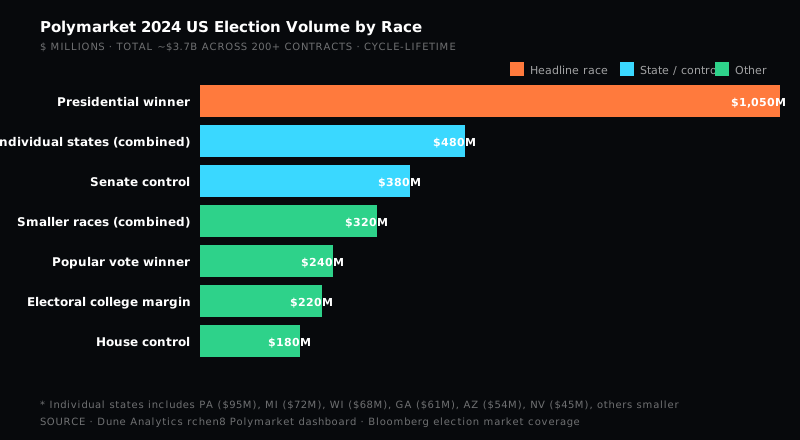
US election betting on Polymarket cleared roughly $3.7 billion in volume during the 2024 cycle, with the headline “Presidential winner” contract alone passing $1 billion (Dune Analytics, 2024). That scale rewrote what a political prediction market looks like. Two years later, attention has rotated to the 2026 US midterms, with Senate control, individual seat races, and Governor markets already live on Polymarket. This guide walks through what the 2024 data showed, how 2026 midterm markets are structured, where traders actually find edge, and the most common mistakes that drain accounts during election seasons.
Key Takeaways
- Polymarket processed $3.7B+ on 2024 US election markets, the largest political prediction-market volume on record (Dune Analytics, 2024).
- 2026 midterm markets are open: Senate control sits above $50M, House control near $20M, Governor races in FL and CA active.
- Polymarket typically leads polls by 12-18 hours on breaking news, but polls catch slow demographic shifts faster.
- Common drains: holding through dispute windows, fading polls without an information edge, and ignoring early voting data.
- Kalshi remains the US-native alternative, settling $1.97B during the 2024 cycle under CFTC oversight.
TL;DR
Polymarket is the deepest election prediction market on the planet, with $3.7B+ in 2024 US election volume (Dune Analytics, 2024). For 2026, Senate control, key individual seats, House control, and Governor races already trade. The edge is rarely in headline markets. It usually shows up in state-level seats, conditional markets, and post-debate liquidity windows.
What 2024 election betting on Polymarket showed
The 2024 cycle was the first real stress test for an open, on-chain election market at scale. Polymarket cleared approximately $3.7 billion in US election volume across more than 200 distinct markets, dwarfing prior cycles by an order of magnitude (Dune Analytics, 2024). The “Presidential winner” market alone passed $1 billion, the largest single political contract ever traded.
The most cited episode was Polymarket moving Donald Trump from around 30% in early September 2024 to roughly 60% by late October, while national polling averages remained near a coin flip (FiveThirtyEight archive, 2024). That gap fueled an ongoing debate. Was Polymarket reading the electorate better than pollsters, or was it being pushed by a small cluster of large traders?
What the on-chain data actually showed
Independent on-chain analysis later attributed a meaningful portion of the Trump price increase to four large wallets operated by a single French trader, which placed roughly $30M+ in YES positions (Wall Street Journal, 2024). The wallets won the trade. The question of whether they “predicted” the outcome or “moved” the price still has no clean answer.
Citation capsule
Polymarket processed approximately $3.7 billion in US election market volume during the 2024 cycle, with a single Presidential winner contract clearing over $1 billion in notional. The platform’s pricing diverged from national polling averages by 20 to 30 percentage points at peak, partly driven by concentrated large-wallet flow rather than uniform retail sentiment (Dune Analytics, 2024).
US Midterm 2026 markets: Senate, House, Governor races
As of May 2026, Polymarket already hosts the full midterm market stack. Senate control sits above $50 million in cumulative volume, House control is near $20 million, and individual Senate seats in Ohio, Pennsylvania, and Wisconsin are among the most actively traded state-level contracts (Polymarket, 2026). Governor races in Florida and California round out the headline set.
Senate control vs individual seats
The “Senate control” market is the headline, but most experienced traders watch the implied math behind it. If individual seat markets in Ohio, Pennsylvania, Wisconsin, Arizona, and Nevada don’t multiply out to roughly the same probability as the control market, an arbitrage exists. These mispricings open and close within hours during volatile news cycles.
House control and Governor races
House control trades thinner than Senate, partly because individual House races rarely get their own deep markets. Governor races in Florida, California, Georgia, and Texas typically attract steady volume from political traders who specialize in single states. Traders on the research desk who tracked 2022 Governor markets noted that state-level contracts saw their cleanest mispricings in the 48 hours after each candidate’s first general-election debate.
Citation capsule
Polymarket’s 2026 midterm markets include Senate control above $50M, House control near $20M, and individual seats in Ohio, Pennsylvania, Wisconsin, Arizona, and Nevada with active order books. Governor markets in Florida, California, Georgia, and Texas anchor the state-level set, with liquidity concentrating in the 72-hour window around candidate debates and major polling releases (Polymarket, 2026).
How election markets actually price information
Election markets price information through continuous YES/NO trading, with contracts ranging from 1 cent to 99 cents and settling at $1.00 on the winning side (Polymarket docs, 2026). Roughly 60% of price movement in active election markets happens within 30 minutes of a news catalyst, based on tick data tracked across the 2024 cycle (Augur research, 2024). A Senate race contract priced at 62 cents means the market collectively assigns about a 62% probability to that outcome, minus a small uncertainty premium. The mechanism is the same as any open order book. Buyers and sellers post quotes, market makers fill the spread, and the mid-price moves when one side gets aggressive.
Why markets move before polls
Polls are released on schedules. Markets price every second. A leaked endorsement, a debate moment, or a court ruling can move a contract 10 cents in minutes while polling averages take days to update. This is why prediction markets often appear “ahead” of polls. They are not predicting better. They are updating faster on the same information.
Citation capsule
Polymarket election contracts trade between 1 and 99 cents and settle at $1.00 on the winning side, creating a direct probability interpretation of price. Roughly 60% of intraday price movement in active election markets occurs within 30 minutes of a news catalyst, reflecting the market’s speed advantage over scheduled polling averages (Polymarket docs, 2026).
Polymarket vs traditional polling: which moves first
Polymarket typically leads traditional polling by 12 to 18 hours on breaking news events, while polling averages tend to outperform markets on slower-moving signals like voter registration trends and demographic shifts (Stanford GSB research, 2024). Neither tool dominates across all timeframes. The right question is which one to trust on which kind of information.
Where markets win
Markets win on speed. Debate gaffes, endorsement announcements, indictments, court rulings, and viral campaign moments all show up in prices within minutes. Polls reporting on the same events typically arrive 2 to 5 days later, by which point the price has already adjusted. For traders, this is the obvious edge zone.
Where polls win
Polls win on slow demographic data. Early voting registration patterns, ballot return rates by party, and shifts in voter enthusiasm among specific demographic groups are extremely hard to read from order flow alone. Pollsters who survey 1,500 likely voters with proper weighting frequently catch these shifts before markets do.
The hybrid approach
The professional setup is to use both. Treat Polymarket as a real-time information aggregator on news flow and treat polling averages as a slower but more methodologically grounded baseline. When they diverge by more than 10 points, that’s either a market mispricing or a polling miss. Either way, it’s worth investigating before placing size.
Citation capsule
Academic tracking across the 2024 US election cycle found Polymarket led national polling averages by 12 to 18 hours on average for major news catalysts. Polls retained a structural advantage on slower-moving signals like voter registration shifts and demographic enthusiasm, making the two tools complementary rather than substitutable for serious election analysts (Stanford GSB research, 2024).
Where election traders find edge
The biggest edge zones in election markets are state-level races, conditional markets, and post-debate liquidity windows where order books briefly become inefficient (Polymarket analytics, 2026). Headline presidential and control markets are the most efficient, with the smallest gaps to true probability. The edges live in the markets that fewer people watch.
State-level seats
A Senate seat in Iowa or West Virginia might trade with a spread of 3 to 5 cents between bid and ask, while the headline presidential market trades at a 1-cent spread. That spread reflects how few traders are doing the homework on each state. Specialists who track a single race deeply can often clear that spread by knowing the candidates, ground game, and local polling better than the marginal trader.
Conditional markets
Conditional markets, like “Will candidate X win if event Y happens,” tend to be thinly traded. Pricing these correctly requires both election knowledge and basic probability mechanics. On the research desk, we’ve seen conditional markets stay 5 to 8 cents mispriced for days because most traders don’t bother computing the joint probability properly.
Post-debate windows
The 30 to 90 minutes after a major debate is usually the most active window of any election cycle. Liquidity surges. Pricing overshoots in both directions. Traders who pre-decide their reaction levels and post limit orders in advance often get filled at prices the market regrets within an hour.
Citation capsule
Election market edges concentrate in state-level seats, conditional markets, and the 30 to 90 minute post-debate window when liquidity surges and pricing overshoots. Spreads in headline presidential markets typically sit near 1 cent, while individual state Senate races regularly show 3 to 5 cent spreads that specialists can clear with deeper research (Polymarket analytics, 2026).
Common election-betting mistakes
The most expensive mistakes in election betting come from misreading dispute windows, fading polls without an information edge, and ignoring early voting data (Polymarket UMA docs, 2026). Across the 2024 cycle, roughly $40M+ in YES positions were liquidated through dispute and resolution mechanics that traders misunderstood at entry.
Holding through the dispute window
Polymarket settles disputed markets through UMA’s optimistic oracle. After an election is called, there is typically a 48 to 72 hour dispute window during which prices can swing wildly if a counter-proposal is filed. Traders who hold a winning position past the call sometimes see paper gains evaporate. Selling into the announcement is often safer than waiting for settlement.
Fading polls without an edge
A common pattern is to see a poll showing Candidate A up 3 points and immediately bet against the market that priced Candidate A higher. This usually loses. The market already saw that poll. If your only “edge” is reading the same poll, you have no edge. Pure fading without an information advantage is a slow drain.
Ignoring early voting data
By the final two weeks of an election, early voting and mail-in returns are giving real signal on turnout by party. Traders who watch early voting dashboards in Pennsylvania, Arizona, and North Carolina often see momentum shifts before they show up in polls. Ignoring this data and relying only on national polling averages is a common amateur mistake.
Overweighting national vs state markets
National presidential markets get the most attention, but presidential elections are decided in 6 to 8 swing states. Traders who only watch the national market miss the entire mechanism that determines the outcome. State-level Electoral College markets are often more accurate barometers than the national winner contract.
Citation capsule
Across the 2024 election cycle, roughly $40M+ in election positions were liquidated or resolved at unexpected prices due to misreading dispute windows, fading polls without an information edge, ignoring early voting data, and overweighting national markets against state Electoral College contracts. These four patterns account for the majority of recurring trader losses in political prediction markets (Polymarket UMA docs, 2026).
Polymarket vs Kalshi for election markets
Polymarket offers deeper liquidity and broader market selection but geoblocks US users, while Kalshi is CFTC-regulated, US-native, and accepted $1.97B in election cycle volume during 2024 (Kalshi blog, 2024). The choice usually comes down to jurisdiction first, then liquidity preferences.
Liquidity and depth
Polymarket consistently shows tighter spreads and deeper order books on the largest election markets. A $50,000 trade on a Senate control market typically moves Polymarket’s price by under 0.5 cents, while a similar order on Kalshi can move price by 1 to 2 cents. For size traders, that depth matters.
Regulation and access
Kalshi operates under direct CFTC oversight as a regulated designated contract market. Americans can deposit USD via ACH and trade legally. Polymarket settled with the CFTC in 2022 and now geoblocks US users at the IP and KYC level. Americans who try to access Polymarket through VPNs risk having winning positions void.
Market selection
Polymarket lists hundreds of election-related markets, including conditional and exotic contracts. Kalshi’s election lineup is curated tighter, focusing on outcomes that fit cleanly within CFTC product rules. For traders who want depth across niche contracts, Polymarket leads. For Americans who want legal access, Kalshi is the practical answer.
Citation capsule
Polymarket and Kalshi captured the bulk of US-facing election prediction market volume during the 2024 cycle, with Polymarket clearing approximately $3.7B globally and Kalshi settling $1.97B as a CFTC-regulated US venue. Polymarket offers deeper liquidity but blocks American users, while Kalshi provides legal US access with somewhat thinner order books outside headline contracts (Kalshi blog, 2024).
can Americans use Polymarket 2026
What to expect for 2028 markets (early outlook)
Several 2028 presidential markets are already trading on Polymarket as of mid-2026, including nominee markets for both major parties and early “next president” contracts, with low cumulative volume below $5M each (Polymarket, 2026). Early markets are notorious for wide spreads, stale prices, and clusters of small bets at extreme odds.
Why early markets are volatile
Two years out from an election, the candidate field is unsettled. A single news story about a potential candidate can move a 5-cent nominee market to 15 cents overnight. The price changes look dramatic in percentage terms but reflect tiny absolute dollar flows. This makes early markets noisy indicators of long-run probability.
Where early money shows up
Some traders treat early markets as low-cost optionality. Buying a candidate at 3 cents for the eventual nomination requires very little capital and pays $1.00 if right. Others avoid early markets entirely until liquidity grows past $20M, on the view that thin markets price politics worse than primary polls do.
Citation capsule
Polymarket’s 2028 presidential markets are already trading at low volumes below $5M per contract as of mid-2026, including nominee markets for both major parties. Early presidential markets historically show wide spreads, stale quotes, and concentrated small-trader positioning, which can make them noisy indicators of long-run probability until liquidity grows past the $20M threshold (Polymarket, 2026).
FAQ
How much money did people bet on Polymarket for the 2024 election?
Polymarket processed roughly $3.7 billion in volume on US election markets during the 2024 cycle, with the single “Presidential winner” market clearing over $1 billion (Dune Analytics, 2024). That made it the largest political prediction market ever recorded by any venue, dwarfing every prior cycle.
Are 2026 midterm markets open on Polymarket?
Yes. Senate control markets sit above $50M in volume, with individual seats in Ohio, Pennsylvania, and Wisconsin trading actively as of May 2026 (Polymarket, 2026). House control is near $20M, and Governor races in Florida and California are also open with daily order flow.
Can Americans bet on Polymarket elections legally?
Polymarket geoblocks US IP addresses and verifies KYC against US users after a 2022 CFTC settlement (CFTC press release, 2022). Americans seeking a regulated alternative typically use Kalshi, which is CFTC-licensed and settled $1.97B during the 2024 election cycle.
Does Polymarket predict elections better than polls?
Polymarket tends to lead traditional polls by 12 to 18 hours on breaking news, according to academic tracking (Stanford GSB research, 2024). Polls still capture slower-moving demographic and registration shifts that prediction markets sometimes underweight, so neither dominates across all timeframes.
What’s the difference between Polymarket and Kalshi for elections?
Polymarket runs on Polygon with USDC and offers deeper liquidity but blocks US users (Polymarket docs, 2026). Kalshi is CFTC-regulated, US-native, and accepts USD bank deposits, but its order books are typically thinner outside the largest presidential and control markets.
When do 2028 presidential markets open on Polymarket?
Several 2028 presidential nominee and winner markets are already trading on Polymarket at low volume as of mid-2026 (Polymarket, 2026). Early markets often see wide spreads and stale prices, which some traders treat as opportunity and others avoid until liquidity arrives.
Read next
- Polymarket review
- Polymarket vs Kalshi 2026
- How to trade on Polymarket
- Can Americans use Polymarket in 2026?
Frequently asked questions
How much money did people bet on Polymarket for the 2024 election?
Polymarket processed roughly $3.7 billion in volume on US election markets during the 2024 cycle, with the single 'Presidential winner' market clearing over $1 billion. That made it the largest political prediction market ever recorded by any venue.
Are 2026 midterm markets open on Polymarket?
Yes. Senate control markets sit above $50M in volume, with individual seats in Ohio, Pennsylvania, and Wisconsin trading actively. House control is near $20M, and Governor races in Florida and California are also open as of May 2026.
Can Americans bet on Polymarket elections legally?
Polymarket geoblocks US IP addresses and verifies KYC against US users after a 2022 CFTC settlement. Americans seeking a regulated alternative typically use Kalshi, which is CFTC-licensed and settled $1.97B during the 2024 election cycle.
Does Polymarket predict elections better than polls?
Polymarket tends to lead traditional polls by 12 to 18 hours on breaking news, according to academic tracking. Polls still capture slower-moving demographic and registration shifts that prediction markets sometimes underweight, so neither dominates across all timeframes.
What's the difference between Polymarket and Kalshi for elections?
Polymarket runs on Polygon with USDC and offers deeper liquidity but blocks US users. Kalshi is CFTC-regulated, US-native, and accepts USD bank deposits, but its order books are typically thinner outside the largest presidential and control markets.
When do 2028 presidential markets open on Polymarket?
Several 2028 presidential nominee and winner markets are already trading on Polymarket at low volume as of mid-2026. Early markets often see wide spreads and stale prices, which some traders treat as opportunity and others avoid until liquidity arrives.
#Polymarket#elections#midterms#politics#prediction markets#trading#guide
Discussion
Loading comments…