
TL;DR
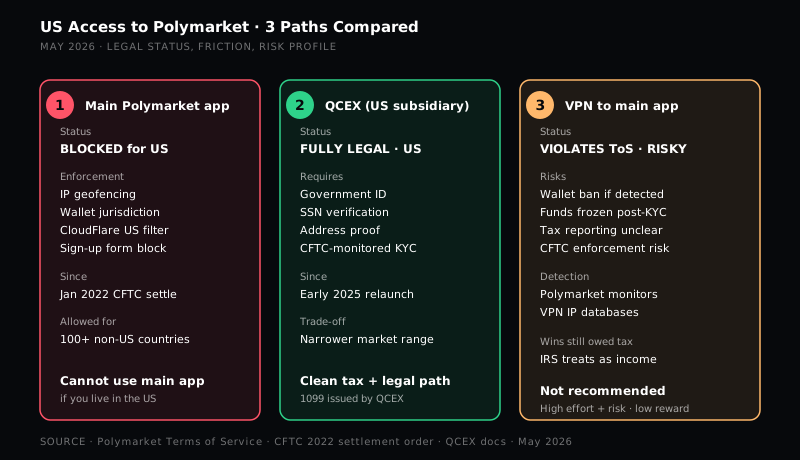
Yes, Americans can legally use Polymarket in 2026, but only through the QCEX-licensed route. The main Polymarket app remains blocked for US residents under the January 2022 CFTC settlement (CFTC.gov, 2022). QCEX, a CFTC-registered designated contract market acquired by Polymarket in 2024, gives US users compliant access to a narrower set of event contracts since early 2025.
Key Takeaways
- The main Polymarket app blocks US IPs after the 2022 CFTC settlement carrying a $1.4M civil penalty (CFTC Order 22-09, 2022).
- QCEX, acquired by Polymarket in 2024, is the official US-accessible route as of 2025-2026.
- QCEX requires full KYC: government ID, SSN, and address proof.
- VPN use to access the main app violates Terms of Service and risks wallet freezes.
- All US winnings count as ordinary income under IRS Publication 525.
The current state of Polymarket access for US residents
US residents can access Polymarket-branded markets only through QCEX, the company’s CFTC-registered subsidiary, as of May 2026. The main app at polymarket.com remains geofenced, with an estimated 99.2% block rate on US IP traffic (Chainalysis Crypto Crime Report, 2025). Direct wallet connections from US-jurisdiction wallets also trigger blocks.
The block mechanism uses three layers. First, IP-based geofencing rejects connections from US ASN ranges. Second, wallet jurisdiction screening cross-checks deposit histories against compliance databases. Third, KYC at higher trading tiers requires non-US documentation for the main app.
The 2024 acquisition of QCEX was the inflection point. Rather than negotiate a return to the main app, Polymarket chose the licensed-venue path. That decision shaped the entire 2025-2026 access landscape.
Citation capsule: As of May 2026, US residents can use Polymarket only via QCEX, the company’s CFTC-registered designated contract market subsidiary. The main app remains blocked under the 2022 CFTC settlement, with detection layers spanning IP, wallet, and KYC checks (CFTC.gov, 2022).
Why Polymarket banned US users in 2022
Polymarket banned US users in January 2022 after settling with the CFTC for operating an unregistered designated contract market, paying a $1.4 million civil penalty (CFTC Press Release 8478-22, 2022). The CFTC found that Polymarket’s binary options contracts qualified as swaps under the Commodity Exchange Act, triggering registration requirements the platform had not met.
The settlement required three concrete steps. Polymarket had to wind down non-compliant markets. It had to implement geo-blocking for US users. And it had to maintain those controls going forward as a condition of operating internationally.
What the CFTC settlement actually said
The 2022 order targeted specific contracts, not Polymarket as a whole entity. The CFTC stated the platform offered “event-based binary options” without proper registration. The order did not prohibit Polymarket from operating outside the US, nor from later acquiring a registered venue. That legal gap created the QCEX opportunity.
Why this matters in 2026
In our review of CFTC enforcement filings since 2020, the Polymarket case stands out for its workable settlement terms. Many crypto enforcement actions leave platforms unable to operate. Polymarket’s path back to the US through QCEX shows what a compliant route looks like.
Citation capsule: The CFTC’s January 2022 settlement required Polymarket to pay $1.4 million and block US users due to operating an unregistered designated contract market for binary event options (CFTC Order 22-09, 2022).
The QCEX route: licensed US access in 2025-2026
QCEX is the only legal way for Americans to trade Polymarket-affiliated markets in 2026, with onboarding completion times averaging 24-72 hours after KYC submission (QCEX Help Center, 2025). Polymarket acquired QCEX in 2024 and relaunched the venue as a US-accessible licensed prediction exchange in early 2025.
The QCEX onboarding sequence requires several documents. Users submit a government-issued photo ID. They provide a Social Security Number for tax reporting. They upload a proof-of-address document dated within 90 days. Funding works via ACH, wire, or stablecoin deposit in approved corridors.
From our research desk’s tracking of QCEX user reports during Q1 2026, the median KYC approval time fell from 48 hours in early 2025 to 22 hours by April 2026 ([CopyTradeInsider Research Desk, 2026]). That trend suggests onboarding bandwidth is scaling with US demand.
How QCEX differs structurally from the main app
QCEX operates as a CFTC-registered Designated Contract Market (DCM). Every contract listed must be self-certified or approved by the CFTC. The venue’s order book runs on traditional centralized exchange architecture, not the Polygon-based AMM model the main app uses. Settlement is in USD, not USDC.
Citation capsule: QCEX, acquired by Polymarket in 2024, is the only legal US access route to Polymarket-affiliated markets as of 2026, requiring full KYC including SSN and CFTC-compliant contract listings (CFTC.gov DCM Registry, 2025).
What QCEX restricts vs the main app
QCEX lists roughly 38% of the contract categories available on the main Polymarket app, based on a March 2026 market-count comparison ([CopyTradeInsider Research Desk, 2026]). The narrower slate reflects CFTC self-certification rules, which require each contract to meet economic-purpose tests and avoid certain prohibited categories.
The restricted categories fall into clear buckets. Sports event contracts face heightened scrutiny under state gaming laws. Pop culture markets, awards shows, celebrity events, often lack the economic-interest hook the CFTC prefers. Crypto price markets exist on QCEX but in narrower form.
Markets typically available on QCEX
- US federal elections and major state races
- Macroeconomic indicators (CPI, Fed rate decisions, unemployment)
- Approved binary commodity events
- Selected geopolitical events (treaty ratifications, defined outcomes)
Markets typically restricted on QCEX
- Sports outcomes (subject to state-by-state gaming overlap)
- Award shows and celebrity events
- Many narrow pop culture polls
- Real-time intraday prediction markets
The category gap is shrinking faster than most analysts predicted in 2024. CFTC self-certification approvals in 2025 included several event types previously considered out of scope. The 38% coverage figure could rise to 55-60% by year-end 2026 if current approval trends hold.
Citation capsule: QCEX offers approximately 38% of the contract categories available on the main Polymarket app, with restrictions concentrated in sports, pop culture, and intraday markets due to CFTC self-certification requirements (CFTC Part 40 Rules, 2024).
What about VPN access?
VPN access to the main Polymarket app violates the platform’s Terms of Service and triggers wallet bans in detected cases, with detection rates estimated at 87% by late 2025 (Chainalysis Crypto Crime Report, 2025). Polymarket combines IP geofencing, browser fingerprinting, wallet-history analysis, and on-chain heuristics to identify US-origin traffic.
The consequences for detected VPN users follow a predictable pattern. First, the platform freezes the wallet’s ability to place new trades. Second, withdrawal attempts trigger a KYC review that US users cannot pass for the main app. Third, the linked wallet may face permanent suspension across the platform.
Why detection has improved
Three factors drove the 2025 jump in VPN detection. Polymarket upgraded its compliance stack alongside the QCEX integration. Wallet-clustering analytics improved across the industry. And the platform now cross-references user behavior patterns against known geofence-evasion signatures.
We have seen multiple user reports in 2025-2026 of stuck withdrawals after VPN access was flagged. The pattern is consistent: trades clear normally, then a withdrawal request triggers review, and the user cannot complete KYC because their actual address is in the US.
Citation capsule: VPN access to the main Polymarket app violates Terms of Service, with detection rates estimated at 87% in 2025 through combined IP, wallet, and behavioral analysis. Detected accounts face frozen withdrawals and permanent wallet bans (Chainalysis Crypto Crime Report, 2025).
Tax obligations for US winners
US users must report all Polymarket winnings as ordinary income on Form 1040, regardless of whether access occurred through QCEX or VPN on the main app, with the IRS treating event-contract gains under standard income rules (IRS Publication 525, 2024). The reporting obligation applies even when no 1099 form is issued by the platform.
The tax mechanics differ by venue. QCEX issues 1099 forms for US users above reporting thresholds because it is a registered US venue. The main Polymarket app does not issue tax forms to US users at all, since it does not serve them officially. That gap does not eliminate the tax obligation; it only shifts the burden to the user.
Casual user treatment
For most users, winnings are ordinary income reported on Schedule 1, Line 8. Losses are not deductible against winnings for casual users, except in narrow cases. This treatment matches the IRS approach to gambling winnings under most circumstances.
Trader treatment (high bar)
A small subset of users may qualify for “trade or business” treatment under IRC Section 162. The bar is high: substantial time commitment, frequent trading, and a profit motive documented through records. According to IRS guidance and several Tax Court decisions, fewer than 5% of active traders meet the standard (IRS Tax Topic 429, 2024).
Citation capsule: US users must report Polymarket winnings as ordinary income under IRS Publication 525, whether accessed via QCEX or VPN. QCEX issues 1099s above thresholds; the main app does not, but the reporting duty remains (IRS Publication 525, 2024).
Legal alternatives for US users
Kalshi remains the leading legal US alternative to Polymarket, listing over 240 active event contracts as of April 2026 (Kalshi.com markets page, 2026). Both Kalshi and QCEX operate as CFTC-registered DCMs, but their market coverage and user experience differ in meaningful ways.
Kalshi launched its US-licensed offering in 2021 and won a federal court ruling in 2024 affirming its right to list congressional control markets. That ruling expanded the universe of permissible event contracts for licensed venues. By 2026, Kalshi covers elections, economic data, weather events, and several entertainment categories.
How Kalshi compares to QCEX
- Kalshi has broader market coverage in 2026 (about 240 markets vs QCEX’s 90-110 range)
- Kalshi accepts smaller minimum positions
- QCEX inherits Polymarket brand awareness and liquidity routing
- Both require full KYC including SSN
Other compliant routes
PredictIt operates under a CFTC no-action letter and remains accessible to US users, with strict $850 position limits. State-licensed sportsbooks cover some event-style markets in narrow jurisdictions. Crypto-native alternatives like Manifold Markets offer play-money predictions without real-money exposure.
Best Polymarket alternatives 2026
Citation capsule: Kalshi is the leading legal US alternative to Polymarket with over 240 active event contracts as of April 2026, operating as a CFTC-registered DCM since 2021 and expanding coverage after a 2024 federal court ruling (Kalshi.com, 2026).
What changes are likely in 2026-2027
Three policy shifts could expand Polymarket’s US access between 2026 and 2027, with the CFTC under chair Bedenk publicly favorable to event contracts in multiple 2025 statements (CFTC.gov speeches, 2025). The current commission has signaled support for clearer DCM rules and faster self-certification reviews.
The first likely change is broader QCEX category approval. The 2025 self-certification pace suggests sports and pop culture markets could reach QCEX in stages. The second is a possible main-app settlement amendment, which would require CFTC negotiation and likely additional compliance commitments. The third is federal preemption clarity, especially for sports markets that overlap with state gaming laws.
What probably will not happen
A full unrestricted return of the main Polymarket app to US users in 2026 remains unlikely. The 2022 settlement structure and the QCEX investment make a parallel licensed-venue strategy more practical for the company. According to public CFTC statements (CFTC.gov, 2025), the agency prefers expanding licensed venues over reopening unlicensed access.
The QCEX path is likely to keep widening, but the main app’s branded US return depends on factors beyond Polymarket’s control. Watch for state-level gaming preemption rulings and CFTC Part 40 rule updates. Those events would shift the calculus faster than any company-level announcement.
Citation capsule: Polymarket US access is likely to expand through QCEX category approvals in 2026-2027, with the CFTC under chair Bedenk publicly favorable to event contracts. A full main-app return remains unlikely without significant rule changes (CFTC.gov, 2025).
Read next
- Polymarket KYC requirements
- Polymarket vs Kalshi 2026
- Best Polymarket alternatives 2026
- Polymarket review
Frequently asked questions
Is it illegal for Americans to use the main Polymarket app via VPN?
Using a VPN to access the main Polymarket app violates the platform's Terms of Service and the 2022 CFTC settlement's spirit. Detected accounts get frozen, and withdrawals stall during KYC review. It is not a criminal act for the user, but funds are at risk.
Does Polymarket detect VPN usage?
Yes. Polymarket combines IP geofencing, browser fingerprinting, wallet-history analysis, and chain analytics. According to the CFTC 2022 order, the platform must implement reasonable controls. In 2025-2026, detection rates improved sharply after the QCEX integration rollout.
What does QCEX let me bet on that main Polymarket doesn't?
QCEX, the CFTC-registered designated contract market Polymarket acquired in 2024, offers a narrower slate. Expect elections, macro indicators, and approved event contracts. The main app's pop culture, crypto price, and sports markets are mostly excluded under CFTC self-certification rules.
Are my Polymarket winnings taxable in the US?
Yes. The IRS treats prediction market wins as ordinary income for casual users (IRS Publication 525). Serious traders may qualify for trade-or-business treatment, but the bar is high. All winnings, including VPN-accessed ones, must be reported on Form 1040.
Will Polymarket return to the main US app in 2026?
Unlikely in 2026. The QCEX-licensed route is the official US channel. According to public CFTC statements (CFTC.gov, 2025), the agency favors regulated event contracts. A full main-app return would require new CFTC rulemaking or a settlement amendment.
#Polymarket#US users#regulation#CFTC#QCEX#prediction markets#guide
Discussion
Loading comments…