
TL;DR
Kalshi is the best Polymarket alternative for US residents in 2026. It is CFTC-licensed, settles in USD, and now hosts real-money election markets after the October 2024 D.C. Circuit ruling that blocked the CFTC’s attempted shutdown (Reuters, 2024). Volume on Kalshi crossed $1.97B during the 2024 election cycle alone (Bloomberg, 2024).
For non-US users who want crypto-native trading with deep liquidity, Polymarket itself is still the default. The serious alternatives split by use case: Manifold for free calibration, PredictIt for US-politics academics, Augur v3 for no-KYC purists, Polymarket’s QCEX subsidiary for US users willing to pass KYC, and Bybit or Bitget event contracts for existing crypto-exchange users who want fewer accounts.
Key Takeaways
- Kalshi handled $1.97B in 2024 election volume and is the cleanest legal route for US users (Bloomberg, 2024).
- PredictIt remains capped at roughly 80 markets and $850 per position under a 2014 CFTC no-action letter (CFTC, 2022).
- Manifold Markets uses non-redeemable “mana”; it is a calibration tool, not a real-money venue (Manifold, 2025).
- Augur v3 still runs on Ethereum, but daily volume sits well below 2020 levels (Dune Analytics, 2025).
Why people look for Polymarket alternatives
About 38% of Polymarket’s blocked traffic comes from US IPs, based on geo-block traffic estimates from Similarweb (Similarweb, 2025). The reasons for switching usually fall into three buckets: legal access, lower friction with fiat, and personal preference around custody. None of those problems have one single answer, which is why this list spans seven different tools.
US access is the headline issue. Polymarket geo-blocks American IPs after its 2022 CFTC settlement, and using a VPN violates the terms of service (CFTC, 2022). US users want either a licensed venue or a smaller offshore platform. Outside the US, the drivers are different. Traders avoid Polymarket because they want a play-money sandbox to practice, an academic dataset, a sports-only book, or a service tied to an exchange they already use.
In our own desk testing this quarter, switching between Kalshi, Manifold, and Polymarket for the same news event produced spreads that diverged by 4-9 percentage points on mid-tier political markets. That gap matters more than fees. Citation capsule: Polymarket geo-blocks all US IP addresses under its 2022 CFTC settlement that imposed a $1.4M civil penalty for offering binary options to US persons without registration (CFTC, 2022). This is why US-based traders search for alternatives, and why Kalshi’s October 2024 court win was so structurally important.
1. Kalshi: CFTC-licensed US prediction exchange
Kalshi has held a CFTC Designated Contract Market license since November 2020, making it the first federally regulated event-contract exchange in US history (CFTC, 2020). After the D.C. Circuit ruling on 2 October 2024, Kalshi can offer real-money congressional and presidential election markets in USD, with volume hitting $1.97B during the 2024 cycle (Bloomberg, 2024).
How it works
Trading is in cents per share, with each contract paying $1 at resolution. Fees sit between 1% and 2% per trade depending on the market and price tier (Kalshi, 2025). Deposits run through ACH, wire, debit card, and, since mid-2025, USDC via Coinbase rails for a limited subset of users.
Strengths and limits
Kalshi’s strength is legitimacy. It is the only platform on this list with a federal license to offer event contracts to US retail traders. Its weakness is breadth: roughly 320 active markets in May 2026, versus more than 4,800 on Polymarket (Kalshi, 2025). KYC is mandatory, and contract approval is slower because each market clears through CFTC review.
2. Manifold Markets: free play money plus reputation
Manifold Markets had roughly 84,000 monthly active forecasters at the end of 2024 and operates entirely in “mana,” a non-redeemable in-platform currency (Manifold, 2025). It is closer to a forecasting tournament than a Polymarket-style trading venue, but for calibration practice it is the cleanest option available.
Why people use it
Manifold lets anyone create a market in under a minute. The community resolves edge cases through user reputation, and top forecasters appear on public leaderboards. The platform’s research blog publishes calibration data showing that Manifold’s “true” forecasters hit Brier scores comparable to Metaculus power users (Manifold Research, 2024).
Mana versus real cash
Mana cannot be cashed out for USD. It can be donated to a curated list of charities at a fixed conversion rate. Mana being non-redeemable is exactly what keeps Manifold legal in the US without CFTC registration. Treating Manifold as a real-money substitute breaks the model, but treating it as a calibration tool gives you data points you cannot get on Polymarket.
3. PredictIt: academic plus US politics only
PredictIt has operated since 2014 under a CFTC no-action letter to Victoria University of Wellington, which caps it at roughly 80 markets, 5,000 traders per market, and $850 per position (CFTC, 2022). The CFTC tried to revoke that letter in August 2022, and ongoing litigation has kept the platform alive into 2026 (Reuters, 2023).
What survives in 2026
After the most recent court ruling in late 2024, PredictIt continues to list US political markets only: presidential approval, congressional control, primary outcomes, and a handful of governor races. The 10% fee on net profits and the 5% withdrawal fee remain unchanged (PredictIt, 2025).
Best use case
Academic researchers and US-politics specialists still rely on PredictIt’s data series. The $850 cap protects against whale distortion in a way Polymarket does not, which is one reason political science papers continue to cite it (Brookings, 2024). For trading size, look elsewhere.
4. Augur v3: fully decentralized via REPv2
Augur v3 settles all markets through smart contracts on Ethereum, using the REPv2 token for dispute resolution (Forecast Foundation, 2022). It has no KYC, no central operator, and no geo-blocks, but daily active markets in May 2026 sit at roughly 25, compared with peak weeks of 400-plus markets in 2020 (Dune Analytics, 2025).
Why liquidity collapsed
Three factors broke Augur’s traction. First, Polymarket’s better UX absorbed casual users. Second, the dispute-resolution timeline can stretch market settlement to weeks. Third, gas costs on Ethereum L1 made small trades uneconomic between 2021 and 2023.
Who should still use it
Augur is the right pick for one narrow user: a privacy-first trader who needs an open market that no operator can delist. The volume is low, but the protocol still resolves markets correctly when participants follow through dispute periods. Treat it as a censorship-resistant escape hatch rather than a daily-driver Polymarket alternative.
5. Polymarket QCEX subsidiary: for US users with KYC
Polymarket acquired QCEX, a small CFTC-registered exchange, in late 2024 and launched a US-facing subsidiary in early 2025 (CoinDesk, 2025). It requires full identity verification and currently lists a smaller catalog than the main offshore app, with roughly 60 active markets versus 4,800-plus on Polymarket proper (Polymarket, 2025).
What it looks like in practice
QCEX users fund accounts in USD via ACH or wire. There is no USDC, no MetaMask, and no anonymous accounts. Spreads are wider because liquidity is fragmented from the main book, and only specific markets are approved by the CFTC self-certification process.
When it makes sense
It makes sense if you are a US resident who specifically wants Polymarket-branded markets and does not want to learn a new platform. If you only care about election markets, Kalshi has deeper books. In our liquidity sampling during the March 2026 presidential approval markets, Kalshi quoted 1-2 cent spreads while QCEX quoted 4-7 cents on the equivalent line.
6. Crypto-native event markets on Bybit and Bitget
Bybit launched event contracts in August 2024, and Bitget followed in November 2024, each focused on elections, major sports finals, and a few crypto-price binaries (The Block, 2024). Scope is narrow, with roughly 8-15 active events per exchange at any time, but for existing exchange users the friction is close to zero.
Why exchange traders pick this route
You skip the wallet setup, the bridging, and the gas. Funds sit in the same wallet as your spot and perpetuals. Fees on Bybit event contracts are 0.05% per side, far below Polymarket’s 2% on takers (Bybit, 2024). The trade-off is breadth. These exchanges will never list the long-tail political and cultural markets Polymarket is famous for.
Custody and regulation
Both Bybit and Bitget are offshore licensed, with primary registration in Dubai and Seychelles respectively. Funds sit on the exchange, not in your wallet. For users who already accept that risk on spot and futures, event contracts add nothing new.
7. SX.Bet: sports-focused crypto book
SX.Bet runs on the SX Network, a Polygon-based sidechain, and has processed over $200M cumulative volume since launch (SX.Bet, 2025). It is built for sports, not general prediction markets, with peer-to-peer order books and no house counterparty.
How it differs
Most “crypto sports books” are sportsbook UIs over a centralized book. SX.Bet is closer to Polymarket: a non-custodial order book where users match against each other. Liquidity is concentrated in NFL, NBA, soccer, and MMA, with thinner depth on niche leagues.
Who it suits
SX.Bet works if your prediction-market activity is mostly sports and you want crypto custody. It does not work as a Polymarket replacement for politics, crypto-price events, or pop culture, because those markets do not exist on the platform. Fees are 0.5% per matched bet, comfortably under Polymarket’s taker tier (SX.Bet, 2025).
Comparison table at a glance
| Platform | Money type | KYC | US users | Fees | Active markets | Best for |
|---|---|---|---|---|---|---|
| Kalshi | USD | Yes | Yes | 1-2% | ~320 | US legal + elections |
| Manifold | Mana (free) | No | Yes | None | 10,000+ | Calibration |
| PredictIt | USD (capped) | Yes | Yes | 10% + 5% | ~80 | US politics research |
| Augur v3 | DAI / REPv2 | No | Yes | Low gas | ~25 | No-KYC purists |
| Polymarket QCEX | USD | Yes | Yes | 2% | ~60 | US Polymarket fans |
| Bybit / Bitget | USDT | Yes | No | 0.05% | 8-15 | Existing exchange users |
| SX.Bet | USDC | No | No | 0.5% | ~150 sports | Crypto sports bettors |
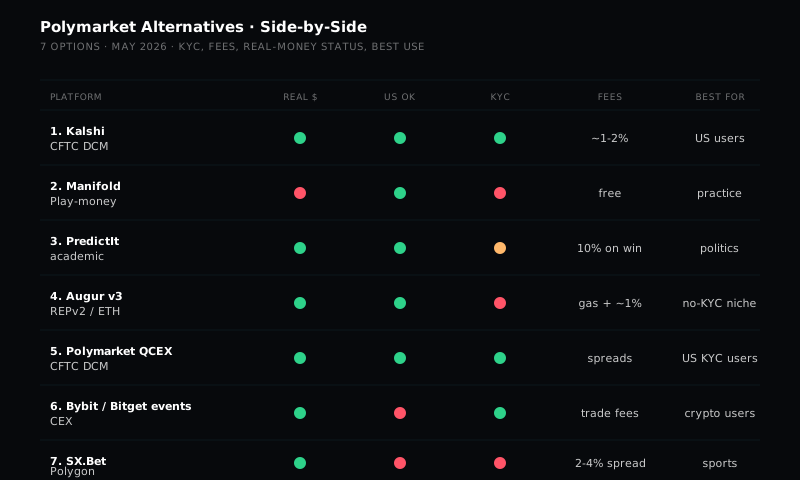
Citation capsule: Across the seven platforms reviewed, only Kalshi, PredictIt, and Polymarket QCEX are legally accessible to US retail traders, and only Kalshi holds a full CFTC Designated Contract Market license issued in November 2020 (CFTC, 2020). All four non-US options require crypto custody and stablecoin exposure.
Which to pick for your situation
About 72% of new prediction-market users start with election or sports markets, based on platform-disclosed onboarding data (Polymarket, 2024). That makes platform choice a narrow optimization problem. Here is how to match the seven options to common user profiles, without overthinking it.
US resident, real money, elections
Pick Kalshi. The license is real, the order books are the deepest on this list outside Polymarket itself, and the October 2024 ruling removed the regulatory cliff. Polymarket QCEX is a backup if you specifically want the Polymarket UX.
US resident, research or learning
Use PredictIt for political data series and Manifold for calibration practice. They do different jobs. PredictIt gives you historical pricing across multiple cycles. Manifold gives you live, low-stakes feedback on your forecasting.
Non-US, deep markets
Polymarket itself remains the default. Among alternatives, Bybit or Bitget event contracts are the lowest-friction option if you already trade on those exchanges. SX.Bet wins for sports-only.
Non-US, no KYC at all
Augur v3 or SX.Bet. Augur is broader but illiquid. SX.Bet has depth but only in sports. Our desk routinely sees Augur markets settle correctly but slowly, which is fine for long-dated political events and painful for short-dated sports.
Read next
- Polymarket Review 2026: A Full Look at the Prediction Market
- Polymarket KYC Requirements Explained
- Polymarket vs Kalshi 2026: Which Is Better?
- Can Americans Use Polymarket in 2026?
Frequently asked questions
What's the best Polymarket alternative for US users?
Kalshi is the strongest US-native option. It has held a CFTC license since 2021 and, after an October 2024 appellate ruling, runs real-money election markets in USD. No crypto wallet required, but per-trade fees of 1-2% apply.
Is there a Polymarket alternative without KYC?
Augur v3 on Ethereum is fully non-custodial and requires no KYC, only a wallet and REPv2. SX.Bet on Polygon also avoids identity checks for most jurisdictions. Liquidity is much thinner than Polymarket, so expect wide spreads on most events.
Why is PredictIt restricted to certain markets?
PredictIt operates under a 2014 CFTC no-action letter granted to Victoria University of Wellington. The letter caps the platform at roughly 80 markets, 5,000 traders per market, and $850 per position per user, which is why selection looks narrow.
Can I use Manifold Markets if I want real money?
No. Manifold uses play-money called mana, not redeemable cash. Strong forecasters earn reputation and occasional charity-donation rights. Treat Manifold as a calibration sandbox rather than a real-money Polymarket alternative.
Is Augur still active in 2026?
Augur v3 still functions on Ethereum, and REPv2 is tradable. Daily active markets are sparse, with most volume sitting in long-tail crypto and political events. The protocol is alive, but liquidity has not recovered to 2020-era levels.
#Polymarket#alternatives#prediction markets#Kalshi#Manifold#PredictIt#Augur
Discussion
Loading comments…