
Staking is one of the first ways people try to earn from crypto beyond simply buying and holding, but the word gets thrown around without much explanation. So, what does staking crypto mean? In plain terms, staking means locking up coins of a proof-of-stake network to help run and secure it, and earning rewards in return. This beginner’s guide explains what that really involves, where the rewards come from, the risks to know, and how to start without getting in over your head.
Not financial advice. This is general education, not a recommendation to stake or buy any asset. Staking carries risk, including price falls, lock-ups and slashing, and you can lose money. Read our risk disclaimer and do your own research first.
Key takeaways
- Staking means committing proof-of-stake coins to help secure a network, and earning rewards for it.
- The reward is payment for providing security and accepting some lock-up and risk, not free money.
- You can lose money if the coin’s price falls more than you earn, or to lock-ups and slashing.
- Beginners usually stake through an exchange Earn product or a pool, which needs only a small amount.
- For current rates and a full where-to-stake comparison, see our dedicated crypto staking guide.
What staking actually means
Many blockchains, including Ethereum and Solana, use a system called proof of stake to agree on what is true. Instead of miners racing with hardware, the network relies on validators who commit, or stake, coins as a security deposit. Honest validators earn rewards, and dishonest ones lose part of their stake. Staking is your participation in that system: you commit coins, they help back a validator, and you share in the rewards. You can do it by running a validator yourself, or far more commonly, by staking through a platform or pool that does the technical work for you.
How staking works
The cycle is straightforward once you see it laid out.
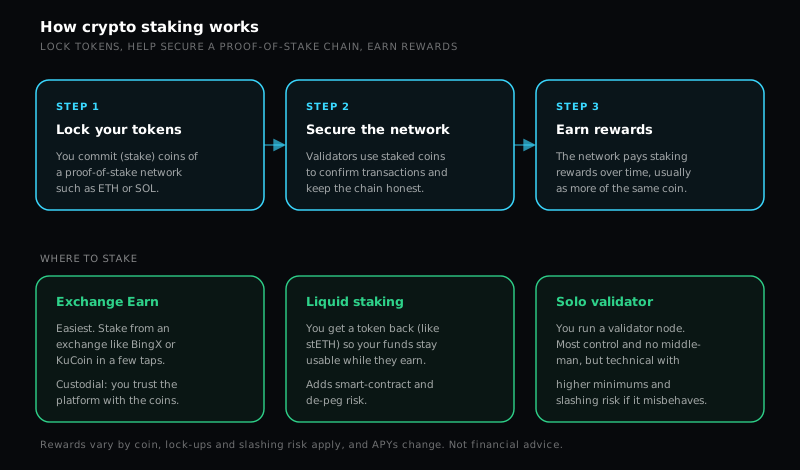
First you lock your tokens by staking them. Those staked coins then help secure the network, since validators use them as collateral to confirm transactions and keep the chain honest. In return, the network pays staking rewards over time, usually as more of the same coin. The exact rate depends on the coin, how many people are staking, and the network’s rules.
How you earn rewards
It helps to understand where the reward comes from, because that is what tells you it is not free. A proof-of-stake network needs coins committed as a security deposit, so validators have real value at risk if they cheat. By staking, you provide some of that security, and the network shares the rewards it issues for confirming blocks. So your reward is compensation for two things: supporting the network, and accepting some lock-up and risk. That framing keeps expectations honest, an advertised rate is a payment for risk, not a guaranteed return.
Where you can stake
There are three common routes, with different trade-offs in convenience and control.
- Exchange Earn. The easiest path. You stake from an exchange in a few taps. BingX and KuCoin both offer staking and Earn products, with flexible or fixed terms. It is custodial, so you trust the platform with your coins. Compare venues in our BingX review and KuCoin review.
- Liquid staking. You stake and receive a token back (for example stETH) so your funds stay usable while they earn, at the cost of extra smart-contract and de-peg risk.
- Solo validator. You run your own node for full control and no middleman, but it is technical and has higher minimums.
For real current rates and a deeper comparison of these routes, see our crypto staking guide, and for how an exchange Earn product compares to staking, see Bybit Earn vs staking.
The risks
- Price risk. The biggest one. If the coin falls more than your rewards, you are down in dollars.
- Lock-up and unbonding. Some networks lock your funds, or make you wait days to withdraw, during which you cannot sell.
- Slashing. A validator that misbehaves can be penalized, and stakers can lose a slice of their stake.
- Platform risk. Staking through a service means trusting it to hold and return your coins. If you fund with stablecoins, read is USDT safe.
Is staking worth it
That depends on you, and the honest answer is that it varies. Staking can be a reasonable way to earn on coins you already plan to hold long term, since you are paid for doing something the network needs anyway. It is a poor reason, on its own, to buy a volatile coin you would not otherwise hold, because price risk usually dwarfs the reward. The sensible question is not what is the highest rate, but would I hold this coin anyway, and am I comfortable with the lock-up and risks. For the numbers that inform that, the staking guide has current rates.
Bottom line
Staking crypto means putting proof-of-stake coins to work securing a network and earning rewards for it. It is more passive than trading, but it is not free money or a savings account: the reward pays you for providing security and accepting lock-ups and risk, and the coin’s price can still fall. For beginners, the simplest start is an exchange Earn product with a small amount, on coins you would hold anyway, with the risks understood up front. When you are ready, you can explore staking on BingX.
This article is general information, not financial advice. Staking carries price, lock-up, slashing and platform risk, and rewards are never guaranteed. Read our risk disclaimer, do your own research, and never stake money you cannot afford to lose.
Frequently asked questions
What does staking crypto mean?
Staking means locking up coins of a proof-of-stake network to help run and secure it, and earning rewards in return. Your staked coins back validators that confirm transactions and keep the chain honest, and the network pays rewards, usually as more of the same coin. In effect, you put your crypto to work supporting the network instead of leaving it idle, and you are paid for it.
How does staking actually earn rewards?
Proof-of-stake networks need coins committed as a security deposit so validators have something to lose if they cheat. In exchange for committing yours, the network shares the rewards it issues for confirming blocks. So the reward is not free money, it is payment for providing security and for accepting some lock-up and risk. The rate depends on the coin and the network's rules.
Is staking crypto safe?
It is lower-drama than trading, but not risk-free. The coin's price can fall more than you earn in rewards, your funds may be locked during an unbonding period when you cannot sell, and validators can be penalized (slashed) for misbehaving. If you stake through a platform you also take on platform risk. Treat the reward as compensation for those risks, not a guaranteed yield.
What is the difference between staking and saving interest?
Bank interest comes from lending and is backed by the bank. Staking rewards come from a blockchain paying you to help secure it, and they carry crypto risks: price swings, lock-ups and slashing. The headline rate can look higher than a savings account, but it is not equivalent, because your principal is a volatile asset and the reward is not guaranteed.
Can I lose money staking crypto?
Yes. The most common way is the coin's price dropping more than the rewards you earn, leaving you down in dollar terms. You can also be exposed during a lock-up when you cannot exit, lose a slice to slashing if a validator misbehaves, or face platform problems if you stake through a service. Staking reduces some risks of active trading but does not remove market risk.
Do I need a lot of crypto to start staking?
No. Running your own validator can need a large minimum, but staking through an exchange Earn product or a staking pool lets you start with a small amount, because many users are pooled together. That is why most beginners stake through a platform rather than running a node. Just remember a platform is custodial, so you are trusting it with your coins.
Where can I stake crypto as a beginner?
The easiest route is an exchange Earn product, where you stake in a few taps. BingX and KuCoin both offer staking and Earn products, and liquid staking is another option that gives you a token back so your funds stay usable. For real current rates and a full comparison of where to stake, see our crypto staking guide. Always check live terms first. This is not financial advice.
#staking#proof of stake#rewards#beginners#crypto#2026
Discussion
Loading comments…