
Bitcoin goes into the end of 2026 on the back foot. It traded near 65,000 dollars on 16 November after briefly dropping to about 62,000 dollars on 15 November, its lowest level since July. That is roughly half its record of about 126,000 dollars from October 2025.
So will it rise in January 2027? Nobody can tell you that, and any article that gives you one number is guessing. What we can do is show what will drive the price between now and the end of January, which dates matter and what would have to happen for BTC to recover or keep falling.
Not financial advice. Prices and data below are as of 16 November 2026 and will change. We do not publish price targets. Crypto is volatile, and you can lose your whole stake.
Where Bitcoin stands now
November has been rough. BTC was around 80,000 dollars on 5 November, just after the US midterms, and lost about 15% in the week to 15 November. Liquidations of leveraged positions topped 1.6 billion dollars in one day, most of them longs.
The trigger was inflation. The October CPI report, released on 10 November, came in a tenth of a point above forecasts. Traders moved to price in a December rate hike, and the dollar index climbed to its highest level since April 2025. A stronger dollar and higher rates usually weigh on Bitcoin.
ETF money kept leaving at the same time. US spot Bitcoin ETFs lost about 1.28 billion dollars in the week of 2 to 6 November and roughly another billion from 9 to 13 November, with outflows in each of the last seven trading sessions to 13 November.
The mood in wider markets did not help either. Tech stocks fell after Nvidia announced on 12 November that Jensen Huang had resigned as CEO, and crypto followed. The Binance hack at the end of October, covered in our Binance hack article, had already shaken confidence.
What will decide January
The Fed in December and January
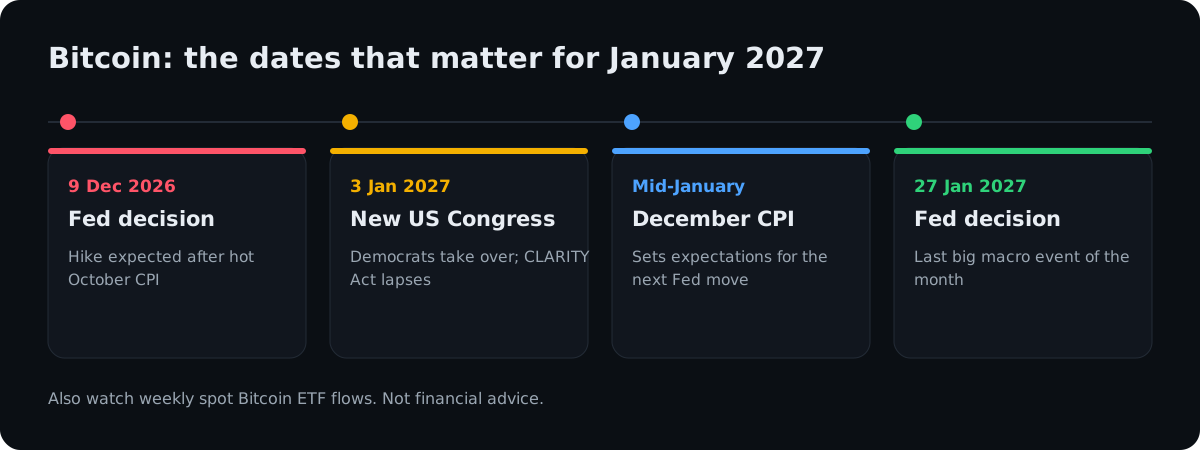
This is the biggest one. The Fed raised rates in September 2026 for the first time since 2023, held at 3.75 to 4 percent on 28 October, and two officials voted for another hike even then. After the hot October CPI, markets price a December hike as very likely. The decision comes on 9 December.
What matters for January is what comes after. If the Fed hikes and signals it is done, markets can stop bracing for more, and that has often been the point where risk assets stabilize. If it hikes and hints at more, as Dallas Fed President Lorie Logan has argued for, pressure on BTC likely continues. The next decision after that is on 27 January 2027, the last trading week of the month. The December CPI report, due in mid-January, will shape expectations for it.
ETF flows
Spot Bitcoin ETFs were a steady buyer for much of the past two years. In November they became sellers. Watch the weekly flow data: a run of inflows would show that institutional buyers see the drop as an opportunity, and continued outflows would mean the main source of new demand is still gone. Our guide to how Bitcoin ETF flows affect the price explains how to read these numbers.
The new US Congress on 3 January
Democrats take control of both chambers on 3 January 2027. Reports say the CLARITY Act, the main crypto market structure bill, expires that day if the Senate does not pass it. That is mostly priced in already, since the bill stalled in September. Our midterms analysis covers what the new Congress can and cannot change. For January, expect headlines from hearings more than real policy shifts.
The four-year cycle debate
Bitcoin’s past bear markets bottomed roughly a year after the cycle peak, in December 2018 and November 2022. The latest peak was in October 2025, so some analysts argue the bottom could form around now. Others, including veteran trader Peter Brandt, warn that Bitcoin may not reach a new record at all for a long time. Three cycles are a small sample, and this one has ETFs and a hiking Fed that earlier cycles did not. Treat the cycle as context, not a timetable.
Does January have a pattern?
Not one you can trade. Since 2013 Bitcoin has closed January up in about half of all years and down in the other half. January 2023 gained about 40%. January 2018 lost about 25%, January 2022 about 17% and January 2026 about 10%, according to CoinGlass data. The swings are large in both directions, and each year had its own rates, flows and news.
Levels traders are watching
These are reference points, not targets. On the downside, the 62,000 dollar low from 15 November is the first level traders watch, and 60,000 dollars is the round number below it. A clean break under 60,000 would suggest the sell-off is not finished. On the upside, 70,000 dollars is the first hurdle, a level BTC lost on 13 November. Above it, the 78,000 to 80,000 dollar area, where Bitcoin traded in early November, is the next resistance zone.
Three scenarios for January
A recovery needs several things to line up. The Fed hikes in December but signals a pause, the December CPI cools, and ETF flows turn positive. Bitcoin could then reclaim 70,000 dollars and test the early-November range.
A range is the most common outcome after a sharp drop. Bitcoin chops between roughly 60,000 and 75,000 dollars while the market waits for the 27 January Fed decision, and neither buyers nor sellers take control.
A further decline would take less. The Fed hikes and points to more, inflation stays hot and ETF outflows continue. Losing 60,000 dollars could trigger another wave of liquidations, the same mechanism that sped up the November drop.
How to use this
Mark 9 December, 3 January, the mid-January CPI release and 27 January in your calendar, and check the weekly ETF flows. If you buy, plan for a further drop of 20% or more, which Bitcoin has seen many times in bear phases, and consider splitting purchases across several weeks instead of buying all at once. Avoid leverage: the November liquidations show how quickly it gets wiped out. Our guide to crypto risk management for beginners covers position sizing.
If you want to buy BTC, BingX and KuCoin list it on spot and futures. Our step-by-step guide shows how to buy Bitcoin, and after the Binance hack it is worth knowing how to withdraw Bitcoin to your own wallet. For why single-number forecasts mislead, read how to read crypto price predictions. This is general information, not financial advice.
Frequently asked questions
Will Bitcoin go up in January 2027?
Nobody can know that. Bitcoin traded near 65,000 dollars in mid-November 2026, about half its October 2025 record, after a hot inflation report and steady ETF outflows. January depends mostly on what the Fed does in December and January and on whether ETF money returns. This is general information, not financial advice.
What is the Bitcoin price prediction for January 2027?
We don't publish price targets. Traders are watching the 62,000 dollar low from 15 November and the round 60,000 dollar level as support, and 70,000 dollars, then the 78,000 to 80,000 dollar area from early November, as resistance. These are reference points, not forecasts.
Why did Bitcoin fall in November 2026?
Several things at once. October inflation came in hotter than expected on 10 November, which made a December Fed rate hike look likely and pushed the dollar up. US spot Bitcoin ETFs saw about a billion dollars of outflows in each of the first two weeks of November, and tech stocks sold off after Nvidia's CEO resigned. The late-October Binance hack had already hurt sentiment.
Is January usually a good month for Bitcoin?
Not reliably. Since 2013 January has closed up in roughly half of all years and down in the other half. It fell about 10% in January 2026 and gained about 40% in January 2023. Seasonality is too weak a signal to trade on.
Where can I buy Bitcoin?
BTC trades on every major exchange. BingX and KuCoin list it on spot and futures. If you buy, start with an amount you can afford to lose and avoid using leverage in a market this volatile.
#Bitcoin#BTC#price prediction#Fed#ETF#analysis#DYOR
Discussion
Loading comments…