
Crypto is in a deep bear market, and the question people now type into Google is whether this is a full crypto winter. Bitcoin fell below 60,000 dollars on 20 November 2026. That is more than 50% under its October 2025 record above 126,000 dollars, and CNBC data show it heading for a seventh straight weekly loss, the first such streak since May 2022. Ether is near 1,800 dollars, down about 40% in a year.
This article compares the current drop with the two classic crypto winters, 2018 and 2022, looks at what is different this time, and lists the signals that have ended past bear markets. It does not predict the bottom, because no one can.
Not financial advice. Data as of 20 to 21 November 2026. We do not publish price targets. Crypto is volatile, and you can lose your whole stake.
Is this a crypto winter?
There is no official definition. In stocks, a bear market starts at a 20% fall from the peak. Crypto people use “winter” for something longer and deeper: months of low prices, thin trading, projects running out of money and new investors staying away.
On the numbers, 2026 qualifies. Bitcoin has more than halved from its peak. The 2026 low so far is about 57,700 dollars, set on 1 July, and the price is again close to it. US spot Bitcoin ETFs lost about 2.9 billion dollars in November through the 18th, against about 0.5 billion in all of October. The Crypto Fear & Greed Index fell to about 10 in mid-November, its lowest reading since February. And the summer rebound, which took BTC back to around 80,000 dollars by early November, unwound in less than three weeks.
What it has not had, so far, is the collapse of a major firm on the scale of FTX in 2022. The record Binance hack in late October, covered in our Binance hack article, hurt confidence, but Binance pledged to cover user losses and kept operating.
How 2026 compares with 2018 and 2022
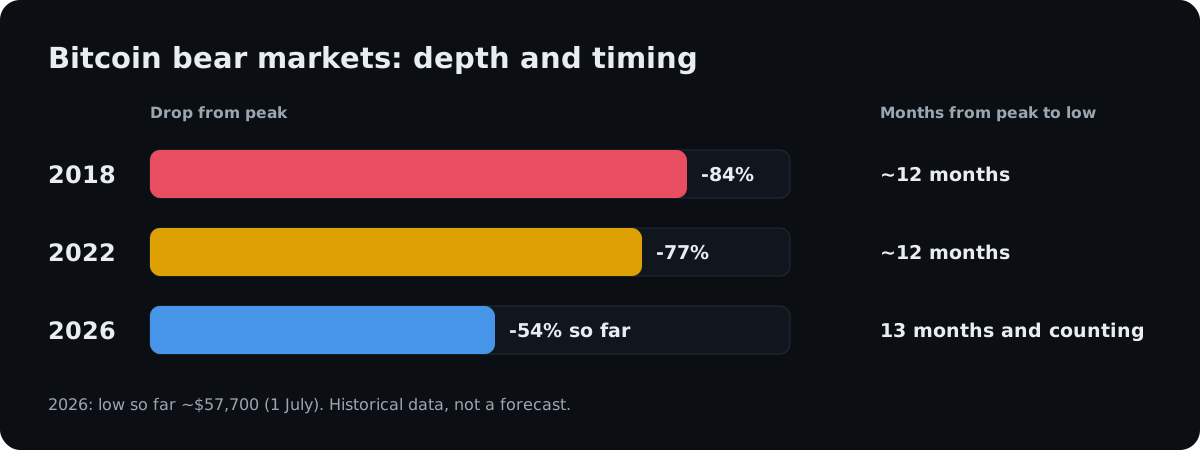
In 2018 Bitcoin fell about 84%, from almost 20,000 dollars in December 2017 to around 3,200 dollars in December 2018. The ICO bubble had burst and regulators were closing in on token sales.
In 2022 it fell about 77%, from about 69,000 dollars in November 2021 to around 15,500 dollars in November 2022. The Fed was raising rates fast, and Terra, Celsius, Three Arrows and then FTX collapsed one after another.
In both cases the bottom came roughly a year after the peak. The 2025 peak was in October, so we are now about 13 months in. That is why some analysts argue a bottom may be forming around now.
The depth is the part that does not fit. At its lowest so far, the 2026 drop is about 54%, well short of the 77 to 84% of earlier winters. Optimists say ETFs and large institutional holders make the market less extreme than before. Pessimists say it means the market still has room to fall. Both are guesses dressed as arguments, and two prior cycles are too few to settle it.
What is different this time
Three things did not exist, or did not matter much, in earlier winters.
Spot Bitcoin ETFs. They were a steady buyer through 2024 and 2025 and are now a seller. ETF flows tell you quickly whether big money is returning, which earlier cycles could only guess from on-chain data. Our guide on how ETF flows affect the price shows how to read them.
A hiking Fed. The Federal Reserve raised rates in September 2026 for the first time since 2023, and after a hot October CPI markets expect another hike on 9 December. In 2022 rate hikes were the main driver of the winter. Bitcoin has also been falling together with tech stocks rather than acting as a hedge; CNBC wrote on 20 November that it is again failing the “digital gold” test.
US politics. The CLARITY Act, the main crypto market structure bill, failed in the Senate in September, and Democrats take over Congress on 3 January 2027. Our midterms analysis explains why that means slower legislation rather than a crackdown.
What analysts expect
Views split widely, and many were published earlier in the year, before the latest drop. In February, Compass Point argued that the bear market was in its “final innings”, with Bitcoin likely to bottom between 60,000 and 68,000 dollars unless US stocks entered their own bear market. Stifel analysts put a possible low near 38,000 dollars. Veteran trader Peter Brandt has warned that Bitcoin may not regain its 126,000 dollar record for a long time. At the other end, Grayscale’s research head said at the start of the year that he saw no crypto winter on the horizon, a call that has not aged well.
Treat these as a range of opinions, not a forecast. When serious analysts disagree by 30,000 dollars on the bottom, nobody knows where it is.
Signals that ended past winters
No single indicator calls the bottom. Past winters ended when several of these lined up over weeks, not days:
- The Fed stopped tightening, or markets started pricing cuts.
- ETF and institutional flows turned positive for several weeks in a row.
- Long-term holders stopped selling and started accumulating, visible in on-chain data.
- Bad news stopped moving the price lower. A sell-off on a scary headline that recovers within days is often a sign that sellers are running out.
- Sentiment stayed in extreme fear for a long time while the price stopped making new lows.
For the next few weeks, the dates to watch are the Fed decision on 9 December, the new Congress on 3 January, the December CPI in mid-January and the Fed decision on 27 January. Our January 2027 Bitcoin outlook explains each one. For the live drivers of the current drop, see why is Bitcoin down today.
How to get through a crypto winter
Most damage in bear markets comes from forced decisions, not from the drop itself. A few rules help:
- Drop the leverage. Liquidations above 1.6 billion dollars in a single day in mid-November show how fast leveraged longs get wiped out.
- Size positions so a further 30 to 50% fall would not force you to sell. If it would, the position is too big.
- If you want to buy, spread purchases over weeks or months instead of going all in. Our comparison of DCA and lump-sum buying shows how the two approaches differ.
- Prefer Bitcoin and large caps to small altcoins. In past winters many small tokens never came back.
- Keep long-term holdings in your own wallet. Our guide on how to withdraw Bitcoin shows how.
- Expect more scams. Fake recovery services and “guaranteed” trading bots multiply when people are desperate.
If you want to hedge rather than sell, our guide on how to short Bitcoin explains the risks first. Our crypto risk management basics cover position sizing.
The bottom line
By the usual measures crypto is in a winter: prices more than halved, ETF money leaving, sentiment at extreme fear. History says winters end, and the timing of this one roughly matches past cycles, but its depth does not, and history is a small sample. Plan for the possibility that it gets worse before it gets better, and size everything so that you are still holding when it ends.
If you buy, BingX and KuCoin list Bitcoin and the major coins on spot. For the broader question of a rebound, read will crypto recover. This is general information, not financial advice.
Frequently asked questions
Is crypto in a bear market right now?
By most common yardsticks, yes. Bitcoin is more than 50% below its October 2025 record above 126,000 dollars, on course for a seventh straight weekly loss, and ETF money has been leaving for weeks. A 20% drop is the usual definition of a bear market in stocks, and crypto has fallen far more than that. This is general information, not financial advice.
What is a crypto winter?
There is no official definition. People use the term for a long bear market in which prices stay low for months, trading volume dries up, projects shut down and new money stops coming in. The 2018 and 2022 bear markets are the two classic examples.
How long does a crypto winter last?
In the last two cycles Bitcoin bottomed about a year after its peak: in December 2018 and in November 2022. Prices then stayed low for several more months before a real recovery started. The October 2025 peak is now about 13 months behind us, but two cycles are too few to treat as a rule.
Has crypto hit the bottom?
Nobody knows until well after the fact. Bitcoin is close to its 2026 low of about 57,700 dollars from 1 July. Analysts' published floors range from around 60,000 dollars to below 40,000. A bottom is usually confirmed only in hindsight, when sellers run out and buyers return for weeks, not days.
What should I do in a crypto winter?
Mostly, avoid the mistakes that turn a drawdown into a permanent loss: no leverage, no position you would be forced to sell, and no all-in buys. Many long-term holders buy in small scheduled amounts instead of trying to catch the exact low. Keep long-term coins in your own wallet and expect more scams, because they spike when people are desperate.
#crypto winter#bear market#Bitcoin#BTC#analysis#risk#DYOR
Discussion
Loading comments…