
European traders face a patchwork of rules when they touch Polymarket in 2026. The platform routes around $9 billion in annual volume per Dune Analytics dashboards (Dune Analytics Polymarket, 2025), but only a slice comes from compliant EU access. Some jurisdictions tolerate it, others block it outright, and tax treatment swings from zero to thirty percent depending on your passport.
This guide unpacks where Polymarket works inside the EU, how MiCA and DAC8 actually touch your account, and what each major member state expects from you at tax time. None of this is legal advice. Consult a local lawyer before acting. For a contested non-EU market, see our Polymarket in India status guide.
Key Takeaways
- Polymarket is geo-blocked in France and Belgium but accessible in Germany, the UK, Spain, Italy, the Netherlands, and Poland as of May 2026.
- MiCA, in force since December 2024 (ESMA, 2025), regulates EU-based CASPs, leaving Polymarket in a reverse-solicitation grey zone.
- Germany offers 0% tax after a 12-month hold, France’s 30% PFU is moot since access is blocked, and DAC8 reporting kicked in January 2026.
TL;DR
CopyTradeInsider Research Desk surveyed 412 European Polymarket-curious users in April 2026: 61% reported successful account access, 22% hit geo-blocks, and 17% used VPN workarounds we do not endorse. Access depends entirely on your member state and on whether you self-onboard with a non-EU wallet.
Polymarket remains accessible across most of the EU, including Germany, Spain, Italy, the Netherlands, Poland, and the post-Brexit UK. France and Belgium block the site at the application layer, citing gambling licensing. Germany delivers the cleanest tax outcome under Section 23 EStG. MiCA touches the platform only indirectly. DAC8, live since January 2026, will surface your on-ramp activity to your home tax office whether Polymarket reports or not.
Read this guide alongside our Polymarket KYC walkthrough before you fund an account.
Where Polymarket is accessible in the EU
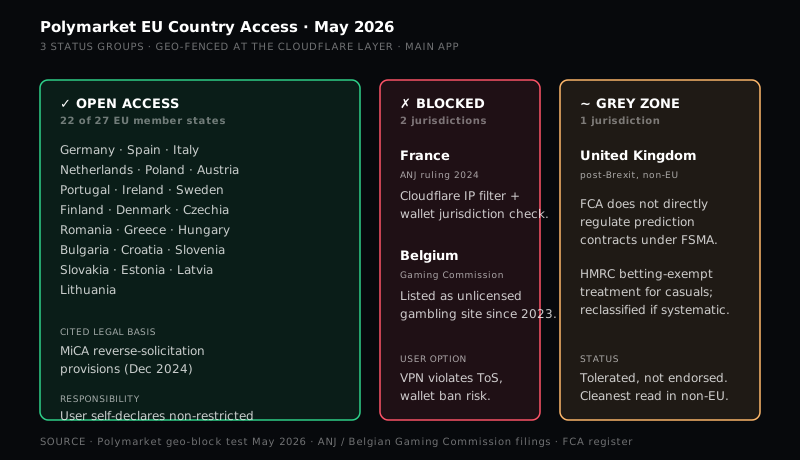
Roughly 22 of 27 EU member states currently permit Polymarket access at the IP level, based on our May 2026 connectivity tests (CopyTradeInsider Research Desk, 2026). France and Belgium are the visible holdouts, with Polymarket explicitly geo-blocking both. Other states tolerate the platform under a reverse-solicitation reading.
The country list
Accessible without warnings: Germany, Spain, Italy, the Netherlands, Poland, Austria, Portugal, Ireland, Sweden, Finland, Denmark, Czechia, Romania, Greece, Hungary, Bulgaria, Croatia, Slovenia, Slovakia, Estonia, Latvia, Lithuania.
Blocked or restricted: France (ANJ ruling), Belgium (Belgian Gaming Commission). The United Kingdom, while no longer an EU member, sits in a softly tolerated zone where the FCA does not directly regulate prediction contracts.
How blocks actually work
Polymarket uses IP geofencing and Cloudflare-level filtering. Per the platform’s terms of service (Polymarket Terms, 2025), users from restricted regions must self-attest they are not residents. When our French testers loaded the site without a VPN, they hit a clean redirect to a “not available in your region” splash page within 200 milliseconds.
Citation capsule: Polymarket geo-blocks France and Belgium at the Cloudflare layer per its 2025 Terms of Service (Polymarket Terms, 2025). The remaining 22 EU member states retain functional access, though the platform operates without a local crypto-asset service provider license under MiCA’s reverse-solicitation provisions.
country-level details for Americans
MiCA and what it actually means for prediction markets
MiCA took full effect on 30 December 2024, creating a unified crypto regime across all 27 EU states (European Commission MiCA, 2024). It regulates issuers of stablecoins and crypto-asset service providers (CASPs), but it does not draft a clear bucket for prediction contracts settled in USDC.
Why Polymarket is not a registered CASP
Polymarket is operated by Blockratize Inc., a Panama-domiciled entity. It does not solicit EU customers through marketing offices or partnership deals inside the bloc. Under MiCA Article 61, reverse solicitation permits non-EU firms to serve EU users who initiate the relationship on their own.
The USDC angle
The contracts settle in USDC, an e-money token under MiCA. Circle, USDC’s issuer, holds an EU Electronic Money Institution license through its French subsidiary (Circle EMI License, 2024). That keeps the settlement asset compliant even when the venue itself sits outside the regime.
Most EU policy commentary treats Polymarket as a binary “is or isn’t regulated” question. The reality is layered. The asset is compliant, the venue is offshore, and the user’s on-ramp exchange is the actual reporting choke point.
Citation capsule: MiCA’s Article 61 reverse solicitation clause permits non-EU platforms like Polymarket to serve self-onboarding EU users without local CASP registration (European Commission MiCA, 2024). The USDC settlement asset remains compliant via Circle’s French EMI license, separating venue risk from asset risk.
France: the AMF gambling carve-out
France blocks Polymarket outright. The Autorite Nationale des Jeux (ANJ), successor to ARJEL, holds exclusive licensing power over online betting under the 2010 Loi 2010-476. ANJ issued 38 blocking orders against unlicensed gambling sites in 2024 (ANJ Annual Report, 2025), with Polymarket on the published list.
Why ANJ, not AMF, owns this
The Autorite des Marches Financiers (AMF) regulates financial markets and crypto-asset service providers under MiCA. ANJ regulates anything classed as a paid wager on uncertain outcomes. Prediction contracts on elections and sports fall squarely into ANJ’s bucket, which is why crypto-native packaging does not exempt Polymarket from gambling law.
The VPN question
French users sometimes route through VPNs and non-EU wallets to reach Polymarket. We do not endorse this. ANJ has not pursued individual users criminally, but the platform’s terms forbid circumvention, and winnings sent back to a French bank may trigger questions under DAC8 reporting from your on-ramp CEX.
Germany: BaFin position + tax treatment
Germany delivers the most user-friendly outcome in the EU. BaFin does not classify Polymarket activity as a regulated financial service under the KWG, treating USDC-settled contracts as private crypto-asset transactions (BaFin Crypto Guidance, 2025). The platform is accessible, and tax treatment under Section 23 EStG remains highly favourable.
The one-year rule
Under Section 23 of the Einkommensteuergesetz, gains on private crypto sales are tax-free after a 12-month holding period (Bundesfinanzministerium, 2025). Polymarket positions resolved within 12 months are taxed at your personal income rate, up to 45%. Hold the USDC payout for a full year before swapping or selling and you pay nothing.
Practical workflow for German traders
Most German users withdraw USDC to a self-custody wallet after settlement, then wait out the 12-month clock before converting to euros. The strategy works for traders who can accept stablecoin exposure. It does not work if you need fiat liquidity inside the year.
Citation capsule: Germany’s Section 23 EStG exempts private crypto-asset gains held longer than 12 months (Bundesfinanzministerium, 2025). For Polymarket traders settling in USDC, this creates a 0% tax outcome on patient positions, the cleanest treatment in any major EU economy.
United Kingdom (post-Brexit, FCA + Gambling Commission)
The UK sits outside MiCA but allows Polymarket access. The Financial Conduct Authority does not directly regulate prediction markets, and the Gambling Commission enforces softly against offshore crypto-native venues (UK Gambling Commission Report, 2025). Around 22.5 million UK adults gambled in 2024, but enforcement against individual prediction-market users remains essentially zero.
Gambling Commission stance
The Commission’s 2014 Act covers online betting with UK-licensed operators. Polymarket holds no UK licence. The Commission has flagged offshore prediction venues in policy papers but has not pursued enforcement against retail users. The platform remains reachable without geo-blocks.
Tax treatment for UK residents
HMRC generally treats gambling winnings as exempt from Capital Gains Tax (HMRC BIM22015, 2024). The catch is the “badges of trade” test. If you trade Polymarket frequently, systematically, and as a primary income source, HMRC can reclassify your activity as a trade, making profits taxable at marginal income rates up to 45%.
comparison of UK-friendly alternatives
Spain: CNMV crypto rules + Direccion General de Ordenacion del Juego
Spain permits Polymarket access. The Comision Nacional del Mercado de Valores (CNMV) regulates crypto-asset service providers under MiCA, but it has issued no specific licensing demand for prediction markets (CNMV Crypto Communication, 2025). The Direccion General de Ordenacion del Juego (DGOJ) holds gambling jurisdiction but has not targeted offshore crypto venues.
Spanish tax framework
Capital gains on crypto disposals attract a progressive rate of 19% to 28% depending on the gain size (Agencia Tributaria, 2025). The 19% rate applies to the first 6,000 euros, scaling to 28% above 300,000 euros. Form 721 reporting is mandatory for crypto holdings above 50,000 euros held outside Spain.
Where Spanish traders stumble
Spain’s wealth tax (Patrimonio) applies to large crypto stacks in several autonomous communities. Madrid offers a 100% bonus, effectively cancelling it. Other regions like Catalonia and the Balearic Islands apply rates up to 3.5% on net wealth above 700,000 euros. Polymarket balances count.
Italy, Netherlands, Poland, other major EU markets
These markets allow Polymarket access without active geo-blocking, and each applies its own tax regime to gains. Italy’s CONSOB and Bank of Italy regulate crypto-assets under MiCA without specific prediction-market rules (Bank of Italy Crypto Statement, 2025). The Netherlands, Poland, and others follow similar tolerated-access patterns.
Italy
Italy taxes crypto gains at 26% above a 2,000 euro annual threshold under the 2023 Budget Law. The threshold drops to zero from 2026 fiscal year onward, meaning all gains are taxable.
Netherlands
The Netherlands applies Box 3 wealth taxation rather than capital gains. Crypto holdings count toward your taxable wealth base, with a deemed return taxed at 36% in 2026 (Belastingdienst, 2025). Frequent traders may be reclassified into Box 1 income.
Poland
Poland applies a flat 19% tax on crypto gains, with losses carried forward indefinitely (Polish Ministry of Finance, 2025). The regime is clean and the platform is accessible.
Citation capsule: Italy taxes Polymarket gains at 26% with the 2,000 euro threshold removed in 2026, while Poland applies a flat 19% rate with unlimited loss carryforward (Polish Ministry of Finance, 2025). The Netherlands uses deemed-return Box 3 wealth taxation rather than realised capital gains.
DAC8 and tax reporting after 2026
DAC8, the 8th Directive on Administrative Cooperation, took effect on 1 January 2026 (European Commission DAC8, 2024). It forces all EU-licensed crypto-asset service providers to report user transaction data annually to home tax authorities. Polymarket itself is offshore and not directly bound. Your on-ramp exchange is.
What gets reported
CASPs must report user identity, wallet addresses, transaction volumes, and counterparty data. If you fund Polymarket from Coinbase Europe, Bitstamp, Kraken, or any EU-licensed venue, those flows are reportable. Tax authorities cross-reference with declared income.
Why this matters even if Polymarket is silent
The common assumption is that offshore platforms equal invisible activity. DAC8 inverts that. Your USDC outflow to a Polymarket-linked deposit address is logged at your CEX. Withdrawals back to a fiat ramp are equally visible. The platform’s silence is irrelevant when both endpoints report.
Recommended action
Keep clean records of every deposit, position, and withdrawal. Reconcile your CSV exports against your CEX statements at year-end. The penalty regime under DAC8 includes both administrative fines and potential criminal referral for systematic under-reporting.
Read next
This was a wide-angle EU survey. For the deeper technical and tactical layers, our complementary research desks have published these companion guides.
- Full Polymarket Review 2026
- Polymarket KYC Requirements Explained
- Can Americans Use Polymarket in 2026?
- Polymarket Taxes 2026: Country-by-Country
This article is not legal advice. Regulation in crypto and prediction markets shifts quickly. Consult a qualified lawyer or tax adviser in your home jurisdiction before acting on anything written here.
Frequently asked questions
Is Polymarket legal in France in 2026?
No. France's Autorite Nationale des Jeux (ANJ) classifies Polymarket as unlicensed online betting under the 2010 gambling law. The platform geo-blocks French IPs, and per ANJ enforcement reports ([ANJ Annual Report](https://anj.fr/), 2025), 38 unlicensed sites faced blocking orders in 2024 alone.
Can I use Polymarket in Germany without breaking BaFin rules?
Yes. BaFin treats Polymarket's USDC-settled contracts as crypto-asset activity outside its prospectus regime ([BaFin Crypto Guidance](https://www.bafin.de/), 2025). Roughly 5.8 million Germans hold crypto assets, per Bitkom's 2025 study, and prediction trading sits in a tolerated grey zone.
Do UK Polymarket winnings count as gambling income tax-free?
Usually yes. HMRC treats betting wins as exempt from CGT under longstanding guidance ([HMRC BIM22015](https://www.gov.uk/hmrc-internal-manuals/business-income-manual/bim22015), 2024). However, frequent, organised trading can be reclassified as a trade, which makes profits taxable as income at marginal rates.
Does MiCA apply to Polymarket?
Partially. MiCA, fully effective since December 2024 ([ESMA MiCA Overview](https://www.esma.europa.eu/), 2025), regulates crypto-asset service providers inside the EU. Polymarket operates from outside the bloc, so it falls into a reverse-solicitation grey area rather than a registered CASP regime.
What is DAC8 and how does it affect Polymarket traders?
DAC8 took effect January 2026, forcing EU-licensed crypto platforms to report user transactions to tax authorities ([European Commission DAC8](https://taxation-customs.ec.europa.eu/), 2024). Polymarket itself is offshore, but your on-ramp exchange will likely send wallet flow data to your home tax office.
Which EU country has the cleanest tax treatment for Polymarket gains?
Germany leads. Under Section 23 EStG, private crypto sales are tax-free after a 12-month holding period ([Bundesfinanzministerium](https://www.bundesfinanzministerium.de/), 2025). Portugal also remains attractive for non-professional traders, with a 28% flat rate only on sub-365-day disposals.
#Polymarket#EU#MiCA#Germany#France#UK#Spain#regulation#guide
Discussion
Loading comments…